Просмотр новости
Найдите то, что Вас интересует
 Спутники
 РН
РН SpaceX
 Роскосмос
 NASA
NASA
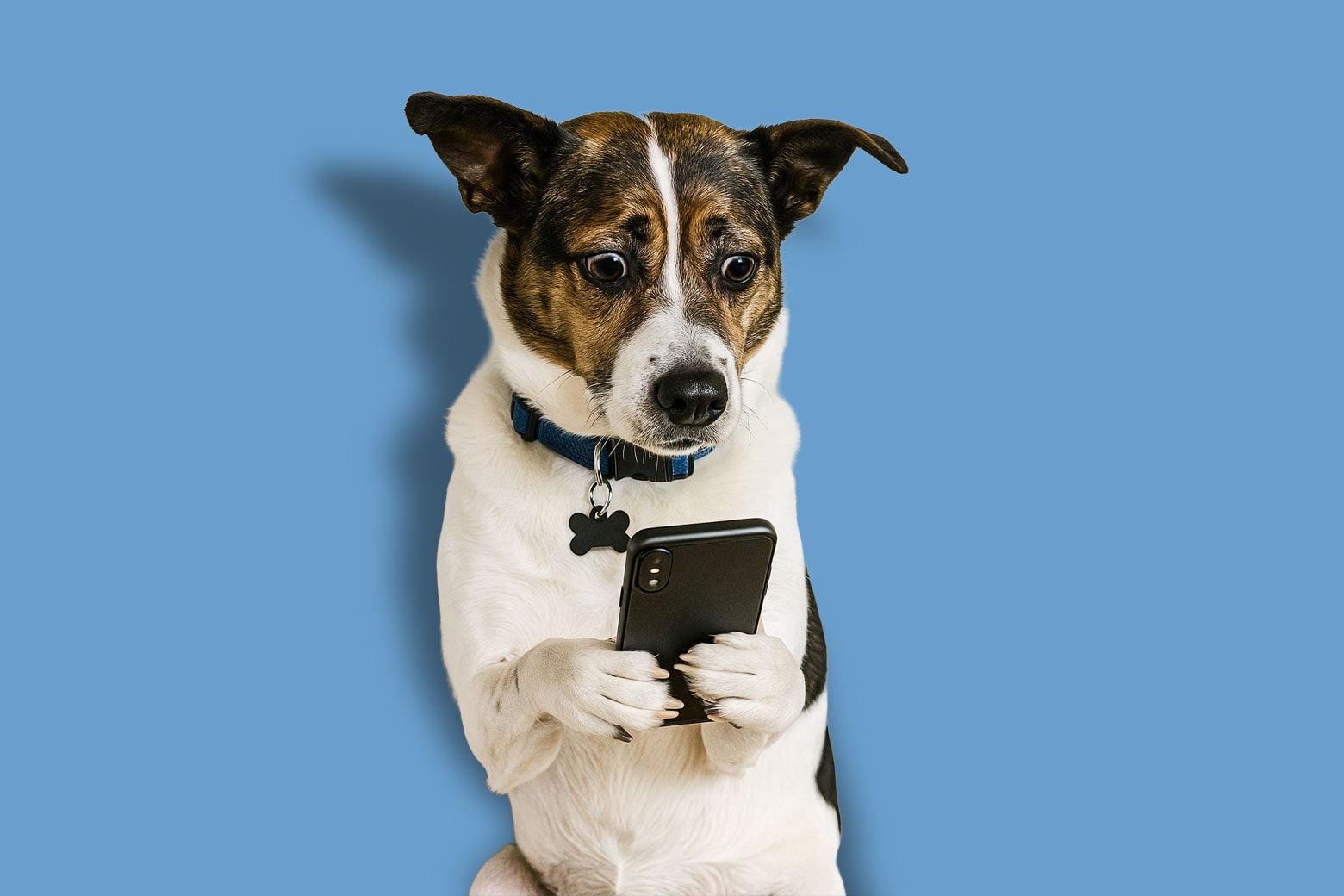
СпутникиРНSpaceXРоскосмосNASAPetPhone promises to unleash a new era of communication with your pets. I gave it to my dog to see if it works.
Sign up for the Slatest to get the most insightful analysis, criticism, and advice out there, delivered to your inbox daily.
Like most parents I know, I have found that the decision of whether to give my child a phone has dogged me. After fretting and weighing the pros and cons, I eventually caved and decided to start mine young. Two years and 4 months old, to be exact.
There are strict limits in place. She has a select number of friends she can chat to over social media. She can call only me. She can text me to say “I’m bored. I want to go out to play”—which, as it turns out, happens a lot—or “I’m thirsty.” When she’s anxious, I can soothe her with classical music or a prerecorded voice note. I can monitor her steps and even track how many calories she burns a day. According to the device, we’re aiming for 280.
My daughter is a Cavalier King Charles spaniel named Clover, and for the past couple of months, she’s had clipped to her collar an A.I. communication device known as the PetPhone. Unveiled earlier this year at Mobile World Congress in Barcelona by the Singapore-based connectivity company uCloudlink, the PetPhone has been heralded as the world’s first smartphone for pets. Chen Chaohui, the company’s founder and CEO, described it as “a pet TikTok” to Yahoo Finance, though one hopes pets will be spared the A.I.-generated fruit videos currently plaguing human users.
uCloudlink introduced the PetPhone to the U.S. specifically because the pet market here is the largest globally, encompassing more than 94 million households across the nation. Americans now spend tens of billions of dollars a year on their animals, and in a country where raising children has become prohibitively expensive, many people lavish their pets instead.
The device, which is about the size of a tube of lip balm and costs $90, is sold primarily through the pet supply website Chewy and connects to the owner’s smartphone through uCloudlink’s GlocalMe app. It requires a data plan that costs about $10 a month. In practical terms, it combines a GPS tracker, a health monitor, a speaker, a microphone, and a collection of A.I.-powered features that are supposed to let owners track pets’ location and monitor their activity. “Call me. I’m waiting,” is written on the packaging, which sounds suspiciously like something you might find written in Sharpie on a bathroom stall.
The PetPhone’s headline feature is two-way calling. Marketed with the tagline “What if your pet could call you whenever they needed attention?,” the PetPhone allows owners to ring their pets and, theoretically, vice versa. Calls from the pet’s side are triggered by a specific gesture: three jumps within six seconds. To text me saying that she wants some water, Clover must tap her dangling collar. To tell me she’s bored, another series of jumps. There is an instructional video demonstrating how to teach this behavior. Clover, who is of above-average intelligence and can—not to boast—twirl, kiss, cuddle, speak, “inside speak,” and perform most of the standard pup party tricks, struggled with it even after a week of dedicated training.
A spokesperson for the company told me that these triggers were selected after extensive testing to ensure that the actions were “well within a pet’s behavioral capabilities” and chosen through “a blend of behavioral science, data engineering, and practical usability testing.” Device stability, the company says, remains the primary consideration.
When I called Clover from home, she reacted as though I’d destuffed her favorite Lamby right in front of her. Although she’s normally impervious to noise—even the most blood-curdling shriek from the many horror films we watch together can’t stir her—the sound of my voice emerging from her collar gave her pause. She cocked her head, padded cautiously across the patio, and hid beneath a chair.
Later, after a trip to the cinema, I tried calling her again. The device automatically dialed several times before connecting. When it finally picked up, I was briefly horrified by what sounded like screaming on the other end of the line. It turned out to be signal interference. The audio has a distinctly early-2000s quality to it, reminiscent of the days when incoming calls caused nearby speakers to violently stutter.
Still, there was something undeniably thrilling about receiving a text message from my dog. The first time it happened, I laughed with genuine delight. Had she really jumped up three times on her own in six seconds?! “I’m bored. Take me out to play,” Clover informed me, her photograph appearing beside the words like an iMessage contact photo. But the novelty wore off slightly after the 17th such notification.
The problem is that the device frequently mistakes ordinary movements for the three jumps. Clover’s long, tasseled ears collect leaves, grass, and assorted debris on walks, and she scratches them out semiregularly. So every time she scratched herself, another message arrived. By midafternoon, my phone was buzzing incessantly.
The PetPhone’s vision rests on the notion that dogs are currently excluded from the digital world and need technological tools to express themselves. That idea does feel apt: It is surprising how little technology exists to facilitate communication between humans and dogs, considering how intimately the two species have coevolved.
Yet the PetPhone’s understanding of communication can feel narrow, prioritizing human language over pets’ physical gestures. That there are really only two options for communication vastly underestimates dogs’ communicative potential. Research into augmentative and alternative communication systems has demonstrated that some dogs can learn to use soundboards that “speak” for the canines and combine concepts in unexpectedly sophisticated ways.
Besides, Clover’s already able to communicate to me that she is bored or needs water. If she’s thirsty, she has access to an automatically refilling bowl. If she wants to go outside, she dramatically paws at the mirror, then tries to punch it with all her might, for some reason. The PetPhone didn’t help me understand her any better than I already did. If anything, it muddled our relationship, the communicative signals of the PetPhone confusing Clover and ultimately making me feel distanced from her.
But where the PetPhone genuinely excels is location tracking. The device uses what the company calls a six-layer hybrid positioning system, combining GPS, assisted GPS, Wi-Fi positioning, Bluetooth, cellular network data, and active radar-style search functions.
I tracked Clover while she played outside and repeatedly checked the map against reality by peering out the window. The positioning remained impressively accurate, without the blind spots or wandering location dots that often plague consumer pet trackers. Because the system combines multiple positioning methods, it can continue estimating location in places where GPS alone struggles, such as dense urban environments, indoors, or underground transit systems. You could potentially reach the peak of Mount Everest and still check in with your dog.
Not everything worked as advertised. Battery life, for instance, fell well short of expectations. On several occasions, the unit powered down after roughly four hours of use.
Still, the PetPhone reveals something interesting about the direction of pet technology. The device itself often feels caught between present reality and future aspiration. Many of its most ambitious features are still under development; several of its current functions work only intermittently. Yet its underlying premise—that pets should become active participants in our digital lives rather than passive subjects of surveillance—captures a broader shift in how humans think about their animals. As we increasingly move pets toward emotional and social roles once reserved for children, many owners are interested in new forms of communication to the pet, beyond sit, lie down, paw, that might feel like narrowing the gap between species.
In my experience with Clover and the PetPhone, it only widened that gap, as the device made us speak a language neither of us was fully on board with. The calling function disturbed us both, the text prompts were too limited and arbitrary, and overall, the device made me realize that our relationship probably didn’t need any technological intervention at all.
As we come to the end of our journey with the PetPhone and go back to our original, better way of communicating, Clover still insists on sending me many, many text messages telling me that she wants to play. Which, come to think of it, makes her remarkably similar to a human child with a smartphone.
It’s only made me realize that one of the great joys of owning a pet is that you develop your own way of communicating, in a way that widens your vocabulary. I must have over 30 names for Clover—Chepi, Miss Jane, Hosho, to name a few—all of which she responds to. In turn, I learn to speak her language: the cold, entitled stare she gives me when she’s hungry; the licking I try to bat away even though I know it’s her way of telling me she loves me; the violent wag and jump when I open the door and I know she’s exclaiming “You’re home!”
Sign up for Slate's evening newsletter.
| # | Наименование новости | Тональность | Информативность | Дата публикации |
|---|---|---|---|---|
| 1 | Hi-Tech Collar Acts As Smartphone For Pets To Communicate With Owners | 0 | 6.77 | 04-03-2026 |
| 2 | 🐾 На рынке гаджетов появился PettiChat — ошейник, который позиционируют ... | 0 | 7 | 14-07-2026 |
| 3 | Best cars for dogs? Start with a minivan | 0 | 5 | 22-06-2026 |
| 4 | Best cars for dogs? Start with a minivan | 0 | 5 | 22-06-2026 |
| 5 | Dogs | 0 | 0 | 03-07-2026 |
| 6 | Best cars for dogs? Start with a minivan | 0 | 5 | 22-06-2026 |
| 7 | Three Dog Bakery unveils new flavor of chips for dogs | 0 | 12.22 | 13-05-2026 |
| 8 | BYD Patents Under-Car Animal Detector; No More Accidents! | 7 | 8 | 30-06-2026 |
| 9 | Miele Guard M1 Cat and Dog Flex review: The gold standard for pet hair | 0 | 5 | 16-07-2026 |
| 10 | Test Tractive DOG 6 : notre avis sur ce collier GPS qui surveille aussi la santé de votre chien | 0 | 7.51 | 01-04-2026 |