Просмотр новости
Найдите то, что Вас интересует
 Спутники
 РН
РН SpaceX
 Роскосмос
 NASA
NASA
СпутникиРНSpaceXРоскосмосNASA‘Continuous depreciation will soon begin hurting the domestic economy’

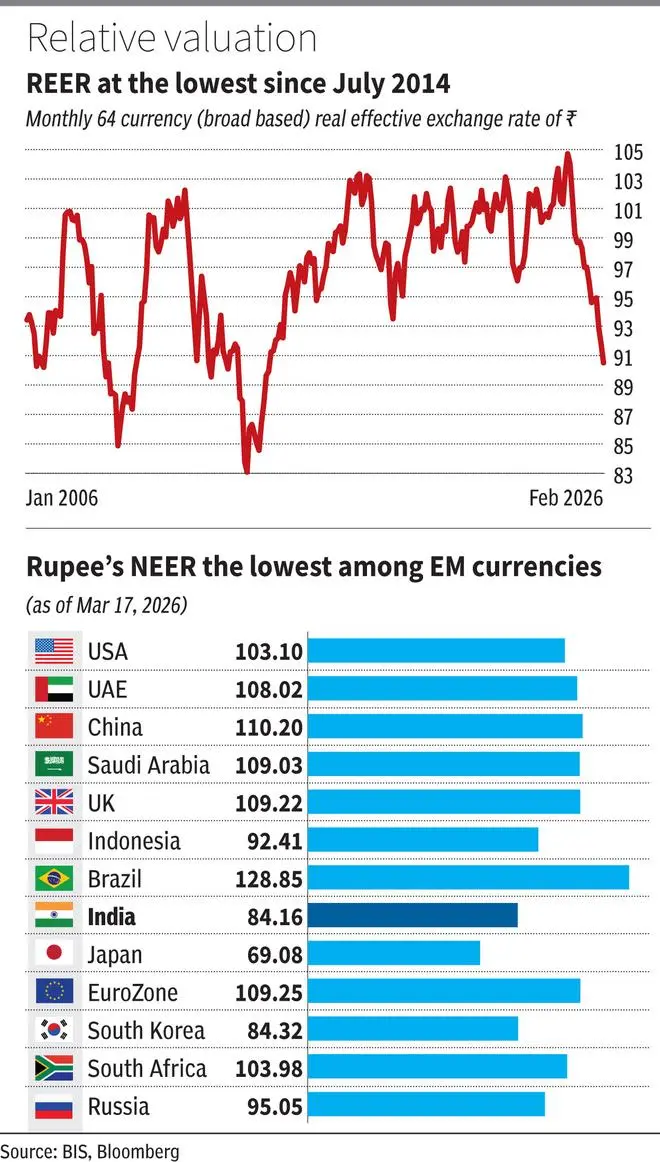
This decline, along with the cooling inflation in India has taken the rupee’s broad-based real effective exchange rate (REER), at the end of February 2026, to its lowest since July 2014 | Photo Credit: HEMANSHI KAMANI
The Indian rupee, which has been on a weak wicket since last year is taking a further hit due to the ongoing West Asia crisis, losing almost 9 per cent over the past 12 months. This decline, along with the cooling inflation in India has taken the rupee’s broad-based real effective exchange rate (REER), at the end of February 2026, to its lowest since July 2014.
While, at moderate levels, this improves the export competitiveness of the rupee, experts say that continuous depreciation will soon begin hurting the domestic economy.
The broad-based REER, as given by the Bank of International Settlement, adjusts for inflation and compares the rupee against a basket of 64 currencies from India’s key trading partners. It is indexed to 100 for the year 2020.
Madan Sabnavis, Chief Economist at Bank of Baroda, explained: “REER is the inflation adjusted nominal effective exchange rate (NEER). Given our low inflation, REER has closely followed the movements of NEER, and depending on the inflation numbers that come out for March, the REER can fall further relative to the NEER.”
Weak rupeeAccording to Anindya Banerjee, Head of Research at Kotak Securities, “the fall in the REER value of the rupee should be considered under two separate circumstances: one before the war and the other after. Before the war the rupee was already one of the weakest and under-valued currencies. In a way it was a deliberate ploy by the RBI, to use the currency as an effective tool to fight the trade war conditions, made possible by the prevalent low-inflation in our economy.”
“However, since the end of February, following the attack on Iran, it is a play on oil. The sudden spike in oil prices from around $65 per barrel to about $113 per barrel, an almost 75 per cent jump within just three weeks has created a shock. This shock induced a surge in the demand for dollar within a very short period of time, creating a demand-supply imbalance. To bridge this gap the RBI has to intervene by either managing the rupee’s value, or bond yields or FPI outflows. Given that FPI outflows (at almost $12 billion) are already at highs last seen during March 2020 (the pandemic lockdown) and bond yields are also rising for most of the global economies, the RBI has no choice but to allow the rupee to be the shock absorber,” explained Banerjee.
Although he feels normalisation of the Hormuz Strait will help the rupee appreciate, Banerjee however cautioned against the excessive dependence on the depreciation of the currency to tide over all challenges. “For a country where consumption is the growth engine, too much depreciation of the currency hits consumption first,” he noted.
Vikram Murarka, Chief Currency Strategist at Kshitij Consultancy Services, on the other hand, questioned the wisdom of allowing for currency depreciation, altogether. “The depreciation of the rupee does not help us in any manner. There is ample data to show that it does not help us to increase our exports, and it obviously does not help us regarding our imports or on the inflation front. Further, it is a challenge in attracting capital,” he added.
Rupee NEER vs the restOf a basket of certain big developed and emerging market (EM) currencies, the rupee has been one of the most undervalued, with a NEER of 84.16 as of March 17, 2026. Only the Japanese Yen is more undervalued at 69.08. As noted earlier, although a low value of NEER points to relative export competitiveness, a weak currency has its own challenges. Presently, Brazil with a NEER of 128.85, China with a NEER of 110.2 and the Euro-zone with a NEER of 109.25 have the most overvalued currencies.
Published on March 24, 2026
| # | Наименование новости | Тональность | Информативность | Дата публикации |
|---|---|---|---|---|
| 1 | India’s forex reserves contract 5% since March, one of the highest among oil importing EMs | 0 | 10.39 | 12-05-2026 |
| 2 | Реальный эффективный курс рубля с начала года снизился на 6,5% | 0 | 0 | 10-12-2018 |
| 3 | Рубль сдает позиции на валютном рынке: названы причины | -2 | 6 | 27-06-2026 |
| 4 | Рубль снижается более чем на 1% к доллару и евро | 0 | 0 | 17-02-2022 |
| 5 | External Shock, Internal Fault: Unfolding India’s BoP Stress | 0 | 11.67 | 21-05-2026 |
| 6 | Индекс РТС опустился ниже 1500 пунктов | 0 | 0 | 25-02-2020 |
| 7 | Реальный эффективный курс рубля в январе снизился на 2,8% | 0 | 0 | 10-02-2022 |
| 8 | ЦБ понизил курс доллара в России | 0 | 5 | 13-07-2026 |
| 9 | Курс бразильского реала упал по отношению к доллару до минимума за последние 2,5 года | 0 | 0 | 24-08-2018 |
| 10 | Реальный эффективный курс рубля в сентябре снизился на 2,4% | 0 | 0 | 09-10-2018 |