Просмотр новости
Найдите то, что Вас интересует
 Спутники
 РН
РН SpaceX
 Роскосмос
 NASA
NASA
СпутникиРНSpaceXРоскосмосNASA Distributed denial-of-service (DDoS) attacks have become increasingly accessible, commercialized, and disruptive. As reported by Yahoo News, European law enforcement agencies recently identified more than 75,000 individuals suspected of purchasing or using DDoS-for-hire services capable of overwhelming websites...
Distributed denial-of-service (DDoS) attacks have become increasingly accessible, commercialized, and disruptive. As reported by Yahoo News, European law enforcement agencies recently identified more than 75,000 individuals suspected of purchasing or using DDoS-for-hire services capable of overwhelming websites, servers, and online services with malicious traffic. These services enable users—often with minimal technical expertise—to disrupt digital operations at scale.
The investigation described coordinated law enforcement action by Europol and international partners to dismantle DDoS-for-hire platforms. Authorities seized domains, databases, and infrastructure that had been used to support attacks across schools, government agencies, businesses, gaming platforms, and critical infrastructure. The scope and scale of the crackdown highlighted how widespread and persistent the DDoS threat has become, particularly against organizations that depend on always-on digital services.
Cost or ConsequencesThe growing availability of DDoS-for-hire services has clear consequences. According to the article, these attacks are not limited to nuisance disruptions such as gaming outages. Law enforcement agencies and the U.S. Department of Justice confirmed that DDoS attacks have been used to extort organizations, disrupt public services, and cause significant financial loss, particularly through downtime, operational disruption, and increased infrastructure and hosting costs.
Beyond immediate financial impact, organizations face reputational damage, loss of customer trust, and regulatory or public accountability challenges following service outages. The fact that law enforcement felt compelled to issue mass warning emails rather than pursue only individual prosecutions underscores the sheer volume of attacks and the difficulty of relying on legal deterrence alone to protect service availability.
How NETSCOUT Can HelpNETSCOUT’s DDoS attack protection solution is designed specifically to address the realities of modern DDoS threats. The NETSCOUT Arbor DDoS protection portfolio combines always-on, on‑path local defense, in‑cloud DDoS mitigation, and global threat intelligence derived from visibility into a significant portion of worldwide internet traffic.
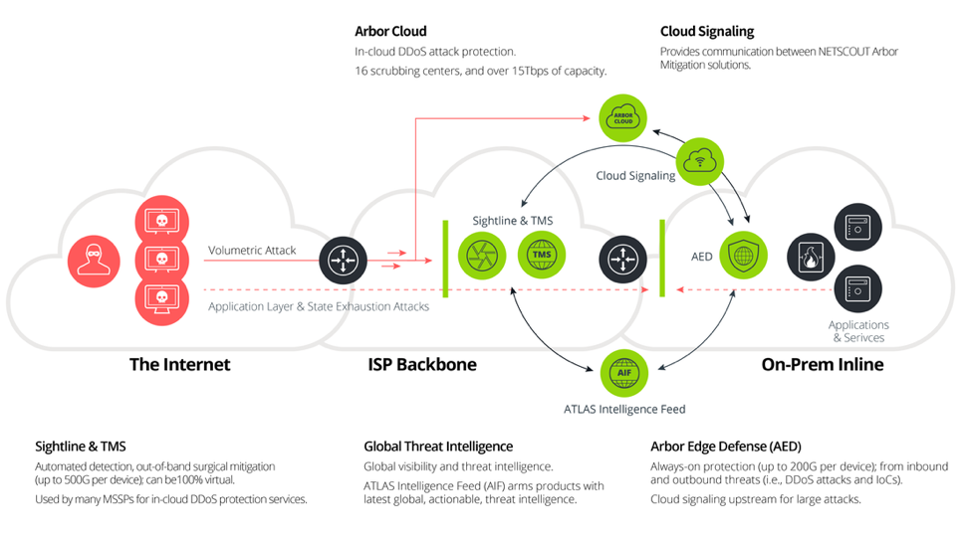
Key elements of the solution include continuous detection of volumetric, state-exhaustion, application-layer, and encrypted DDoS attacks, backed by intelligence from NETSCOUT’s ATLAS Intelligence Feed. This intelligence enables automated, explainable mitigation decisions that can be applied locally or upstream without routing all traffic through a single external dependency. The architecture is designed to preserve service availability while adapting to new and evolving attack techniques as they emerge globally.
Potential ResultsBy adopting a purpose-built DDoS protection architecture, organizations gain the ability to defend critical services against both large-scale attacks and smaller, targeted disruptions that often evade basic upstream or generic protections. The NETSCOUT Arbor approach enables faster detection, automated response, and operational visibility into why traffic is allowed or blocked—capabilities that are essential when facing frequent, low-barrier DDoS attacks such as those described in law enforcement investigations.
Most importantly, the solution shifts the focus from reacting to outages to maintaining service continuity, even as DDoS activity continues to grow in volume and accessibility. In an environment where tens of thousands of attackers can be identified in a single enforcement action, resilient, intelligence-driven DDoS protection becomes a foundational requirement for digital operations rather than an optional security layer.
For more information click here:
| # | Наименование новости | Тональность | Информативность | Дата публикации |
|---|---|---|---|---|
| 1 | How Botnet-Driven DDoS Attacks Evolved in 2H 2025 | 0 | 15.3 | 20-03-2026 |
| 2 | Defending Against DDoS Attacks at Scale | 0 | 9.89 | 15-05-2026 |
| 3 | Why CDNs Alone Are Not Sufficient for Modern DDoS Protection | 0 | 9.23 | 08-07-2026 |
| 4 | Black Box Versus Glass Box DDoS Protection | 0 | 8.81 | 11-06-2026 |
| 5 | Отечественные компании столкнулись с высокоорганизованной серией DDoS-атак | -1 | 6 | 30-06-2026 |
| 6 | Коммерсант»: компании в России подвергаются DDoS-атакам мощностью более 2 Тбит/с | 0 | 7 | 06-07-2026 |
| 7 | Хакеры провели в 2025 году более 140 000 DDoS-атак на российские компании | 0 | 5 | 17-02-2026 |
| 8 | Эксперты: мощные DDoS-атаки на РФ могут быть «обкаткой» нового ботнета | 0 | 7 | 30-06-2026 |
| 9 | Роскомнадзор в августе отразил более 700 DDoS-атак | 0 | 0 | 03-09-2025 |
| 10 | Минцифры: DDOS-атаки на инфраструктуру электронного правительства успешно отражены | 0 | 0 | 17-09-2021 |