Просмотр новости
Найдите то, что Вас интересует
 Спутники
 РН
РН SpaceX
 Роскосмос
 NASA
NASA
СпутникиРНSpaceXРоскосмосNASAThyme is easy to grow and harvest in almost any condition. Follow these tips to get started growing, harvesting (and drying) thyme in your home or backyard!
It’s about time we talk about thyme! Thyme, a medicinal herb and a flavorful addition to meals, is easy to grow and harvest in almost any condition. Follow these tips to get started growing thyme in your backyard!
The following is an excerpt from The Organic Medicinal Herb Farmer, Revised Edition by Jeff and Melanie Carpenter. It has been adapted for the web.
Thyme is a woody perennial that is hardy in USDA zones 5 to 9.
It has a rich history of use and is native to Europe, North Africa, and Asia. Thyme is a mint and a member of the Lamiaceae family. It is a short, bushy shrub that has rough, woody branches and grows 6 to 12 inches tall. The small leaves of thyme are narrow, lance shaped, and deep green in color.
Thyme foliage is extremely fragrant and contains a valuable phenol called thymol that has antiseptic properties. Thyme flowers consist of clusters of white and purplish blossoms that are located at the end of the branches.
Growing ConditionsThyme is a sturdy plant that likes to grow in full sun in well-drained, loamy soil. It can also grow at higher elevations and can overwinter in cold climates if mulched well. Overall, thyme is a low-maintenance plant, provided it is not grown in wet, weedy areas.
Thyme Propagation
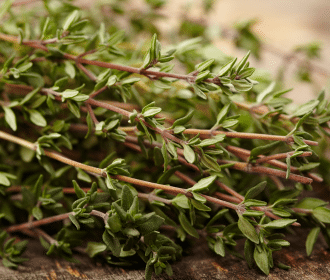
Thyme can be grown by direct seeding, vegetative cuttings, root divisions, or transplants. Because thyme germinates easily, we seed it early in the spring into plugs and transplant them into fields when the plants are well established. Thyme does not outcompete weeds easily.
Transplant it into clean, weed-free beds and consider using mulches to reduce weed pressure. Recommended plant spacing for thyme is 12 inches between plants, in triple rows with 14 inches between rows within the bed.
Planting ConsiderationsThyme may be diminutive in size, but it has hearty, delightful aromatics and strong healing properties. We like to plant thyme next to other low-growing perennials such as oregano, sage, and lavender. The plants have a genuine affinity for one another and do not tend to crowd each other out.
It is also beloved by bees and other pollinators and is a great selection for gardens located near hives. Not only will it contribute to tasty honey, but the antimicrobial components of the plant are thought to be beneficial to the health of the insects.
Thyme Harvesting SpecificationsWe harvest thyme as it begins to flower in late summer. This is when the volatile oils are at their highest levels and the plant has reached the apex of its growth cycle for the season. Mechanical harvest is challenging due to the low-growing, woody nature of the plants.
We have found it easiest to harvest using very sharp pruners rather than trying to saw through the woody stems with field knives, which can be time consuming and hard on the arms. When harvesting be sure to leave 2 to 3 inches of the plant intact to allow for regeneration and to help the plant overwinter.
Post-Harvest and Drying ConsiderationsDry thyme at temperatures of 100 to 120°F (38– 49°C) in order to maintain the delicate aromatic compounds. It is best to keep thyme out of direct light to help maintain vibrant color and medicinal quality.
In good drying conditions, it should dry in a couple of days. When dry, the leaves will easily rub off from the stems. Run stalks over 1/4-inch stainless steel mesh and separate the leaves from the stems.
Harvesting 101: Basics of Harvesting Herbs, Roots, Fruits & More!
| # | Наименование новости | Тональность | Информативность | Дата публикации |
|---|---|---|---|---|
| 1 | Harvesting 101: Basics of Harvesting Herbs, Roots, Fruits & More! | 0 | 22.82 | 16-07-2026 |
| 2 | Capturing the Crunch: How to Harvest and Store Cucumbers | 0 | 24.12 | 24-07-2026 |
| 3 | How to Grow Healthy Plants: Strengthening Your Farm or Garden’s Immune System | 0 | 22.25 | 15-07-2026 |
| 4 | Living Mulch: A Better Way to Cover Ground | 0 | 21.9 | 10-07-2026 |
| 5 | A Passion For Plants: In Botanical Time | 0 | 21.82 | 20-06-2026 |
| 6 | How to Manage Garden Pests (Without Pesticides!) | 0 | 16.89 | 29-07-2026 |
| 7 | The Whole Sunflower: Delicious Down to the Stem | 0 | 22.98 | 19-06-2026 |
| 8 | What to plant in July: Best vegetables and flowers to grow | 5 | 7 | 01-07-2026 |
| 9 | What to plant in July: Best vegetables and flowers to grow | 5 | 7 | 01-07-2026 |
| 10 | What to plant in July: Best vegetables and flowers to grow | 5 | 7 | 01-07-2026 |