Просмотр новости
Найдите то, что Вас интересует
 Спутники
 РН
РН SpaceX
 Роскосмос
 NASA
NASA
СпутникиРНSpaceXРоскосмосNASAThe four dimensions of heart health that matter most.
If your last cardiac workup came back normal and you still don’t feel right, you are not imagining it. The standard measurements may not be capturing what is wrong.
James, 58, a working architect, came to my office two weeks after his cardiologist had told him everything looked fine. His cholesterol was “borderline,” his blood pressure “a little high but acceptable,” and his stress test was normal.
Yet he could no longer climb the two flights of stairs to his studio without stopping on the landing to catch his breath. Three or four nights a week, he woke at 3 a.m. with his heart pounding. He had stopped traveling for work because long flights left him very uncomfortable.
Eight months later, James was climbing those stairs without stopping. A key blood marker for arterial disease had fallen from a dangerous level to a healthy one. His heart rate variability—one of the strongest predictors of cardiovascular health available in medicine—had nearly doubled. He had, at last, allowed himself to grieve a loss that had quietly driven his symptoms for four years. None of which appeared in the original workup.
How James RecoveredHeart disease remains among the leading causes of death in most industrialized countries, and a substantial proportion of patients who suffer a first cardiac event had no prior diagnosis of heart disease. Standard cholesterol panels, EKGs, and even stress tests routinely miss the warning signs that matter most. Millions of patients walk around with advancing arterial disease, and they know nothing about it.
In my clinical experience, the cardiovascular system is the most legible system in the body—once a clinician knows how to read it. The heart and arteries respond measurably and quickly to inflammation, metabolic state, nervous system balance, and the quality of a patient’s emotional life. None of that requires special technology to assess, yet most of it is not included in a standard cardiology workup.
After 30 years in medicine, I have come to believe that no single specialty can, on its own, protect the heart. What I have found useful is to examine four dimensions at once, which I call the ACES model: anatomy, chemistry, energy, and soul. It is a clinical framework, informed by both Western medicine and traditional Chinese medicine, developed and refined through direct patient care.
Conventional cardiology, with its cholesterol numbers and ejection fractions, measures a sliver of the first two dimensions—and usually only after years of damage have accumulated—and almost none of the last two.
James needed all four—just like most patients with a struggling heart.
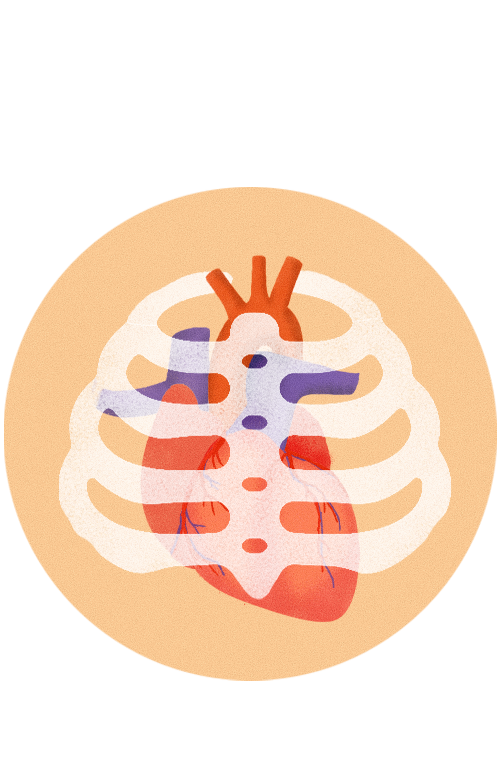 Anatomy–The Cage the Heart Lives In
The first thing to understand is that the heart does not float freely. It sits inside the rib cage, and the shape of the cage determines how easily the heart can fill and empty with every beat. Forward head posture, rounded shoulders, and the shallow, chest-high breathing that defines modern desk life all compress the cage, restrict movement of the diaphragm, and force the heart to work harder for every ounce of blood it moves.
The diaphragm deserves special attention. It is effectively the second pump of the cardiovascular system. With every full breath, the diaphragm drops and creates the pressure change that pulls venous blood back toward the heart and moves lymphatic fluid through the chest. Patients who breathe shallowly all day—which is most patients—operate with chronically sluggish venous return and lymphatic drainage. The heart’s workload rises, and the puffy, congested, perpetually tired state so common in midlife sets in.
When I watched James breathe, I saw what I see in nearly every patient who comes in with cardiac symptoms: shoulders hiked up, chest barely moving, ribs almost frozen. He had been breathing that way for 30 years.
What to Do
The mechanical dimension responds quickly, which is why I start here:
It is important to discuss any new exercise or physical therapy regimen with your physician before starting.
 Chemistry–What Your Blood Should Be Telling You
The standard lipid panel explains only a fraction of cardiovascular risk. Five tests matter most—all inexpensive, all routinely available, and all worth requesting by name at your next medical visit. Your doctor can advise on how to interpret results in the context of your full history.
What to Do
 Energy–The Force That Animates the Heartbeat
“Energy” is the dimension for which Western medicine has the least language, and the one that, in my clinical experience, most often decides whether a heart ages well. By energy I mean two things: the measurable activity of the nervous system, and the concept that traditional Chinese medicine (TCM) calls qi.
Begin with the modern view. The heartbeat is governed not by the heart alone but by the autonomic nervous system—the automatic control system that also runs breathing, digestion, and the body’s response to stress. That system has two branches: a sympathetic “accelerator” that speeds the heart and braces the body for threat, and a parasympathetic “brake” that slows the heart and allows repair. The balance between the two can be read through heart rate variability—the tiny, beat-to-beat variation in the spacing of heartbeats. A heart whose rhythm varies flexibly is a well-regulated, resilient heart; a rigid, metronome-like rhythm is a warning sign.
Patients stuck in sympathetic overdrive—driven, anxious, perpetually braced—develop stiff arteries, high blood pressure, and inflamed vessels at accelerated rates, no matter what their cholesterol levels are.
TCM arrived at essentially the same physiology more than 2,000 years ago, through a different pathway and a different vocabulary. A short orientation helps, since these terms are unfamiliar to most Western readers.
Its central concept is qi (pronounced “chee”)—the body’s vital energy, the animating force that powers every organ and every function. The closest modern translation is something like usable biological energy: the capacity of the body’s cells and systems to do their work. When qi is abundant and flows freely, the body functions with vigor; when qi is depleted or blocked, function falters. For the heart, two expressions of qi matter most.
The first is zhong qi—“central qi,” sometimes called gathering qi. Zhong qi is the combined energy of the chest, produced when the heart, the lungs, and the digestive center work in harmony. A patient with depleted central qi presents with shortness of breath, a weak and breathy voice, easy exhaustion, and a hollow, sunken feeling in the chest. It maps closely onto what a modern physician would call poor cardiopulmonary reserve and low vagal tone—the very state James was in.
The second is shen—the “spirit” or conscious mind. TCM holds that the heart houses the shen, meaning the heart is regarded as the seat of consciousness, emotional steadiness, and mental clarity, not merely a pump. When the shen is disturbed—by grief, fear, or prolonged stress—insomnia, a racing heart, anxiety, and waking in the small hours of the night follow. James, waking at 3 a.m. with his heart hammering, was describing a disturbed shen in almost textbook form.
A third idea completes the picture: The pericardium, the thin protective sac that physically surrounds the heart, is regarded in TCM as the heart’s guard—the buffer meant to absorb emotional shocks so they do not strike the heart directly. Years of unabsorbed emotional injury, in this framework, eventually overwhelm that buffer and reach the heart itself.
These are examples of varying traditions examining the same underlying condition. Encouragingly, the path back is also the same.
What to Do
 Soul–What the Heart Is Holding
The heart is the body’s most emotionally responsive organ. Decades of research in psychocardiology have confirmed what every seasoned clinician observes: Grief, isolation, and unresolved emotional pain produce measurable, physical damage to the cardiovascular system. “Broken heart syndrome,” a sudden, sometimes fatal weakening of the heart muscle triggered by acute emotional shock, is the dramatic extreme.
The everyday versions are more subtle. Patients in chronically unhappy marriages have more cardiac events than those who leave them. Lonely patients carry cardiovascular mortality comparable to that of smokers. Patients who suppress anger or grief for years develop high blood pressure and inflamed arteries that medication alone cannot fully resolve.
When a patient tells me in one form or another that he no longer knows who he is, or that nothing seems to matter the way it once did, he is describing a genuine cardiovascular risk—yet a reassuring cholesterol number says nothing about any of that, and emotional weight rarely shows up in a patient’s own account of “heart trouble.”
How do I uncover it on the first visit?
After the physical exam, I ask a different set of questions from what a cardiologist would ask: When did the symptoms actually begin? What else was happening in your life that season? Who do you turn to when things are hard? What in your life feels unfinished? I pay particular attention to timing. When a patient can name the month when symptoms began, I ask, gently, what the patient lost around that time—because the body often dates its distress to an event the mind has filed away.
With James, the timeline told the story. His shortness of breath and his 3 a.m. wakings had begun within a few months of his father’s sudden death four years earlier—a loss he had never allowed himself to grieve. He had gone back to work the week after the funeral and had not slowed down since.
What surfaced when he finally spoke about it was not only sadness but also disorientation: His father had been the man he measured himself against, and without him, James felt unmoored, unsure what his long hours were even for, and—for the first time in his life—exposed. Those were precisely the feelings, I told him, that the heart registers most deeply. His pericardium, in TCM terms, had absorbed a blow it was never given the chance to release.
Naming that connection is itself the first step in healing. A patient who understands that the heart is responding to an unmetabolized loss no longer experiences the symptoms as random or shameful.
What to Do
The struggling heart is usually the cumulative product of a compressed, immobile chest (anatomy), an inflamed, insulin-resistant bloodstream (chemistry), a nervous system locked in overdrive, a depleted central qi (energy), and emotional weight carried without acknowledgment (soul). Conventional cardiology, for all its power, addresses one or two of those dimensions, and usually only after years of damage have accumulated.
The approach works because it allows the body to heal in ways that addressing any single dimension rarely achieves.
The result is a patient who breathes deeply, eats with awareness, sleeps enough, moves daily, quiets the nervous system, and takes the emotional life as seriously as the cholesterol number, one who can carry a healthy heart into his or her 80s and beyond. The heart keeps a record of the life it has been asked to power. At some point, it asks to be heard.
Lidan Du-Skabrin, who holds a doctorate in nutrition, contributed to this article.
Views expressed in this article are the opinions of the author and do not necessarily reflect the views of The Epoch Times. Epoch Health welcomes professional discussion and friendly debate. To submit an opinion piece, please follow these guidelines and submit through our form here.
| # | Наименование новости | Тональность | Информативность | Дата публикации |
|---|---|---|---|---|
| 1 | Как не попасть в группу риска? Ответы на вопросы ко Всемирному дню сердца | 0 | 0 | 28-09-2018 |
| 2 | From blood sugar to cancer screening: Doctor lists the health tests every adult should consider after 30, 40, and 50 | 5 | 7 | 01-07-2026 |
| 3 | Какие четыре признака старения сердца обнаружили ученые? | 0 | 7 | 21-07-2026 |
| 4 | What We Mean When We Talk About Heart Health Equity | 0 | 8.1 | 17-02-2026 |
| 5 | Сердце под угрозой? Врач объяснил, как быстро оценить риск инфаркта | 0 | 6 | 03-07-2026 |
| 6 | Кардиологи рассказали, как защитить сердце без спортзала | 0 | 14.65 | 30-07-2026 |
| 7 | 5 Virtues That Directly Influence Your Health | 0 | 12.98 | 12-06-2026 |
| 8 | Тест: Сердце осталось в СССР? Тест на знание советской жизни: осилить 8/8 смогут единицы | 0 | 5 | 03-07-2026 |
| 9 | Бег лучше ходьбы: три правила для сохранения здорового сердца | 3 | 4 | 25-06-2026 |
| 10 | Best Beef Organ Supplements (2026): Expert Tested and Reviewed | 2 | 3 | 26-06-2026 |