Просмотр новости
Найдите то, что Вас интересует
 Спутники
 РН
РН SpaceX
 Роскосмос
 NASA
NASA
СпутникиРНSpaceXРоскосмосNASASlope delivers pure speed with simple controls and endless action. Roll through glowing platforms, avoid dangerous barriers, <a href="https://slope-play.com" rel="nofollow ugc">slope</a> and stay alive as long as possible. Every run feels different because the track changes constantly and the challenge never slows down.
3D printing news News UCLA’s 3D-Printed Zinc-Ion Battery Stores 7 Times More Energy
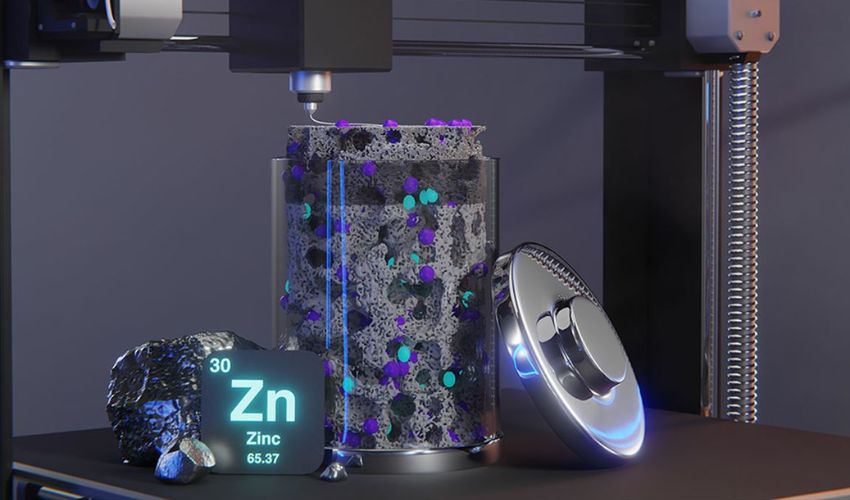
A UCLA-led research team has used 3D printing to build a porous carbon electrode that pushes a hybrid zinc-ion battery to store more than seven times the charge of comparable devices, while retaining 82% of that capacity after 1,500 charge cycles. The study, published in the journal Small, was led by co-corresponding authors Maher El-Kady and Ric Kaner along with first author Sophia Uemura.
A Honeycomb ElectrodeThe device combines two modes of energy storage in one hybrid cell. One terminal behaves like a conventional lithium-ion battery electrode. The other is a carbon electrode similar to what’s found in a supercapacitor, a technology that charges and discharges quickly and lasts for decades, but stores comparatively little energy because it can only hold charge on the surface of its electrodes.
To get around that limitation, the team 3D printed the carbon electrode with a honeycomb-like internal structure, using a resin that solidifies under UV laser light. After heating and gassing the printed structure to leave only conductive carbon riddled with open cavities, the researchers loaded it with vanadium oxide, a material with high energy storage capacity. The resulting surface area is large enough that a single gram, flattened out, would cover roughly ten tennis courts.
“The method we used lets us build any 3D scaffold, layer by layer, and control its microstructure,” said co-corresponding author Ric Kaner, a UCLA distinguished professor of chemistry and biochemistry and of materials science and engineering. “We can actually have billions and billions of these tiny holes, producing an enormous internal surface area. That means we can store a lot of charge.”
Zinc-based storage also carries a cost and sustainability argument: zinc is roughly 100 times more abundant than lithium, and easier to mine and recycle. “At some point, we will need to look for something to complement the current options for grid-scale energy storage,” said El-Kady, an assistant researcher in UCLA’s chemistry and biochemistry department.
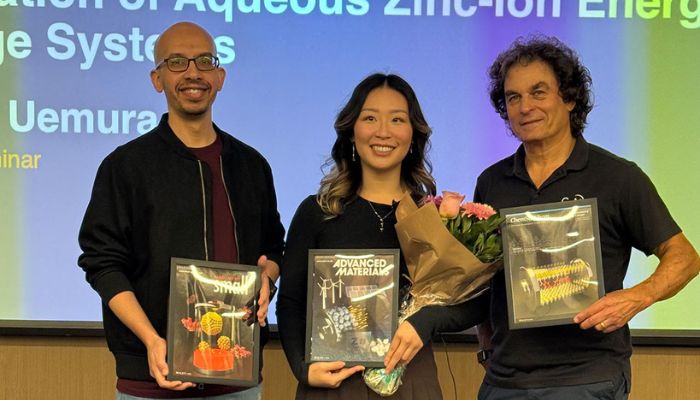
From left to right, co-corresponding author Maher El-Kady, first author Sophia Uemura and co-corresponding author Ric Kaner. (Photo credit: Julia Hu and Hai Co Tiet)
Alongside the battery itself, the team introduced a 3D-printed test cell with a sealed top and fixed electrode spacing, designed to replace the open beaker setups still common in battery labs. Electrolyte evaporation and inconsistent electrode positioning make beaker tests unreliable over time. In UCLA’s printed cell, standardized carbon electrodes retained 98% of their charge after 1,500 cycles, compared to failure in under 100 cycles in a conventional open-cell setup.
“It’s a concept that we hope can be useful to other researchers in the field by helping them obtain more consistent measurements and reliable data for their devices,” said Uemura, who recently earned her Ph.D. from UCLA. “One of the exciting things about 3D printing is how accessible it has become. In this case, anyone with access to a 3D printer will be able to make a test cell like ours and adapt it for their own work.”
It’s a research-tooling advance rather than a device, but a notable one: unlike premade glass test cells, which cost $1,000 and up, a printed version is within reach of any lab with a 3D printer.
The study was conducted through a collaboration between UCLA and National Tsing Hua University in Taiwan, with funding from a University of California Climate Action Seed Grant, Nanotech Energy Inc., and UCLA’s Dr. Myung Ki Hong Endowed Chair in Materials Innovation. Read the full study here.
What do you think of this research? Let us know in a comment below or on our LinkedIn and Facebook pages! Don’t forget to sign up for our free weekly Newsletter here, the latest 3D printing news straight to your inbox! You can also find all our videos on our YouTube channel.
*Cover Photo Credit: Maher El-Kady/UCLA