Просмотр новости
Найдите то, что Вас интересует
 Спутники
 РН
РН SpaceX
 Роскосмос
 NASA
NASA
СпутникиРНSpaceXРоскосмосNASAAmericans are now almost evenly split over which party they most agree with on economic policies: 37% say the Democrats, while 36% say the GOP.
This Pew Research Center analysis examines views of Congress and issues for the upcoming midterm elections, including the economy.
Why did we do this?Pew Research Center conducts research to help the public, media and decision-makers understand important topics. We have studied Americans’ views of politics and major policy issues for decades.
Learn more about Pew Research Center.
How did we do this?We surveyed 3,554 U.S. adults from July 6 to 12, 2026. Everyone who took part in this survey is a member of the Center’s American Trends Panel. The survey represents the views of the full U.S. adult population.
Here are the survey questions used for this analysis, the detailed responses and the survey methodology.
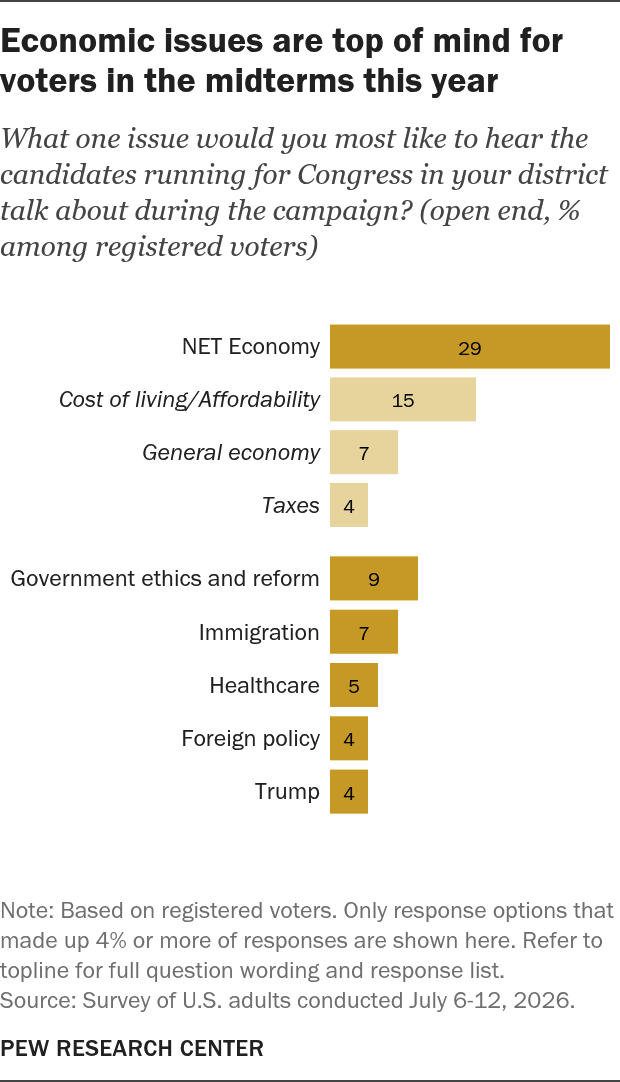
By a wide margin, voters most want candidates running for Congress to talk about economic issues – with many specifically mentioning prices and affordability.
Economic issues are top of mind for voters in the midterms this year
What one issue would you most like to hear the candidates running for Congress in your district talk about during the campaign? (open end, % among registered voters)
Note: Based on registered voters. Only response options that made up 4% or more of responses are shown here. Refer to topline for full question wording and response list.
Source: Survey of U.S. adults conducted July 6-12, 2026.
PEW RESEARCH CENTER
Economic issues are top of mind for voters in the midterms this year
What one issue would you most like to hear the candidates running for Congress in your district talk about during the campaign? (open end, % among registered voters)
| Category | % | Group |
|---|---|---|
| NET Economy | 29 | subgroup |
| Cost of living/Affordability | 15 | subgroup |
| General economy | 7 | subgroup |
| Taxes | 4 | subgroup |
| Government ethics and reform | 9 | group |
| Immigration | 7 | group |
| Healthcare | 5 | group |
| Foreign policy | 4 | group |
| Trump | 4 | group |
Note: Based on registered voters. Only response options that made up 4% or more of responses are shown here. Refer to topline for full question wording and response list.
Source: Survey of U.S. adults conducted July 6-12, 2026.
PEW RESEARCH CENTER
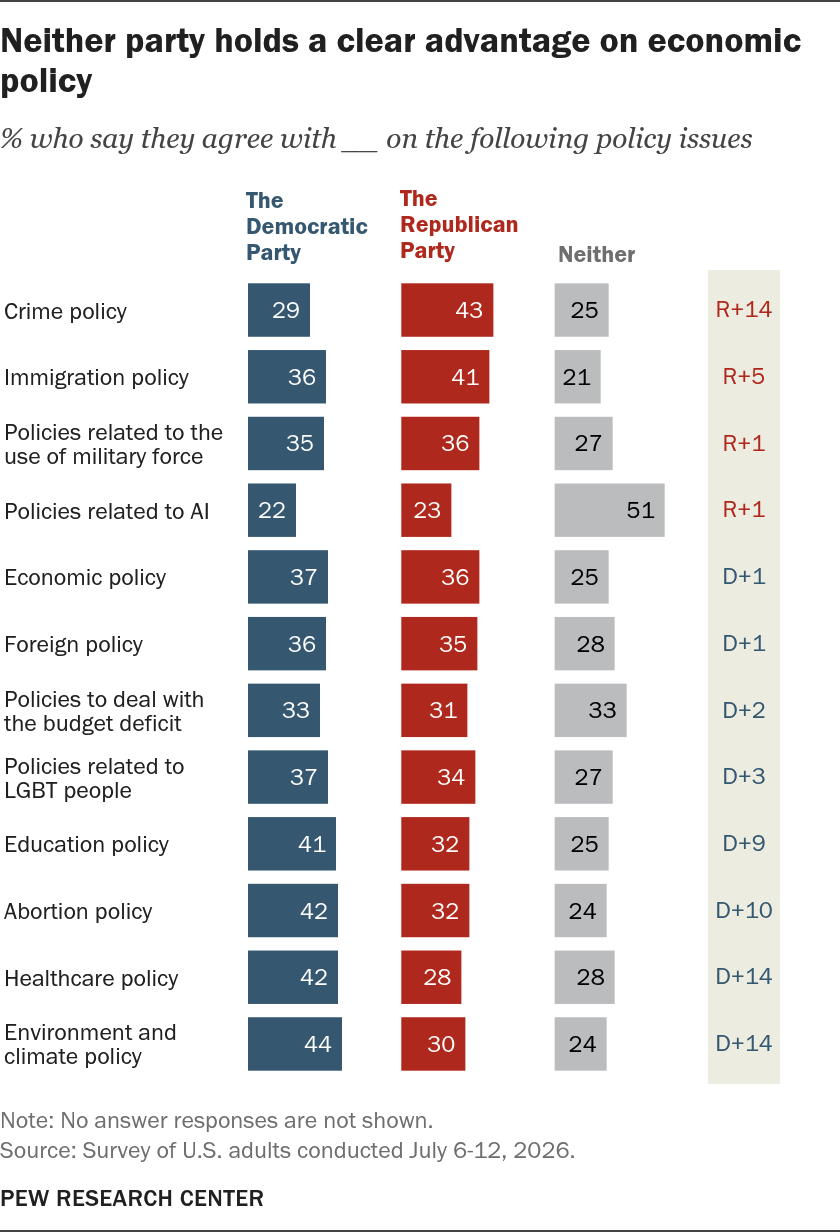
But with the November elections on the horizon, neither party is seen as having an advantage on these issues. Americans are now almost evenly split over which party they most agree with on economic policies: 37% say the Democratic Party, while 36% say the Republican Party.
At this early stage, Democrats have both an edge in voters’ congressional candidate preferences and an engagement advantage among their coalition. Among registered voters:
At a similar stage of the 2022 midterm campaign, Republicans held a modest edge on both engagement measures.
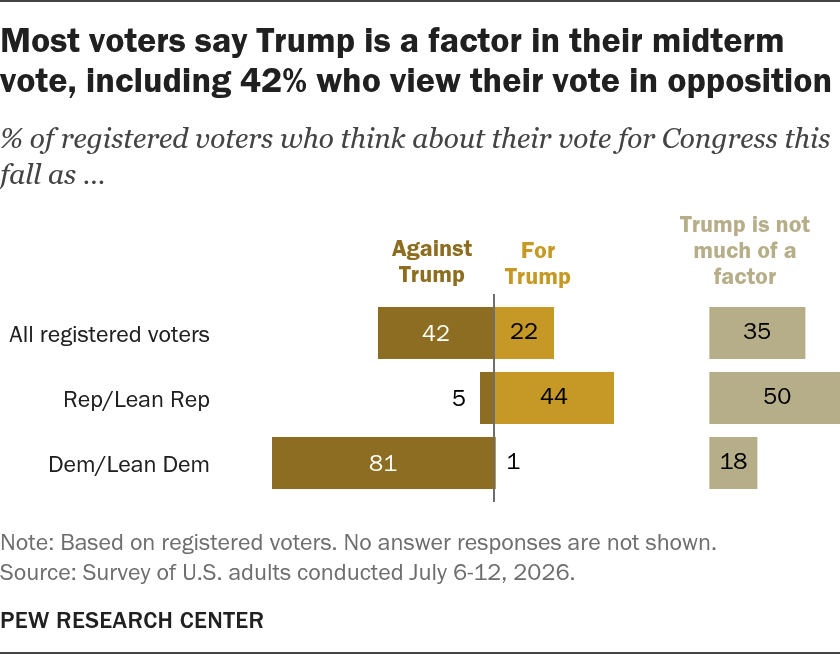
These are among the key findings of a new Pew Research Center survey conducted from July 6 to 12 among 3,554 U.S. adults, including 2,779 registered voters. The survey also finds that President Donald Trump looms large in the campaign. Most voters say the president is a factor in their vote – though by roughly two-to-one, voters are more likely to say they think of their vote this fall as a vote against Trump (42%) than to say they think of it as a vote for him (22%).
Views of Trump are a bigger factor for voters today than views of then-President Joe Biden were at a similar point four years ago.
Most voters say Trump is a factor in their midterm vote, including 42% who view their vote in opposition
% of registered voters who think about their vote for Congress this fall as …
Note: Based on registered voters. No answer responses are not shown.
Source: Survey of U.S. adults conducted July 6-12, 2026.
PEW RESEARCH CENTER
Most voters say Trump is a factor in their midterm vote, including 42% who view their vote in opposition
% of registered voters who think about their vote for Congress this fall as …
| Against Trump | For Trump | Trump is not much of a factor | |
|---|---|---|---|
| All registered voters | 42 | 22 | 35 |
| Rep/Lean Rep | 5 | 44 | 50 |
| Dem/Lean Dem | 81 | 1 | 18 |
Note: Based on registered voters. No answer responses are not shown.
Source: Survey of U.S. adults conducted July 6-12, 2026.
PEW RESEARCH CENTER
Democrats overwhelmingly say they consider their vote for Congress this fall a vote against Trump – 81% view their vote this way.
In contrast, half of Republicans say Trump is not much of a factor in their vote, while 44% say their vote is a vote for him.
Views of the parties on key issuesBefore the start of Trump’s second term, Americans were more likely to agree with the Republican Party than the Democratic Party on economic policy. Continuing a trend since Trump took office, the public is now about evenly split (37% say they agree with Democratic Party, 36% the Republican Party).
Neither party holds a clear advantage on economic policy
% who say they agree with __ on the following policy issues
Note: No answer responses are not shown.
Source: Survey of U.S. adults conducted July 6-12, 2026.
PEW RESEARCH CENTER
Neither party holds a clear advantage on economic policy
% who say they agree with __ on the following policy issues
| The Democratic Party | The Republican Party | Neither | R-D advantage | |
|---|---|---|---|---|
| Crime policy | 29 | 43 | 25 | R+14 |
| Immigration policy | 36 | 41 | 21 | R+5 |
| Policies related to the use of military force | 35 | 36 | 27 | R+1 |
| Policies related to AI | 22 | 23 | 51 | R+1 |
| Economic policy | 37 | 36 | 25 | D+1 |
| Foreign policy | 36 | 35 | 28 | D+1 |
| Policies to deal with the budget deficit | 33 | 31 | 33 | D+2 |
| Policies related to LGBT people | 37 | 34 | 27 | D+3 |
| Education policy | 41 | 32 | 25 | D+9 |
| Abortion policy | 42 | 32 | 24 | D+10 |
| Healthcare policy | 42 | 28 | 28 | D+14 |
| Environment and climate policy | 44 | 30 | 24 | D+14 |
Note: No answer responses are not shown.
Source: Survey of U.S. adults conducted July 6-12, 2026.
PEW RESEARCH CENTER
Similarly, Republicans no longer hold an advantage on policies to deal with the budget deficit.
For more on Americans’ economic views, including views of the impact of Trump’s economic policies on the economy, jump to “Americans’ evaluations of the economy remain negative.”
Neither party has an advantage on foreign policy or policies related to the use of military force, or on policies related to lesbian, gay or transgender people – a Democratic strength in 2022 and 2023.
And when it comes to policies to deal with artificial intelligence, 51% of adults say they agree with neither party.
Areas where Republicans hold an advantageAmericans continue to be more likely to agree with the Republican Party (43%) than the Democratic Party (29%) on policies to deal with crime.
Republicans also hold a 5 percentage point edge on immigration policy. This compares with a 9-point Republican advantage in September.
Areas where Democrats hold an advantageDemocrats hold 14-point advantages on both healthcare and environmental policy, a 10-point advantage on abortion policy, and a 9-point advantage on education policy.
Other key findingsTrump’s approval rating stands at 34%, while 64% of Americans say they disapprove of his job performance – unchanged since April. About seven-in-ten Republicans (69%) currently approve of his performance, while roughly three-in-ten (29%) disapprove. Democrats continue to overwhelmingly disapprove of his performance (93% disapprove, 6% approve).
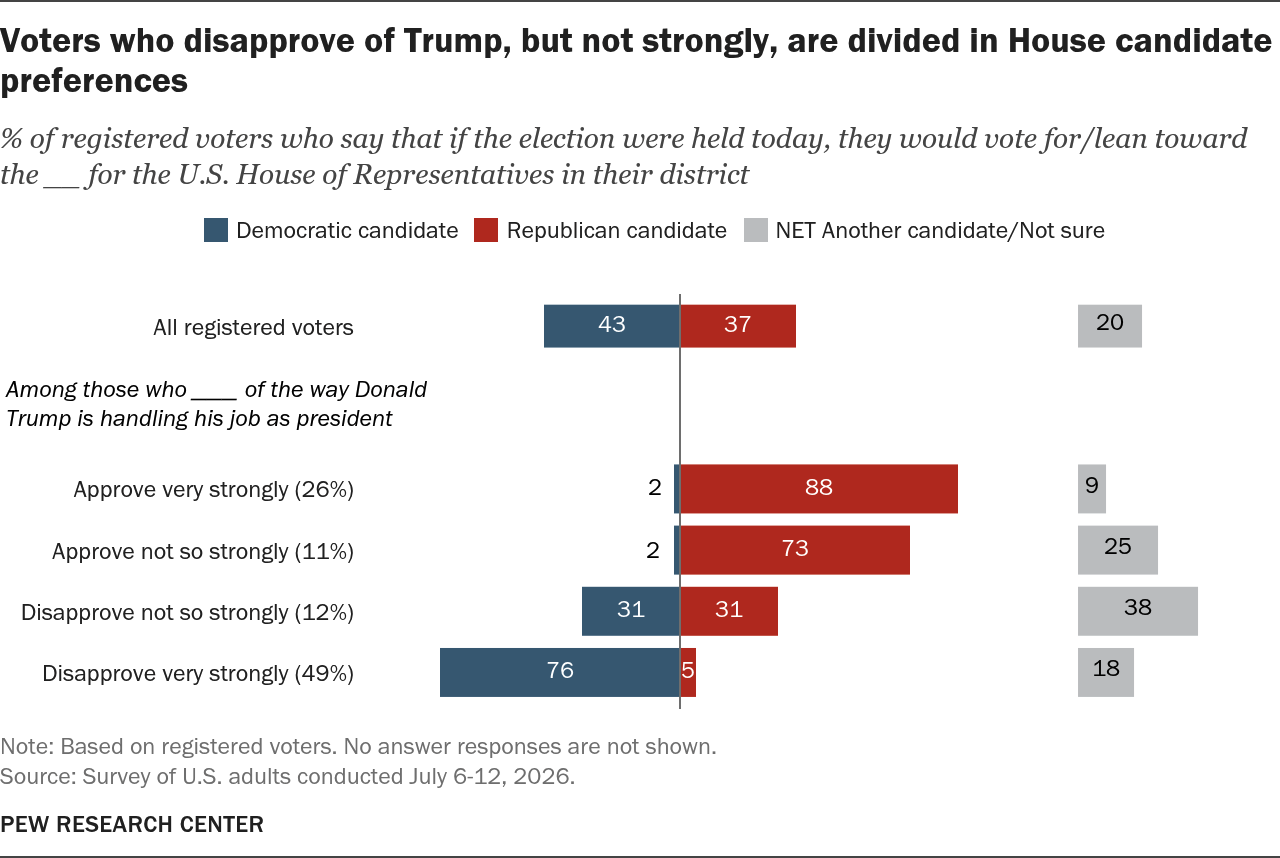
Voters who disapprove of Trump, but not strongly, are divided in House candidate preferences
% of registered voters who say that if the election were held today, they would vote for/lean toward the __ for the U.S. House of Representatives in their district
Note: Based on registered voters. No answer responses are not shown.
Source: Survey of U.S. adults conducted July 6-12, 2026.
PEW RESEARCH CENTER
Voters who disapprove of Trump, but not strongly, are divided in House candidate preferences
% of registered voters who say that if the election were held today, they would vote for/lean toward the __ for the U.S. House of Representatives in their district
| Group | Republican candidate | Democratic candidate | Another candidate | Not sure | NET Another candidate/Not sure | |
|---|---|---|---|---|---|---|
| All registered voters | All | 37 | 43 | 5 | 14 | 20 |
| Approve very strongly (26%) | Among those who ___ of the way Donald Trump is handling his job as president | 88 | 2 | 1 | 8 | 9 |
| Approve not so strongly (11%) | Among those who ___ of the way Donald Trump is handling his job as president | 73 | 2 | 4 | 21 | 25 |
| Disapprove not so strongly (12%) | Among those who ___ of the way Donald Trump is handling his job as president | 31 | 31 | 10 | 28 | 38 |
| Disapprove very strongly (49%) | Among those who ___ of the way Donald Trump is handling his job as president | 5 | 76 | 7 | 12 | 18 |
Note: Based on registered voters. No answer responses are not shown.
Source: Survey of U.S. adults conducted July 6-12, 2026.
PEW RESEARCH CENTER
The narrow slice of registered voters who disapprove of Trump, but not strongly (12%), are split in their midterm preferences: 31% back Republicans, 31% back Democrats. And many (28%) say they are not sure, while 10% back “another candidate.” In contrast, voters who approve of Trump back Republican candidates in the fall by an overwhelming margin, while those who strongly disapprove of Trump largely back Democrats.
Demographic differences in voters’ midterm preferences largely track patterns familiar to past elections. Today, Republican candidates have a 10 percentage point edge among White voters, while Democrats hold wider advantages among Hispanic, Black and Asian voters.
For more on demographic differences in candidate support, jump to “Midterm voting preferences by race and ethnicity, age, and other demographics” and explore the detailed tables.
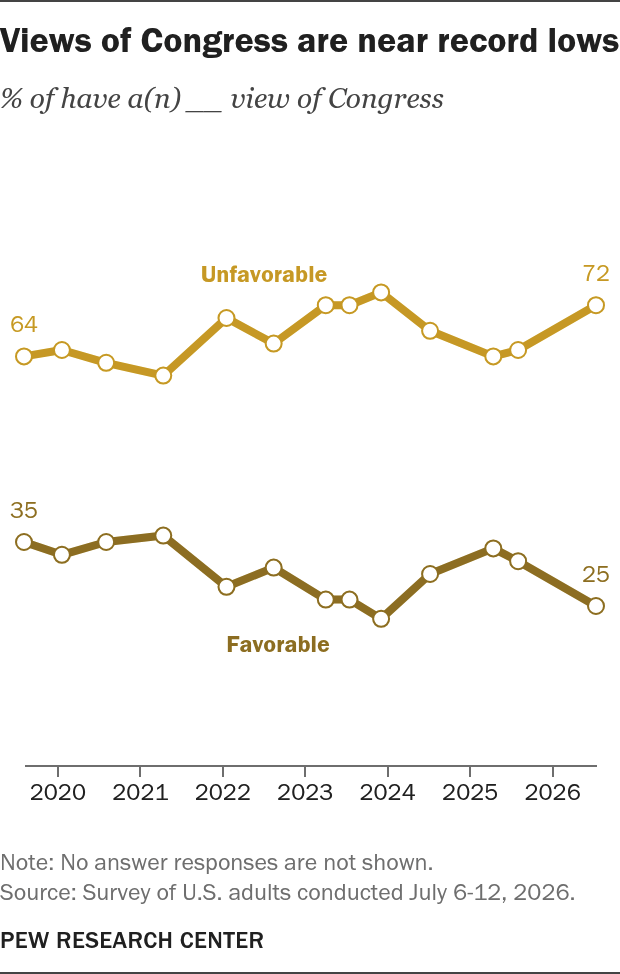
Views of Congress are near record lows
% of have a(n) __ view of Congress
Note: No answer responses are not shown.
Source: Survey of U.S. adults conducted July 6-12, 2026.
PEW RESEARCH CENTER
Views of Congress are near record lows
% of have a(n) __ view of Congress
| Date | Favorable | Unfavorable |
|---|---|---|
| 8/4/19 | 35 | 64 |
| 1/19/20 | 33 | 65 |
| 8/2/20 | 35 | 63 |
| 4/12/21 | 36 | 61 |
| 1/17/22 | 28 | 70 |
| 8/14/22 | 31 | 66 |
| 4/2/23 | 26 | 72 |
| 7/16/23 | 26 | 72 |
| 12/3/23 | 23 | 74 |
| 7/7/24 | 30 | 68 |
| 4/13/25 | 34 | 64 |
| 8/1/25 | 32 | 65 |
| 7/12/26 | 25 | 72 |
Note: No answer responses are not shown.
Source: Survey of U.S. adults conducted July 6-12, 2026.
PEW RESEARCH CENTER
Just a quarter of Americans now hold favorable views of Congress. Current ratings are near record lows and down from 32% last August. Republicans (35%) remain more likely than Democrats (16%) to view Congress positively.
| # | Наименование новости | Тональность | Информативность | Дата публикации |
|---|---|---|---|---|
| 1 | Midterm voting preferences by race and ethnicity, age, and other demographics | 0 | 16.54 | 23-07-2026 |
| 2 | Should congressional candidates seek common ground or push hard for party priorities? | 0 | 7.57 | 23-07-2026 |
| 3 | How confident are Americans in the midterm elections’ fairness and accuracy? | 0 | 10.42 | 05-08-2026 |
| 4 | Americans and the 2026 midterms | 0 | 11.17 | 31-07-2026 |
| 5 | Almost half in poll don't consider themselves Democrats or Republicans | 0 | 5 | 17-06-2026 |
| 6 | Republicans, Democrats continue to differ sharply on voting access | 0 | 5 | 16-06-2026 |
| 7 | Democrats hold 11-point lead over GOP on generic ballot: Poll | 0 | 7.73 | 23-07-2026 |
| 8 | “This Is a God Thing” — Johnson Claims Prayers Will Help GOP Win the Midterms | 0 | 8.26 | 30-07-2026 |
| 9 | Voters Pick Republicans Over Democrats on Guns, Put Issue Far Down Their Priority List | 0 | 8.89 | 31-07-2026 |
| 10 | US House of Representatives 2026 forecast | 5 | 7 | 21-04-2026 |