Просмотр новости
Найдите то, что Вас интересует
 Спутники
 РН
РН SpaceX
 Роскосмос
 NASA
NASA
СпутникиРНSpaceXРоскосмосNASAMachines can now print tissues, layer by layer, using “inks” made of living cells. This technology brings lab-grown organs closer to reality.
With the help of 3-D printers, even hobbyists can make model rockets or gaming accessories out of seemingly nothing. What if that printer could make new body parts, such as an ear, lung or skin? This may sound like science fiction. But scientists are already using living cells to “ink” prototypes of these tissues.
This 3-D bioprinting uses the same basic strategy now used to print toys, sculptures, metal pieces or even basketballs. Specialized printers just swap out plastic or metal for living cells.
Actually, there’s a bit more to it than that. In most cases, you can’t use the same devices to make tissues. And you can’t just spew cells onto a surface, layer by layer, and expect them to link up into working organs. The cells have to be mixed with some soft, gel-like materials to make them unite with their neighbors.
Although still experimental, some devices have already printed skin, cartilage and even early-stage blood vessels. In 2025, researchers in Australia used an experimental robot to bioprint ink made from a patient’s own skin cells directly onto her burn wounds.
One of the doctors who pioneered the bioprinting of skin onto burn wounds describes how it’s done and why her team is excited about it. It starts with the ink
In most 3-D printers, a resin, plastic filament or metal serves as the ink. Bioprinters instead use cells — and something to keep them alive.
“Bioinks are specialized soft gels that can have living cells mixed inside them,” explains Ryan Martin. He works on this tech at Virginia Commonwealth University, or VCU, in Richmond. Think of these inks like Jell-O: wobbly, soft materials that can hold their shape while protecting what’s inside.
Scientists make these hydrogels from materials such as alginate (AL-jin-ate) and collagen. Alginate comes from seaweed. Collagen is a protein found in skin and bones.
But bioinks contain more than just cells and hydrogel. That extra stuff — part of a complex matrix — helps the mix mimic the material that surrounds cells in the body, explains Ankita Pramanick. She’s a biomedical engineer at Utrecht University in the Netherlands.
 NASA Johnson Space Center/Wikimedia Commons
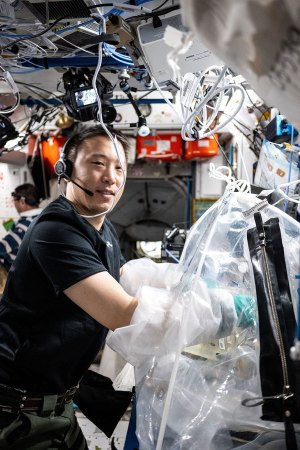
NASA astronaut Jonny Kim treats bioprinted liver tissue on September 17, 2025, in a portable glove-bag on the International Space Station. These samples later went into another research device so researchers could study the effects of microgravity on blood vessel formation in engineered tissues.
What makes bioinks different from most other 3-D inks is that they host living cells. And those cells must survive the printing process, where they’ll get squeezed through nozzles and exposed to temperature changes. The matrix is designed with these challenges in mind.
After printing, the inked structures go into incubators, which are containers that maintain ideal conditions to help cells grow. There, the newly printed cells can mature, strengthen and grow together to form tissues — perhaps cartilage for joints or layered skin with blood vessels.
Printing living cellsEngineers have been developing several different ways to turn bioinks into tissue. Which one they choose depends on what they’re building.
Most times, a “bioink is pushed through a nozzle like toothpaste from a tube,” Martin explains. This process is known as extrusion. A machine controls how fast the ink comes out, building up a tissue layer by layer.
For example, to create skin tissue, you’d first print fibroblasts (FY-broh-blasts) — the cells that make up the inner layer of your skin. Later, you’d layer on keratinocytes (Kare-uh-TIN-oh-sites). These are the cells that make up our skin’s protective outer layer. Once printed, this combined structure matures within an incubator.
Extrusion works well for thicker, structured tissues. These include skin and cartilage. But it’s relatively slow. Squeezing cells through a nozzle can also stress them.
Inkjet bioprinting is faster and gentler. It sprays tiny droplets of bioink onto a surface in much the same way an office printer sprays ink onto paper. It works best with a very liquid matrix. That’s why it’s often used for thin cell layers, such as those that line the insides of blood vessels.
Another type of bioprinting creates entire structures at once instead of building them layer by layer. To start, a laser shines its light into a spinning tube of light-sensitive gel and cells. This solidifies them into the precise shape needed.
With this, scientists might print a small network of blood vessels all at once — complete with all its branches. It could take just seconds. And that’s important, because speed matters. The faster tissues are printed, the less time their cells spend outside their ideal environment.
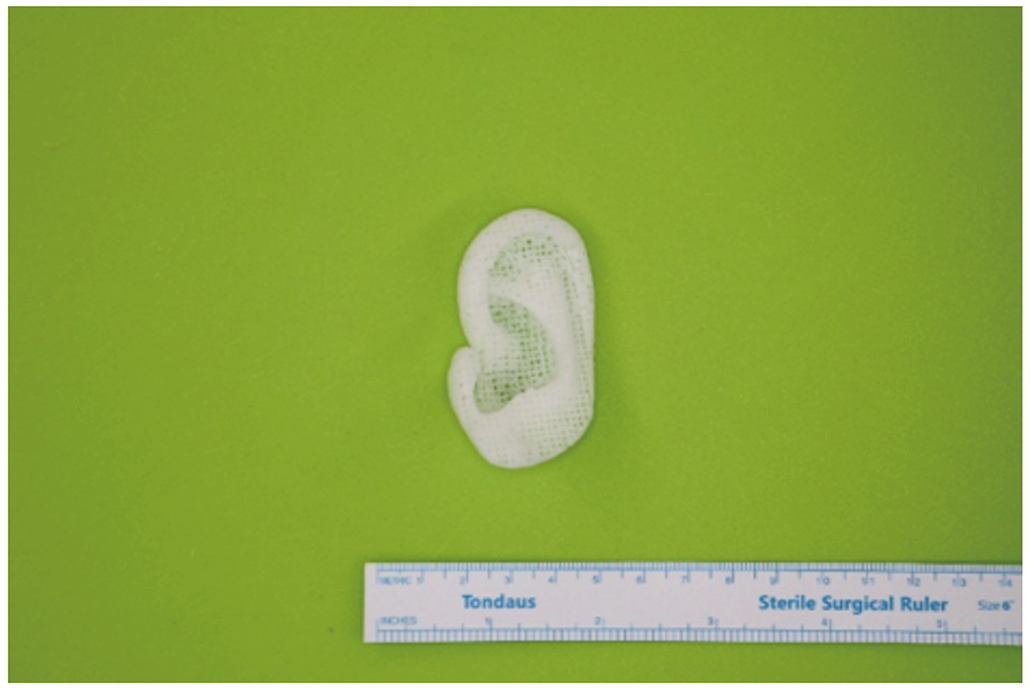 This 3-D printed ear implant was made from polycaprolactone (PCL), a biodegradable polymer. The implant is custom-designed to match a patient’s own ear and is shown next to a ruler for scale. The goal is to transition from plastic, as here, to implants made from living cells.M. Kim et al./Yonsei Medical Journal 2024 (CC BY-NC 4.0)
What’s being printed
This 3-D printed ear implant was made from polycaprolactone (PCL), a biodegradable polymer. The implant is custom-designed to match a patient’s own ear and is shown next to a ruler for scale. The goal is to transition from plastic, as here, to implants made from living cells.M. Kim et al./Yonsei Medical Journal 2024 (CC BY-NC 4.0)
What’s being printed
In 2022, a patient received a 3-D–printed ear made from their own cells. In late 2025, surgeons successfully implanted a bioprinted cornea — the clear outer layer of the eye — into someone who had been legally blind.
Skin grafting is perhaps the most advanced application. A skin graft is a type of transplant where healthy skin is used to cover missing or injured skin. A 2025 trial in Australia tested bioprinted skin on burn patients. In a news conference with her doctor, the first patient to receive such a graft showed it had successfully worked on her leg.
Bone is trickier to print. Unlike skin or cartilage, it contains hard minerals mixed with living cells. Scientists have used 3-D printing to create bone scaffolds — frameworks that encourage the body’s own bone cells to grow and fill in the gaps. But no one has yet bioprinted actual bone with living cells in it for people.
Complex, fully-functioning organs such as hearts and kidneys are still a work in progress. Tissues thicker than a few millimeters (about a tenth of an inch) face a critical problem: Shortly after printing, their cells quickly start dying from a lack of oxygen and nutrients.
 A Pramanick et al./Advanced Functional Materials 2025 (CC BY 4.0)
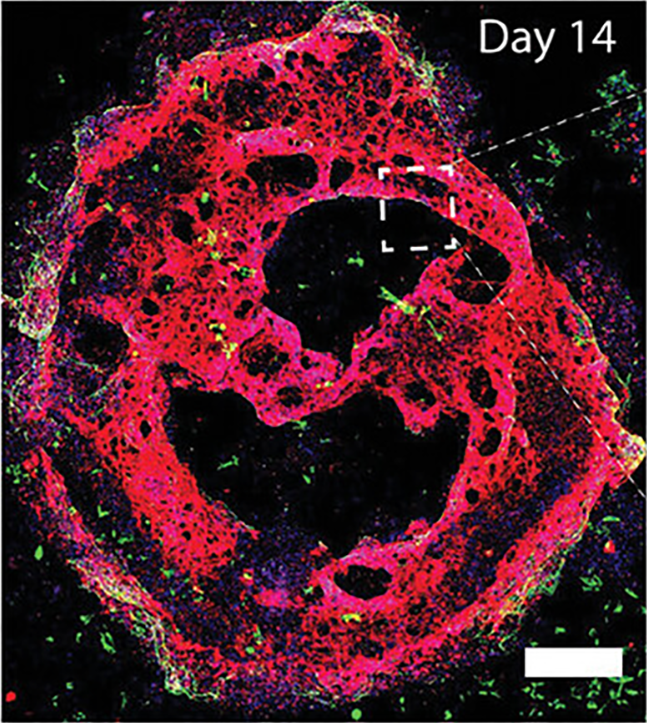
The image shows bioprinted heartlike tissue after 14 days in an incubator. The different colors help show the position of different types of cells inside the tissue.
The missing piece: blood vessels. These are needed for bringing oxygen to cells deep inside thick tissues and carrying away wastes. Without that oxygen and waste removal, cells will die. That’s why building blood vessels into tissues is the biggest hurdle standing in the way of fully printed organs.
The problem comes down to diffusion — the movement of molecules from areas of high concentrations to low concentrations. Oxygen can diffuse only a few millimeters into tissue. In thicker tissues, cells in the center would suffocate before oxygen could reach them. Imagine a big, densely populated city with no roads. Food trucks can’t bring in supplies. Garbage trucks can’t haul away waste.
Scientists have tried ways to avoid this problem. One method uses sacrificial inks. These serve as temporary placeholders. The inks are printed in the shape of vessels, then tissue is printed around them. Once the tissue solidifies, the sacrificial ink dissolves. In its place sit hollow channels through which blood can flow.
Scientists are also looking for a way to print blood vessels directly into tissue as it’s being built up.
Submit your question here, and we might answer it an upcoming issue of Science News Explores
This short overview describes what bioprinting is, how advanced it’s become and where it might go.
In September 2025, researchers made a promising advance with a 3-D bioprinting system they’re calling GRACE. ”This technology enables the printing of blood vessels directly around [the printed tissue itself],” explains Pramanick at Utrecht. She works in the lab that’s developing GRACE.
Here’s how it works. A computer-vision system “sees” where cells are located. It then asks artificial intelligence to figure out the best pattern of blood vessels to deliver oxygen-rich blood to all those cells. In seconds, bioprinting then creates pipe-shaped structures to begin delivering that blood.
Speed matters enormously here. Traditional methods might take hours to print vessel networks layer by layer. Because GRACE does it in seconds, cells spend little time without oxygen.
Full organs remain years away. Forming stable, treelike structures in different sizes — from big arteries down to the tiniest vessels known as capillaries — to seamlessly work with a patient’s blood-vessel system remains a big challenge, notes Martin at VCU. As bioinks and printing speeds improve, the prospect of integrating printed tissues with blood vessels into the body appears ever nearer. Today, the question is no longer if 3-D bioprinting can create replacement organs — it’s when.
3-D printing: The creation of a three-dimensional object with a machine that follows instructions from a computer program. The computer tells the printer where to lay down successive layers of some raw material, which can be plastic, metals, food or even living cells. 3-D printing is also called additive manufacturing.
application: A particular use or function of something.
artificial intelligence: A type of knowledge-based decision-making exhibited by machines or computers. The term also refers to the field of study in which scientists try to create machines or computer software capable of intelligent behavior.
blood vessel: A tubular structure that carries blood through the tissues and organs.
cartilage: (adj. cartilaginous) A type of strong connective tissue often found in joints, the nose and ear. In certain primitive fishes, such as sharks and rays, cartilage provides an internal structure — or skeleton — for their bodies.
cell: (in biology) The smallest structural and functional unit of an organism. Typically too small to see with the unaided eye, it consists of a watery fluid surrounded by a membrane or wall. Depending on their size, animals are made of anywhere from thousands to trillions of cells.
collagen: A fibrous protein found in bones, cartilage, tendons and other connective tissues.
concentration: (in chemistry) A measurement of how much of one substance has been dissolved into another.
core: Something — usually round-shaped — in the center of an object.
cornea: The transparent front section of the eye. The shape of the cornea allows our eyes to bring objects at many distances into focus.
diffuse: (as adj.) To be spread out thinly over a great area; not concise or concentrated. (v) To spread light or to broadly release some substance through a liquid (such as water or air) or through some surface (such as a membrane).
diffusion: The process of spreading out thinly over a great area. It can involve the release or movement of light or some substance through a liquid (such as water or air) or through some surface (such as a membrane). Or it can refer to the spreading out of other things, such as ideas throughout a society.
dissolve: To turn a solid into a liquid and disperse it into that starting liquid. (For instance, sugar or salt crystals, which are solids, will dissolve into water. Now the crystals are gone and the solution is a fully dispersed mix of the liquid form of the sugar or salt in water.)
engineer: A person who uses science and math to solve problems. As a verb, to engineer means to design a device, material or process that will solve some problem or unmet need.
environment: The sum of all of the things that exist around some organism or the process and the condition those things create. Environment may refer to the weather and ecosystem in which some animal lives, or, perhaps, the temperature and humidity (or even the placement of things in the vicinity of an item of interest).
extrude: (n. extrusion) To push or otherwise force some liquid or viscous material through a tiny opening to create a desired shape that often will eventually harden into a permanent structure.
fibroblast: A type of cell found in connective tissue; it makes and releases proteins important in wound healing.
filament: Something with a thin, thread-like shape. For instance, the fragile metal wire that heats up to emit light inside an incandescent light bulb is known as its filament.
gel: A gooey or viscous material that can flow like a thick liquid.
host: (in biology and medicine) The organism (or environment) in which some other thing resides. Humans may be a temporary host for food-poisoning germs or other infective agents. (v.) The act of providing a home or environment for something. A website, for instance, could host photos, news or other types of information.
hydrogel: A “smart” polymer-based material that can change its structure in response to its environment, such as the local temperature, pH, salt or water concentration. The polymers that make up a hydrogel have water-attracting ends sticking out. Those ends help hydrogels latch onto molecules of water. Some hydrogels are used in baby diapers to hold urine. Others are added to potting soils to hold water near to plants until they need it. Still others may be part of wound dressings to prevent a sore from drying out.
kidney: Each in a pair of organs in mammals that filters blood and produces urine.
laser: A device that generates an intense beam of coherent light of a single color. Lasers are used in drilling and cutting, alignment and guidance, in data storage and in surgery.
link: A connection between two people or things.
matrix: (pl. matrices) The background material in which something else is embedded. Or the basic material from which something else takes form or is developed, molded or fashioned.
mature: (adj.) Connoting an adult individual or full-grown and fully developed (non-juvenile) form of something. (verb) To develop toward — or into — a more complex and full-grown form of something, be it a living thing, a technology or an idea.
mineral: Crystal-forming substances that make up rock, such as quartz, apatite or various carbonates. Most rocks contain several different minerals mishmashed together. A mineral usually is solid and stable at room temperatures and has a specific formula, or recipe (with atoms occurring in certain proportions) and a specific crystalline structure (meaning that its atoms are organized in regular three-dimensional patterns). (in physiology) The same chemicals that are needed by the body to make and feed tissues to maintain health.
model: A simulation of a real-world event (usually using a computer) that has been developed to predict one or more likely outcomes. Or an individual that is meant to display how something would work in or look on others.
molecule: A group of atoms that represents the smallest possible amount of a chemical compound. Molecules can be made of single types of atoms or of different types. For example, the oxygen in air is made of two bound oxygen atoms (O2). Water is made of two hydrogen atoms and one oxygen atom (H2O).
network: A group of interconnected people or things. (v.) The act of connecting with other people who work in a given area or do similar things (such as artists, business leaders or medical-support groups), often by going to gatherings where such people would be expected, and then chatting them up. (n. networking)
nozzle: A round spout or slot at the end of a pipe, hose or tube. Nozzles are typically used to control the flow of a jet of some high-pressure liquid or gas.
nutrient: A vitamin, mineral, fat, carbohydrate or protein that a plant, animal or other organism requires as part of its food in order to survive.
organ: (in biology) Various parts of an organism that perform one or more particular functions. For instance, an ovary is an organ that makes eggs, the brain is an organ that makes sense of nerve signals and a plant’s roots are organs that take in nutrients and moisture.
oxygen: A gas that makes up about 21 percent of Earth's atmosphere. All animals and many microorganisms need oxygen to fuel their growth (and metabolism).
plastic: Any of a series of materials that are easily deformable; or synthetic materials that have been made from polymers (long strings of some building-block molecule) that tend to be lightweight, inexpensive and resistant to degradation. (adj.) A material that is able to adapt by changing shape or possibly even changing its function.
prospect: (n.) The vista (as in what’s in view) or the future of something (such as whether it’s going to be successful).
protein: A compound made from one or more long chains of amino acids. Proteins are an essential part of all living organisms. They form the basis of living cells, muscle and tissues; they also do the work inside of cells. Antibodies, hemoglobin and enzymes are all examples of proteins. Medicines frequently work by latching onto proteins.
prototype: A first or early model of some device, system or product that still needs to be perfected.
resin: A sticky, sometimes aromatic substance, often secreted by plants. It may also be the viscous starting ingredient for some plastics that will harden when heated or treated with light.
robot: A machine that can sense its environment, process information and respond with specific actions. Some robots can act without any human input, while others are guided by a human.
rocket: Something propelled into the air or through space, sometimes as a weapon of war. A rocket usually is lofted by the release of exhaust gases as some fuel burns. (v.) Something that flings into space at high speed as if fueled by combustion.
scaffold: A framework erected to temporarily support something, such as people putting siding onto the exterior of a building. (in medicine) A structure implanted into the body to support tissues as they heal or grow.
science fiction: A field of literary or filmed stories that take place against a backdrop of fantasy, usually based on speculations about how science and engineering will direct developments in the distant future. The plots in many of these stories focus on space travel, exaggerated changes attributed to evolution or life in (or on) alien worlds.
strategy: A thoughtful and clever plan for achieving some difficult or challenging goal.
stress: (in biology) A factor — such as unusual temperatures, movements, moisture or pollution — that affects the health of a species or ecosystem. (in psychology) A mental, physical, emotional or behavioral reaction to an event or circumstance (stressor) that disturbs a person or animal’s usual state of being or places increased demands on a person or animal; psychological stress can be either positive or negative. (in physics) Pressure or tension exerted on a material object.
suffocate: To be unable to breathe, or to cause a person or other organism to be unable to breathe.
system: A network of parts that together work to achieve some function. For instance, the blood, vessels and heart are primary components of the human body's circulatory system. Similarly, trains, platforms, tracks, roadway signals and overpasses are among the potential components of a nation's railway system. System can even be applied to the processes or ideas that are part of some method or ordered set of procedures for getting a task done.
tissue: Made of cells, it is any of the distinct types of materials that make up animals, plants or fungi. Cells within a tissue work as a unit to perform a particular function in living organisms. Different organs of the human body, for instance, often are made from many different types of tissues.
News announcement: Precise Bio Inc. Precise Bio achieves world’s first 3D-bio-printed corneal implant. November 19, 2025.
Journal: S. Florczak et al. Adaptive and context-aware volumetric printing. Nature. Vol. 645, September 3, 2025, p. 108. doi: 10.1038/s41586-025-09436-7.
Journal: J. Son, S. Li and W. Jeong. Bioprinting vascularized constructs for clinical relevance: Engineering hydrogel systems for biological maturity. Gels. Vol. 11, August 12, 2025, p. 636. doi: 10.3390/gels11080636.
Journal: L. Jing et al. The sculpting tool in bioprinting: research and application progress of sacrificial inks. Frontiers in Bioengineering and Biotechnology. Vol. 13, June 24, 2025. doi: 10.3389/fbioe.2025.1486459.
News announcement: Office for Health and Medical Research. Novel 3D bioprinting device prints skin-growing ink from patient cells in world-first clinical trials. Government of New South Wales, Australia. May 15, 2025.
Journal: T.A.M. Andrade et al. 3D bioprinting a novel skin co-culture model using human keratinocytes and fibroblasts. Journal of Biomedical Materials Research Part A. Vol. 113, January 2025. doi: 10.1002/jbm.a.37831.
Journal: A Pramanick et al. 4D bioprinting shape-morphing tissues in granular support hydrogels: Sculpting structure and guiding maturation. Advanced Functional Materials. Vol. 35, January 29, 2025. doi: 10.1002/adfm.202414559.
Journal: M. Kim et al. One-year results of ear reconstruction with 3D printed implants. Yonsei Medical Journal. Vol. 65, August 2024, p. 456. doi: 10.3349/ymj.2023.0444.
Journal: Y. Hao et al. The first 3D-bioprinted personalized active bone to repair bone defects: A case report. International Journal of Bioprinting. Vol. 9, December 22, 2022, p. 654. doi: 10.18063/ijb.v9i2.654.
News announcement: D. Nutt. Cornellian-founded company implants 3D-bioprinted ear. Cornell Chronicle. June 2, 2022.
Journal: J. Li et al. Recent advances in bioprinting techniques: approaches, applications and future prospects. Journal of Translational Medicine. Vol. 14, September 20, 2016. doi: 10.1186/s12967-016-1028-0.
| # | Наименование новости | Тональность | Информативность | Дата публикации |
|---|---|---|---|---|
| 1 | Состоится первый эксперимент по имплантации тканей, напечатанных на 3D-принтере | 0 | 0 | 12-08-2025 |
| 2 | Живая печать: как 3D-принтеры создают человеческие органы =================== Медицина стоит ... | 0 | 7.24 | 25-07-2026 |
| 3 | На МКС впервые напечатали ткани человеческой печени и почек в ... | 5 | 7 | 12-07-2026 |
| 4 | Трансплантолог Минздрава назвал сложности при печати органов | 0 | 8.34 | 04-08-2026 |
| 5 | На борту МКС напечатали на биопринтере ткани почки и печени | 5 | 7 | 14-07-2026 |
| 6 | 🚀 На МКС напечатали живые ткани почек и печени С ... | 5 | 8 | 15-07-2026 |
| 7 | В "Инвитро" заявили, что космонавты смогут печатать самовозобновляемую еду на биопринтере | 0 | 0 | 05-03-2019 |
| 8 | На борту МКС напечатали на биопринтере ткани почки и печени | 5 | 8 | 14-07-2026 |
| 9 | Исследователи впервые смогли напечатать в космосе ткани человеческой почки и ... | 5 | 8 | 11-07-2026 |
| 10 | Hybrid bioprinter creates capillary networks narrower than 10 micrometers | 0 | 9.89 | 12-08-2026 |