Просмотр новости
Найдите то, что Вас интересует
 Спутники
 РН
РН SpaceX
 Роскосмос
 NASA
NASA
СпутникиРНSpaceXРоскосмосNASAChiral molecules are mirror images of each other. They might not seem all that different — but can have drastically different effects in medicine, materials and more.
Have you ever put a shoe onto the wrong foot? Usually, you notice straight away that something’s wrong — it doesn’t fit quite right. That’s because your two feet (and your two shoes) have opposite shapes. One is a mirror image of the other.
In chemistry, biology and materials science, such mirroring is called chirality (Ky-RAAL-ih-tee). And this mirroring shows up even at the tiniest of scales, among molecules.
“Molecules have shapes,” says Kate Adamala. She’s a synthetic biologist at the University of Minnesota in Minneapolis. A molecule is made up of an assortment of atoms that combine together.
With most simple molecules, such as water (H2O), there’s only one way for the atoms to combine. They can only make one shape. So water is achiral. It does not have chirality.
But many larger, more complex molecules have atoms that can combine in more than one way. Sometimes, the atoms connect in a different order. Or they may connect in the same order but fold or twist into different 3-D shapes. All these alternate ways for a molecule to form are called isomers.
Chirality is a special feature of some isomers where the same atoms connect in the same order but with mirror-image shapes. Two chiral forms are made from the same stuff, but just like your two feet, their shapes won’t overlap perfectly. The two mirrored versions of the molecule are known as the left- and right-handed forms.
Spearmint gum or rye bread?Just as shoes need to fit onto feet to be useful, molecules often need to fit into other molecules to have an effect. An achiral molecule, like water, will react the same way with either form of a chiral molecule. But chiral molecules react very differently with the opposite forms of other chiral molecules.
“Depending on the molecules, the reaction may work well, [or] it may not work as well. It may make different products. And it may not work at all,” says Vincent Maloney. He’s an organic chemist who retired from Purdue University in Fort Wayne, Ind.
Opposite, chiral forms can lead to drastically different effects. You can experience a simple example of this with a quick trip to the kitchen.
Sniff a stick of mint gum and a fresh loaf of rye bread. They smell completely different. But these two scents come from the same molecule, called carvone. The scent receptors in your nose are chiral, explains Maloney. So they react differently to the mirror-image forms of carvone. The right-handed version of the molecule occurs naturally in spearmint, which gives chewing gum its minty scent. And the left-handed version is found in caraway, the seeds that flavor rye bread.
Most of the molecules that make up living things are chiral. But bodies only make one of the two possible chiral forms. DNA always twists to the right. The sugar glucose — the body’s main source of energy — is right-handed, too. Proteins are the workhorses of biology, and these are formed from amino acids. Just one amino acid, glycine, is achiral. The rest of the amino acids our bodies make are all left-handed.
The chiral shape of a molecule is “incredibly important for all of biology — for all of life on Earth,” says Adamala.
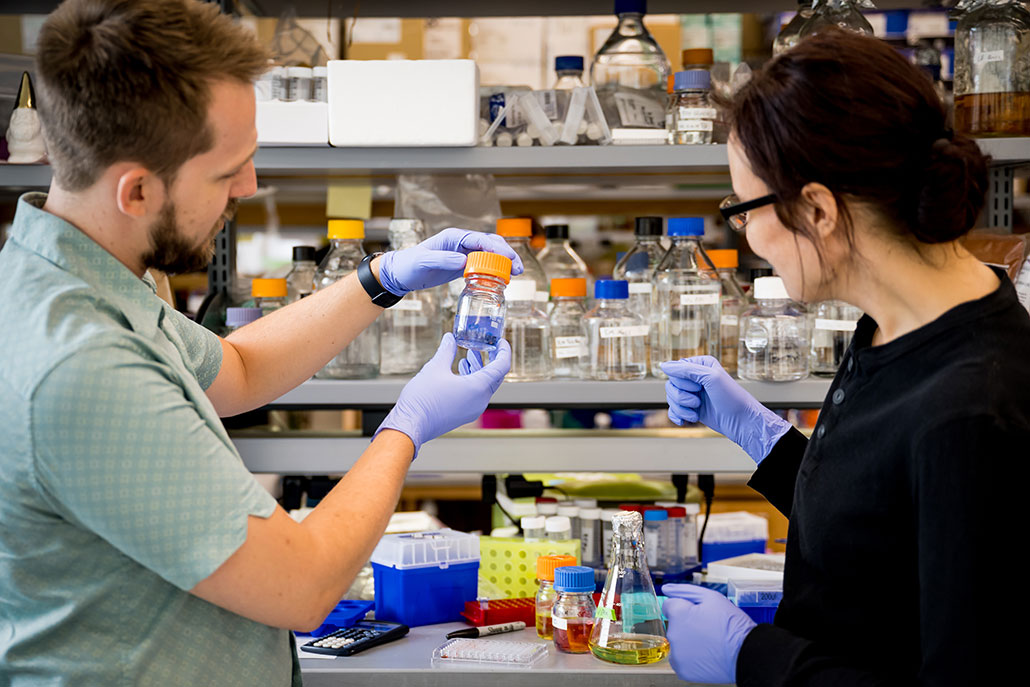 Kate Adamala (right) and her colleague Nathaniel Gaut (left) are synthetic biologists. They have worked on engineering simple versions of living cells. Understanding chiral molecules is very important for this type of work. Jackson Eddy/A Frame Forward Photography
A medical disaster
Kate Adamala (right) and her colleague Nathaniel Gaut (left) are synthetic biologists. They have worked on engineering simple versions of living cells. Understanding chiral molecules is very important for this type of work. Jackson Eddy/A Frame Forward Photography
A medical disaster
The body’s reactions to mirror-image molecules are highly important in medicine.
Medicines often work because the shape of a drug molecule fits into a shape on a target. That target may be a problematic enzyme in a person’s body or a disease-causing germ. The drug can disable the enzyme or germ — but only if it has the right shape. And one chiral form of a drug molecule may be the right shape while the other, chiral form doesn’t fit.
Making a drug with just one chiral form can be a painstaking process. To make a drug, chemists can trigger a series of chemical reactions to get substances to combine in just the right way. But most known triggers, called catalysts, are achiral. So they produce a hodge-podge mix of both left- and right-handed forms of a desired chiral molecule. The mixture is called a racemate (Ray-SEE-mayt).
Drug makers often sell a medicine as a racemate, even though only one of the chiral forms in the mixture does the job. The opposite form may do nothing at all inside the body. But in some cases, it can be harmful.
Back in 1957, women in Europe began taking the drug thalidomide for nausea during pregnancy. The drug calmed their symptoms. But it also caused many babies to be born with missing or deformed arms and legs and other serious health problems.
Research eventually revealed that only the right-handed form of the drug eased nausea. The left-handed form harmed developing babies. Plus, the right-handed form could morph inside the body to become the left-handed form. So neither form is a safe medicine for pregnant people.
Drug makers today have to test both forms of a chiral molecule to prove they are each safe. Many drugs are still racemates. But others are carefully crafted to include only the most effective chiral form of a molecule. Or drug makers can carefully filter out one chiral form from a racemate. Both processes can be slow and expensive.
Making a single chiral form “is a pain in the lower back,” says Adamala.
But “we’re getting better and better at it,” says Maloney.
Mirror lifeLab-made, or synthetic, drugs almost always form a racemate. But if the wanted substance is a biomolecule — one that forms naturally — then there’s another option. Chemists can coax living bacteria to make it.
Living things can only make one chiral form of a biomolecule. For example, they make right-handed DNA and proteins formed from left-handed amino acids. This is true of people, animals, plants and even fungi and bacteria.
And, only the natural chiral form of a biomolecule can react with the body’s chemistry. One made from ingredients that twist or bend the wrong way typically won’t interact with body systems. It’s like a stealthy ninja.
This fact is something many drug makers want to take advantage of. Drugs often fail to work well because the body recognizes them as not part of itself. The result can be a drug that fails to work because the stomach digests it. Or there could be problematic side effects because the immune system attacks it. A wrong-handed ninja molecule can reach a target in the body without being detected along the way. And biologists can carefully craft it so it can still fit onto its target. So these kinds of drugs could be safer and more effective.
But, as we learned above, single chiral forms are tough to manufacture. It can take hours to days to make a few micrograms of a mirror version of one of life’s molecules.
 MARK GARLICK/SCIENCE PHOTO LIBRARY/Getty Images
All DNA twists to the right, as depicted on the right side of this illustration. A mirrored left-handed form, as shown on the left, doesn’t exist in nature.
To speed things up, scientists once imagined creating something they call mirror life. This would be a bacterium whose DNA and amino acids all twist or branch the opposite way. It would be a new form of life that had never existed before. And it could crank out biomolecules with the opposite chiral form.
Mirror life would be sort of like something from the Upside Down in the TV show Stranger Things. It would look like a normal living thing, but its chemistry would work the opposite way. And it turns out that, just like in the show, the upside-down variety of life could be very dangerous.
A single mirror molecule that twists the wrong way can be useful. But as soon as you make mirror bacteria, they could do what life does and “make more of themselves,” Adamala says. That’s a huge problem because no life on Earth has evolved alongside such organisms. That means “nothing eats them, and nothing makes them sick,” says Adamala. So they could potentially spread out of control. (They’d be able to eat normal, non–mirror life food because bacteria can feed on very simple, achiral molecules.)
Perhaps we normal lifeforms would manage to adapt, and something would evolve to eat or kill the mirror bacteria. But what if that doesn’t happen? Adamala and a large group of other experts around the world have agreed to stop all efforts toward developing mirror life.
While it might be cool to create a new form of life, the risks are too dire. And “responsibility in science is as important as innovation,” says Adamala.
Submit your question here, and we might answer it an upcoming issue of Science News Explores
Chirality is important for more than just biology and medicine. In materials science, chirality can affect properties such as toughness or flexibility. Most plastics form from long chains of molecules. If the molecules are chiral and all line up in the same direction or in a regular pattern, this can make the material harder and tougher. But if the chiral molecules pile together randomly “like spaghetti,” says Maloney, the material will be softer.
In other cases, the molecules that make up a material may not be chiral themselves. But the way these molecules pack together forms structures that twist in a specific way. The way the structures within a material twist can give it special properties. For example, it might react with sound or light differently. Or it might conduct electricity differently.
These and other exciting possibilities inspire new efforts to make mirror molecules. A simple twist can make a world of difference in medicines, materials and more.
3-D: Short for three-dimensional. This term is an adjective for something that has features that can be described in three dimensions — height, width and length.
amino acids: Simple molecules that occur naturally in plant and animal tissues and that are the basic building blocks of proteins.
atom: The basic unit of a chemical element. Atoms are made up of a dense nucleus that contains positively charged protons and uncharged neutrons. The nucleus is orbited by a cloud of negatively charged electrons.
bacteria: (singular: bacterium) Single-celled organisms. These dwell nearly everywhere on Earth, from the bottom of the sea to inside other living organisms (such as plants and animals). Bacteria are one of the three domains of life on Earth.
bacterium: (pl. bacteria) A single-celled organism. These dwell nearly everywhere on Earth, from the bottom of the sea to inside of plants and animals.
biologist: A scientist involved in the study of living things.
biology: The study of living things. The scientists who study them are known as biologists.
catalyst: (v. catalyze) A substance that helps a chemical reaction to proceed faster. Examples include enzymes and elements such as platinum and iridium.
chemical: A substance formed from two or more atoms that unite (bond) in a fixed proportion and structure. For example, water is a chemical made when two hydrogen atoms bond to one oxygen atom. Its chemical formula is H2O. Chemical also can be an adjective to describe properties of materials that are the result of various reactions between different compounds.
chemical reaction: A process that involves the rearrangement of the molecules or structure of a substance, as opposed to a change in physical form (as from a solid to a gas).
chemistry: The field of science that deals with the composition, structure and properties of substances and how they interact. Scientists use this knowledge to study unfamiliar substances, to reproduce large quantities of useful substances or to design and create new and useful substances. (about compounds) Chemistry also is used as a term to refer to the recipe of a compound, the way it’s produced or some of its properties. People who work in this field are known as chemists.
chirality: The quality of a pattern or form that can exist as a mirror image of itself, such as a right hand or a left hand. Chirality is sometimes referred to as “handedness.” For a spiral, chirality generally describes whether the swirl travels in a clockwise or counterclockwise direction.
digest: (noun: digestion) To break down food into simple compounds that the body can absorb and use for growth. Some sewage-treatment plants harness microbes to digest — or degrade — wastes so that the breakdown products can be recycled for use elsewhere in the environment.
dire: An adjective that means grave, or hard to survive.
DNA: (short for deoxyribonucleic acid) A long, double-stranded and spiral-shaped molecule inside most living cells that carries genetic instructions. It is built on a backbone of phosphorus, oxygen, and carbon atoms. In all living things, from plants and animals to microbes, these instructions tell cells which molecules to make.
electricity: A flow of charge, usually from the movement of negatively charged particles, called electrons.
evolve: (adj. evolving) To change gradually over generations, or a long period of time. In living organisms, such an evolution usually involves random changes to genes that will then be passed along to an individual’s offspring. These can lead to new traits, such as altered coloration, new susceptibility to disease or protection from it, or different shaped features (such as legs, antennae, toes or internal organs). Nonliving things may also be described as evolving if they change over time. For instance, the miniaturization of computers is sometimes described as these devices evolving to smaller, more complex devices.
filter: (n.) Something that allows some materials to pass through but not others, based on their size or some other feature. (v.) The process of screening some things out on the basis of traits such as size, density, electric charge.
fungi: (sing: fungus) Organisms with one or more cells that reproduce via spores and feed on living or decaying organic matter. Examples include mold, yeasts and mushrooms.
germ: Any one-celled microorganism, such as a bacterium or fungal species, or a virus particle. Some germs cause disease. Others can promote the health of more complex organisms, including birds and mammals. The health effects of most germs, however, remain unknown.
glucose: A simple sugar that is an important energy source in living organisms. As an energy source moving through the bloodstream, it is known as “blood sugar.” It is half of the molecule that makes up table sugar (also known as sucrose).
immune: (adj.) Having to do with immunity. (v.) Able to ward off a particular infection. Alternatively, this term can be used to mean an organism shows no impacts from exposure to a particular poison or process. More generally, the term may signal that something cannot be hurt by a particular drug, disease or chemical.
immune system: The collection of cells and their responses that help the body fight off infections and deal with foreign substances that may provoke allergies.
isomer: (in chemistry) Two or more molecules having the same chemical formula, but with their atoms arranged slightly differently. The result are related molecules that can have very different properties. For instance, one might be beneficial and the other toxic. (in physics) Two or more nuclei of atoms with an identical atomic number and mass but different energy states.
molecule: A group of atoms that represents the smallest possible amount of a chemical compound. Molecules can be made of single types of atoms or of different types. For example, the oxygen in air is made of two bound oxygen atoms (O2). Water is made of two hydrogen atoms and one oxygen atom (H2O).
morph: Short for metamorphose, it means to change or transform from one form to another (such as from a caterpillar to a butterfly) or from one shape to another. Or it can mean to evolve or mutate, where one or more parts of the genome undergo some sort of change in their chemistry — and potentially in their function. (in non-living systems) It refers to a thing, policy or activity that has undergone change, becoming something that looks or seems new and different.
nausea: The feeling of being sick to one's stomach, as though one could vomit.
organic: (in chemistry) An adjective that indicates something is carbon-containing; also a term that relates to the basic chemicals that make up living organisms. (in agriculture) Farm products grown without the use of non-natural and potentially toxic chemicals, such as pesticides.
plastic: Any of a series of materials that are easily deformable; or synthetic materials that have been made from polymers (long strings of some building-block molecule) that tend to be lightweight, inexpensive and resistant to degradation.
protein: A compound made from one or more long chains of amino acids. Proteins are an essential part of all living organisms. They form the basis of living cells, muscle and tissues; they also do the work inside of cells. Antibodies, hemoglobin and enzymes are all examples of proteins. Medicines frequently work by latching onto proteins.
receptor: (in biology) A molecule in cells that serves as a docking station for another molecule. That second molecule can turn on some special activity by the cell.
risk: The chance or mathematical likelihood that some bad thing might happen. For instance, exposure to radiation poses a risk of cancer. Or the hazard — or peril — itself. (For instance: Among cancer risks that the people faced were radiation and drinking water tainted with arsenic.)
symptom: A physical or mental indicator generally regarded to be characteristic of a disease. Sometimes a single symptom — especially a general one, such as fever or pain — can be a sign of any of many different types of injury or disease.
synthetic: An adjective that describes something that did not arise naturally, but was instead created by people. Many synthetic materials have been developed to stand in for natural materials, such as synthetic rubber, synthetic diamond or a synthetic hormone. Some may even have a chemical makeup and structure identical to the original.
system: A network of parts that together work to achieve some function. For instance, the blood, vessels and heart are primary components of the human body's circulatory system. Similarly, trains, platforms, tracks, roadway signals and overpasses are among the potential components of a nation's railway system. System can even be applied to the processes or ideas that are part of some method or ordered set of procedures for getting a task done.
Kathryn Hulick is a freelance science writer and the author of Strange But True: 10 of the World's Greatest Mysteries Explained, a book about the science of ghosts, aliens and more. She loves hiking, gardening and robots.
| # | Наименование новости | Тональность | Информативность | Дата публикации |
|---|---|---|---|---|
| 1 | Synchronized infrared lasers control molecular shape changes and expose hidden fingerprints | 5 | 8 | 02-07-2026 |
| 2 | Scientists find molecular-level evidence for two structures in liquid water | 0 | 8 | 25-06-2026 |
| 3 | Ultrafast X-rays allow researchers to 'watch' how molecules rearrange during a chemical reaction controlled by light | 5 | 7 | 24-06-2026 |
| 4 | Why Astigmatism Makes the World Look Blurry | 0 | 23.74 | 27-07-2026 |
| 5 | Explainer: What are ultraprocessed foods? | 0 | 7.59 | 15-04-2026 |
| 6 | Что такое разное зрение на глазах? Разное зрение на глазах ... | 0 | 7 | 29-06-2026 |
| 7 | Metal hydride molecule trapped with laser light opens path to ultracold hydrogen | 0 | 7 | 26-06-2026 |
| 8 | Disorder creates direction-dependent optics in compound semiconductors | 0 | 7 | 29-06-2026 |
| 9 | Programmable metasurface generates dozens of holograms at once | 0 | 7 | 06-07-2026 |