Between 20–22 June, the coastal regions of the countries bordering the Gulf of Guinea, particularly Côte d’Ivoire, Ghana, Togo, and Nigeria, experienced exceptionally widespread and severe flooding following intense and persistent rainfall. In several locations, more than 140 mm of rain fell within less than 24 hours, overwhelming natural drainage systems and triggering extensive flash floods.
The event was part of a longer period of heavy rainfall that has affected West Africa for weeks, stretching from Côte d’Ivoire to Nigeria, displacing hundreds of people and causing widespread damage (The Economist, 2026). The rainfall at the end of June led to a series of deadly flash floods across the region from Lagos to Monrovia, submerging vehicles and washing away markets. At least 34 people died in Ghana, where June rainfall reached its highest level since 1995, while five fatalities were reported in Togo (The Economist, 2026). The rainy season, which is expected to continue for several more weeks, raises concerns that further severe weather and flooding may occur (The World, 2026). In Côte d’Ivoire, flooding has claimed 59 lives since May but the death toll could increase as search and rescue operations continue during the rainy season, which lasts from May through July and heavy rainfall could continue throughout July (The Guardian, 2026).
To assess to what extent human-induced climate change altered the likelihood and intensity of the heavy precipitation leading to the severe flooding, researchers from Côte d’Ivoire, Ghana, Kenya, the Netherlands, Sweden, the United States and the UK undertook an attribution study on the 3-day event of the heaviest rainfall in the most impacted region (red box in figure 1).
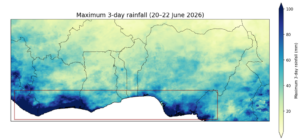
Fig. 1: Accumulated rainfall over the gulf of Guinea Coast 20-22 June 2026 in TAMSAT.
Main Findings
- The floods affected a very densely populated region where rapid urbanisation and the expansion of formal and informal settlements into floodplains and conversion of natural vegetation to croplands have reduced natural drainage capacity and increased exposure to flooding. Population growth is projected to continue its upward trajectory in this region, further increasing exposure in the decades to come.
- The flood impacts extend far beyond the areas directly inundated. Disruptions to infrastructure, livelihoods, and agriculture can worsen food insecurity, and contaminated water and damaged sanitation and hygiene systems increase the risk of water-borne diseases in the coming week and months, particularly for children and people with pre-existing health conditions. This year’s flooding is part of a pattern of similar floods that periodically occur in this region, eroding people’s assets and ability to recover.
- The event is not rare in today’s climate, which is 1.4°C warmer than it would have been at the beginning of the industrial period. A 3-day rainfall event of this magnitude is now expected to occur about once every 2-4 years in the study region.
- To assess if human-induced climate change influenced the heavy rainfall in the study region, we first determine if there is a trend in the observations. Results showed that observed 3-day rainfall has increased in intensity by about 23% over the study region since records began. Equivalently, an event like this is about five times more likely to occur today than it would have in a 1.4°C cooler climate. However uncertainties around these numbers are high and depend on which datasets are used.
- To quantify the role of human-induced climate change we also analyse climate models over the relatively small study region. Overall, the available climate models indicate only a very small increase in the likelihood of an event such as the one under study with about 4% increase in intensity. While the majority of the models show a trend toward more extreme precipitation events, they systematically underestimate the observed increase. While most models show an increase in 3-day rainfall, supporting the conclusion that the observed increase is attributable, confidence in the estimated magnitude of the attributed change is constrained by the models’ limited performance and by the fact that none were developed or calibrated specifically for the African continent. Consequently, combining model- and observation-based estimates to derive a single quantitative attribution result is not meaningful.
- Under a future warming scenario where the global temperature is 2.8°C higher than pre-industrial levels, climate models suggest that even wetter 3-day periods should be expected. Given that these events are not rare today, this means they will be common occurrences, and the region needs to prepare for much heavier events than those observed in 2026.
- Research has shown that sea level rise along the Gulf of Guinea coast has exceeded the global average, compounding the impacts of increasingly intense rainfall. Together, these changes are thus driving greater flood risk along the Gulf of Guinea than would result from rainfall intensification alone, increasing risks to densely populated cities and critical infrastructure.
- Floods and associated impacts will continue to occur unless significant efforts are made to reduce vulnerability and exposure to the floods. While the dominant form of flood adaptation in the region is physical infrastructure, a range of solutions is needed to address the impacts to infrastructure, health, economic losses, and displacement that results from these floods. These can include increasing access to safe and affordable housing, improving drainage and sanitation systems, enforcing policies on safer construction, improving early warning dissemination, and greater participation of affected communities in planning.
 Спутники
 РН
РН SpaceX
 Роскосмос
 NASA
NASA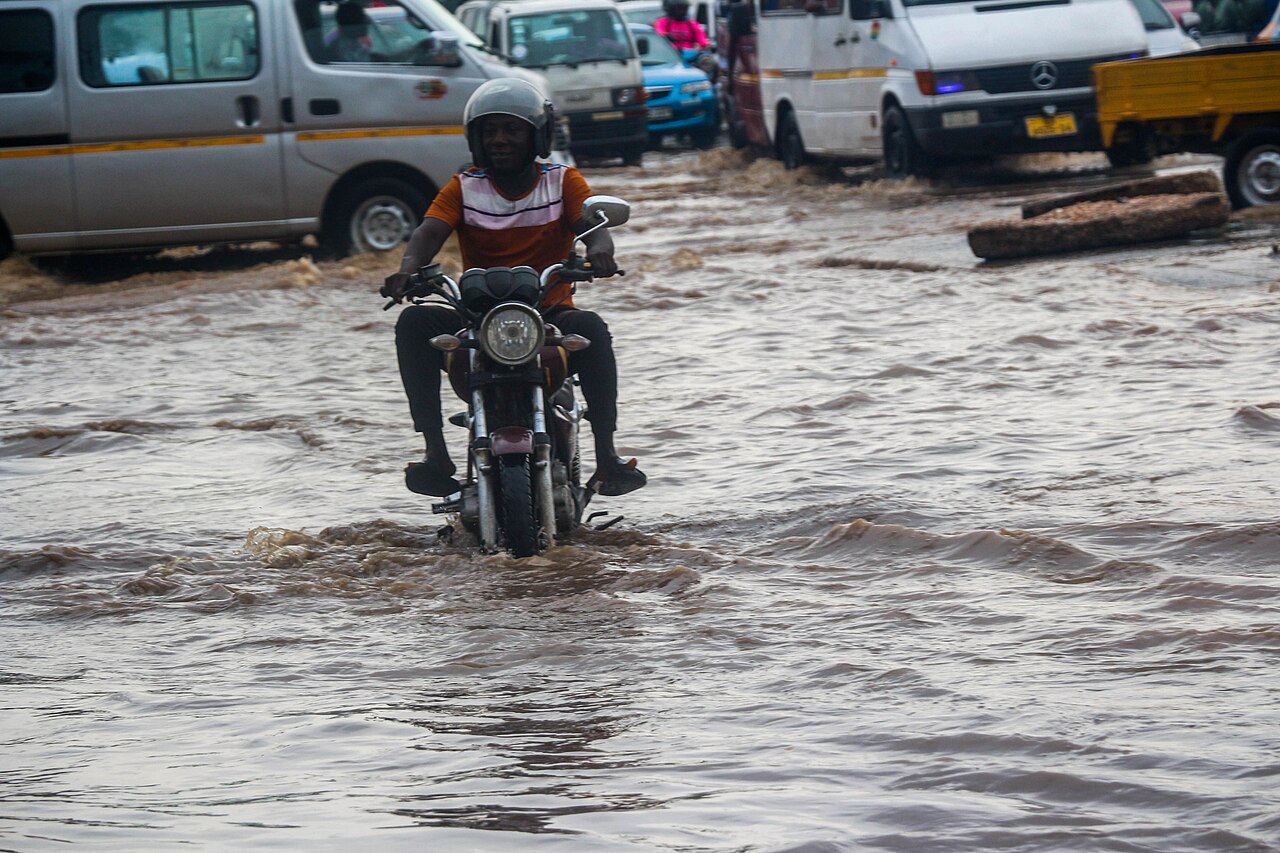 Flooding in Accra in 2023. Image: Fquasie, License: https://creativecommons.org/licenses/by-sa/4.0/