Просмотр новости
Найдите то, что Вас интересует
 Спутники
 РН
РН SpaceX
 Роскосмос
 NASA
NASA
СпутникиРНSpaceXРоскосмосNASAExecutive Summary The telecommunications industry’s transition to AI is often stalled by the complexities of infrastructure plumbing. Essedum, a new open source candidate project under LF Networking, solves this by...
The post The Future of Telecom AI is Here: Unlocking Value and Escaping the “Plumbing” Trap with Essedum appeared first on LF Networking.
Executive Summary
The telecommunications industry’s transition to AI is often stalled by the complexities of infrastructure plumbing. Essedum, a new open source candidate project under LF Networking, solves this by offering a converged, enterprise-grade AI platform. By unifying data pipelines, model management, and agent orchestration, Essedum empowers telecom operators to focus on building intelligent networking applications (like automated 5G slice qualification) rather than managing fragmented toolchains.
Solving the Plumbing Problem
The telecommunications and networking industry is racing to adopt AI, but scaling these initiatives from proof-of-concept to production is notoriously complex. All too often, development teams find themselves trapped in the “plumbing” phase; stitching together fragmented tools and managing infrastructure instead of focusing on actual value creation and accelerated use case development.
Enter Essedum, a candidate project under LF Networking dedicated to accelerating the integration of AI data, models, and applications for the networking industry. Essedum solves the fragmentation crisis by providing a converged, comprehensive framework that unifies data pipelines, machine learning model lifecycle management, and AI agent development into a single, extensible ecosystem.
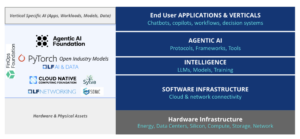
Built for the Enterprise: Security, Compliance, and Governance.
In the telecom sector, agility cannot come at the expense of security or compliance. Essedum brings enterprise readiness to AI platforms with a profound emphasis on security and tailored governance from day one. The platform features an integrated Responsible AI Toolkit (incorporating open source tools like those offered by Project Salus) that establishes guardrails, ensures adherence to strict ethical guidelines, and offers robust governance features for transparency, fairness, and accountability. By offloading the heavy lifting of platform orchestration, Essedum empowers telco developers to finally shift their focus from underlying plumbing to building next-generation applications.
From Theory to Reality: AI-Assisted 5G Network Slicing.
To truly understand the power of Essedum, let’s look at a practical, high-stakes scenario: 5G network slicing. Imagine a telecom operator rolling out on-demand, ultra-reliable low-latency (URLLC) slices tailored for critical use cases like industrial robotics. Before the operator accepts a customer order, they need a simple AI-assisted slice feasibility check to determine if the current RAN and core capacity, combined with the predicted load, can actually accommodate the new URLLC slice.
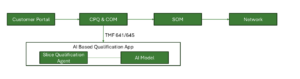
With Essedum, this process is transformed into an automated workflow. The platform acts as the central orchestration layer, effortlessly orchestrating three distinct layers to deliver a real-time qualification decision:
Under the Hood: An Open, Poly-Cloud Architecture Built for the Enterprise.
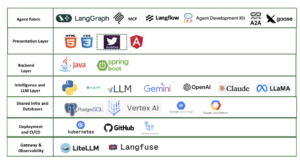
To enable these complex use cases without vendor lock-in, Essedum relies on an open, extensible architecture. Under the hood, Essedum is a highly modular, microservices-based framework featuring a Java Spring Boot backend and an Angular frontend, utilizing REST APIs to connect to a vast array of services.
Rather than reinventing the wheel, the platform embraces the industry’s most popular open-source AI frameworks. It natively integrates Langflow as its UI-based Agent Designer, LiteLLM for centralized LLM access with carefully controlled routing, and Langfuse for comprehensive model monitoring and observability. Furthermore, Essedum provides built-in support for the Model Context Protocol (MCP) and Agent-to-Agent (A2A) communications.
In the telecom space, data doesn’t live in just one place. Essedum is built on a “Poly Cloud Infrastructure,” meaning it supports execution containers across AWS SageMaker and GCP Vertex AI. It provides ready-to-use libraries to consume data from distributed enterprise sources like PostgreSQL, Amazon S3, and Azure Blob Storage. Ultimately, this architecture ensures that large enterprise teams can share data and orchestrate AI securely without being tethered to a single provider.
Join the Movement: Shape the Open Standard for Telecom AI
The transition to an AI-native telecom industry cannot happen in isolated silos. Built on seed code from LFN member organization Infosys, Essedum represents a unique opportunity to unify fragmented efforts.
A Catalyst for the Broader LF Networking and LF AI & Data Vision
Essedum does not exist in a vacuum; it is a critical pillar within the broader Linux Foundation ecosystem, bridging the gap between LF Networking (LFN) and the LF AI & Data Foundation‘s mission to drive open-source innovation. As outlined in the recent LFN whitepaper Architecting Autonomy: The Convergence of Agentic AI and Open Source Networking, the telecom industry is undergoing a fundamental shift toward agent-centric operations. Essedum is explicitly architected to lead this charge as a Networking Agentic AI Framework.
The platform directly supports the industry’s dual mandate: delivering “AI for Networks” (using intelligent agents for capacity planning, fault isolation, and automated assurance) and “Networks for AI” (optimizing high-bandwidth, low-latency fabric paths to support distributed AI workloads). To achieve this without fragmentation, Essedum aligns its models, APIs, and orchestration logic with the newly established Agentic AI Foundation (AAIF). By natively adopting standards like the Model Context Protocol (MCP), Essedum creates a unified architectural language between AI inference layers and network control layers.
Ultimately, this positions Essedum alongside other core LF projects—such as Project Sylva, Nephio, ONAP, and CAMARA—to embed agentic capabilities consistently across the entire open networking stack. By converging these efforts, Essedum ensures that telecommunications operators can move beyond isolated machine learning experiments and realize a truly autonomous, self-managing, and AI-native network.
The Road Ahead: Essedum’s Open Source Development Roadmap
A thriving open-source platform is defined by its continuous evolution. Essedum is actively charting its future through transparent, community-driven development on GitHub. The project’s roadmap is heavily focused on expanding enterprise readiness, enhancing the developer experience, and deepening telecom-specific capabilities.
Here is a look at the strategic themes coming next to the Essedum platform:
By joining hands and contributing to the Essedum project, you are directly accelerating the integration of AI data, models, and applications for the entire networking industry. Together, we can take a massive leap toward a smarter, fully automated, and AI-powered networking future.
| # | Наименование новости | Тональность | Информативность | Дата публикации |
|---|---|---|---|---|
| 1 | LF Networking Expands Portfolio with New StratoWeave Project, Contributed by Deutsche Telekom, to Advance Open, AI-Native Transport Network Automation | 0 | 12.53 | 08-07-2026 |
| 2 | Why Speak at ONE Summit 2026, and How to Build a Proposal That Reviewers Actually Want | 0 | 8.65 | 10-08-2026 |
| 3 | From Packets to Insight: How Curated Network Data Powers AI | 0 | 12.04 | 21-04-2026 |
| 4 | Does Agentic AI Networking Need Its Own Playbook? | 0 | 10 | 06-08-2026 |
| 5 | All That Glitters Isn’t Gold: Why AI Needs Better Data | 0 | 9.56 | 07-07-2026 |
| 6 | The Future of Telecom Operations Is Powered by Autonomy at Scale | 0 | 14.24 | 29-07-2026 |
| 7 | Lumentum Puts The Insane Opportunity for Companies like Marvell and Ciena Into Focus With One Stunning Quote | 0 | 7.28 | 13-08-2026 |
| 8 | Introducing StratoWeave: Building a More Declarative Approach to Network Automation | 0 | 7.4 | 13-07-2026 |
| 9 | 中国移动发起,业内首个 AI-eSIM 产业协同平台成立 | 5 | 7 | 04-07-2026 |
| 10 | Soracom announces commercial release of SGP.32-compatible IoT eSIMs | 0 | 12.61 | 09-07-2026 |