Просмотр новости
Найдите то, что Вас интересует
 Спутники
 РН
РН SpaceX
 Роскосмос
 NASA
NASA
СпутникиРНSpaceXРоскосмосNASAIn images of the early cosmos, astronomers found little red dots scattered across the universe. Now they've figured out what these are: young black holes.
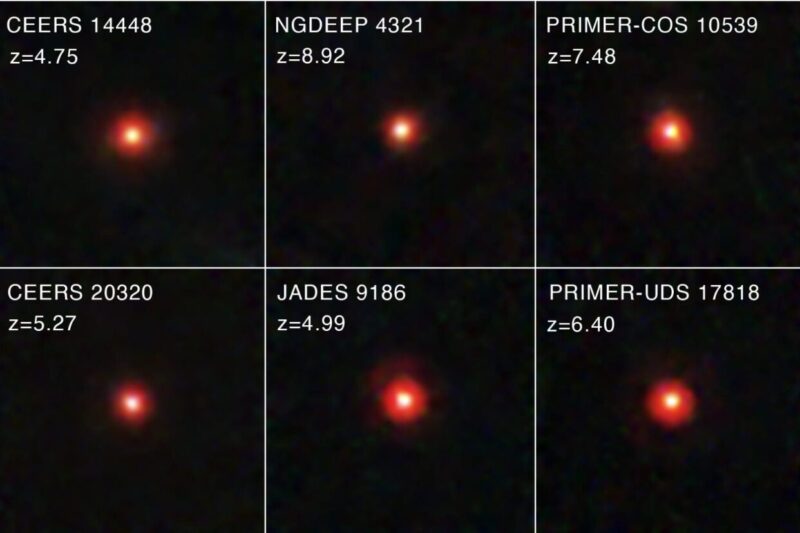 Little red dots from the James Webb Space Telescope. Photo: NASA, ESA, CSA, STScI, Dale Kocevski
When the James Webb Space Telescope sent back its first images of the cosmos, astronomers were stunned to find tiny red points scattered across the early universe. Since 2022, astronomers have been trying to determine what these so-called “little red dots” (LRDs) are. They’ve finally figured it out: LRDs are young black holes.
Some researchers suggested that the dots might be very early galaxies because they emitted light. But galaxy formation appears to be a very slow process. The LRDs appear only a few hundred million years after the Big Bang and then disappear a billion years later. The galaxies wouldn’t have had time to grow large and bright enough to be easily visible. Furthermore, their deep red color doesn’t match the expected emissions from starlight alone.
Over the last two years, astronomers from the Niels Bohr Institute’s Cosmic Dawn Center in Copenhagen analyzed the dots using spectroscopy. They found that 70% of them show evidence of rapidly orbiting gas.
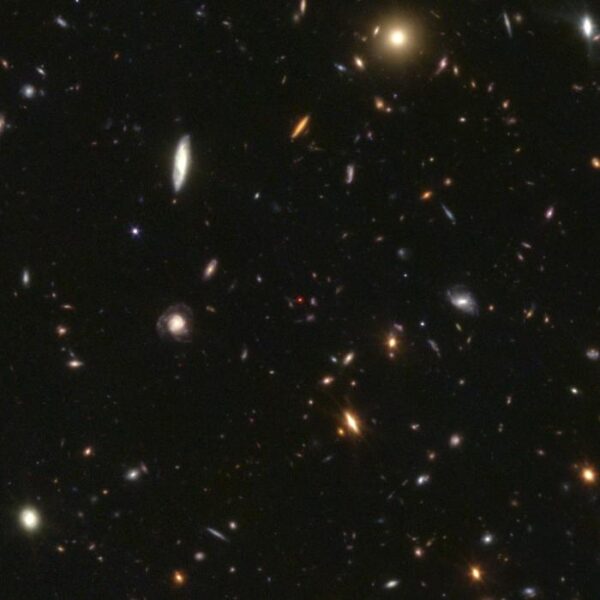
Little red dots appear in multiple JWST images. Photo: Darach Watson/JWST
Dense clouds of gas surround the dots, and as gas spirals into the LRDs, it heats up and releases energy, producing bright light that the JWST detects as red.
“The little red dots are young black holes, a hundred times less massive than previously believed, enshrouded in a cocoon of gas, which they are consuming to grow larger,” says co-author of the new study, Darach Watson. “This process generates enormous heat, which shines through the cocoon. This radiation…gives little red dots their unique red color.”
Watson continued in a statement:
When gas falls toward a black hole, it spirals down into a kind of disk or funnel toward the surface. It ends up going so fast and is squeezed so densely that it generates temperatures of millions of degrees and lights up brightly. But only a very small amount of the gas is swallowed by the black hole. Most of the gas is blown back out from the poles as the black hole rotates. That’s why we call black holes messy eaters.
Though these black holes are much smaller than the supermassive giants found in the center of mature galaxies, they still have a mass that is ten million times larger than our Sun.