Просмотр новости
Найдите то, что Вас интересует
 Спутники
 РН
РН SpaceX
 Роскосмос
 NASA
NASA
СпутникиРНSpaceXРоскосмосNASABloombergNEF’s (BNEF) annual Electric Vehicle Outlook (EVO) expects over a quarter (27%) of cars sold globally in 2026 to be electric – up from 9% five years ago – and over half (52%) of all passenger vehicles to be electric by 2035. The continued rise in sales comes as lithium-ion battery prices fall, more affordable EV models are introduced and EV adoption in emerging markets surges. In addition, the Iran war and resulting increase in prices at the pump have boosted consumer interest in buying an EV, although it is…
The post BloombergNEF’s Electric Vehicle Outlook 2026: Global EV Sales Set For Another Record-Breaking Year, But Growth in Some Major Markets Slows first appeared on Ethical Marketing News.

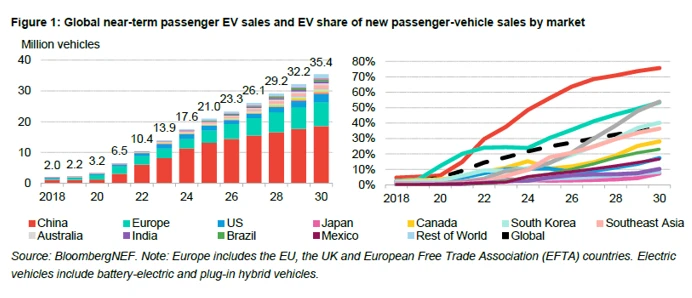
BloombergNEF’s (BNEF) annual Electric Vehicle Outlook (EVO) expects over a quarter (27%) of cars sold globally in 2026 to be electric – up from 9% five years ago – and over half (52%) of all passenger vehicles to be electric by 2035.
The continued rise in sales comes as lithium-ion battery prices fall, more affordable EV models are introduced and EV adoption in emerging markets surges. In addition, the Iran war and resulting increase in prices at the pump have boosted consumer interest in buying an EV, although it is still too early to draw a clear connection with higher EV sales over the near-term.
China continues to account for the largest share of the global EV market, both in terms of market share of global EV sales and its domestic EV sales which now make up almost two thirds (64%) of total domestic car sales.
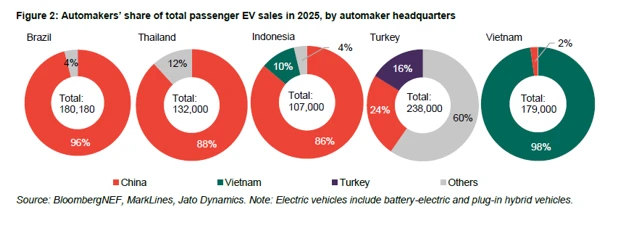
Focus is also turning to emerging EV markets where the demand for EVs is surging and where adoption now often exceeds that of the US. Nearly half of all cars sold in Singapore in 2025 were electric, followed by Vietnam at 39% and Thailand at 27%. In just one year, passenger EV sales in Turkey more than doubled, with 22% of all cars sold in the country being electric. Drive towards oil imports independence, relative openness to Chinese automakers, as well as EV-centric industrial policies, are behind this growth.
In Singapore and Thailand, EV models from Chinese brands have driven adoption, with Chinese brands making up 88% of all EVs sold in Thailand in 2025. Similar – or higher – EV penetration rates without Chinese automakers are possible. Vietnam, for instance, saw EV sales almost double to 179,000 in 2025, with domestic automaker VinFast accounting for 98% of the total. Similarly, in Turkey, domestic manufacturer Togg was the market’s second-largest EV brand in 2025, after BYD.
The growing proliferation of EVs in road transport has a deep impact on the trajectory for global oil consumption, with total road fuel demand expected to peak in 2029. Under the Economic Transition Scenario (ETS), the combined impact of fleet electrification and fuel efficiency improvements avoids 25.8m b/d of road fuel demand by 2040, four times larger than the oil displacement across aviation, marine and petrochemicals sectors combined.
Despite the positive global sales picture, BNEF has reduced its long-term and short-term passenger EV adoption outlook for the second year in a row. The downgraded outlook is largely due to a slowdown in sales in two major markets: China and the US. In China, tightening of the eligibility requirements behind EV incentives and the increasingly competitive and mature EV market are the key drivers behind the slowdown. In the US, where sales are set to fall 19% this year, it has been the full withdrawal of federal regulatory support for electrification, including the rollback of national fuel-economy targets and the scale back of the Inflation Reduction Act. The significant slowdown in US EV sales means only 24% of the country’s fleet is electric by 2040.
What is more, affordability remains a key factor in the rate of EV adoption globally. In the major European markets of Germany, Italy and the UK, battery electric vehicles (BEVs) are still 17% more expensive than competing ICE cars. That said, the BEV price premium over ICE dropped from the average 34% in 2024.
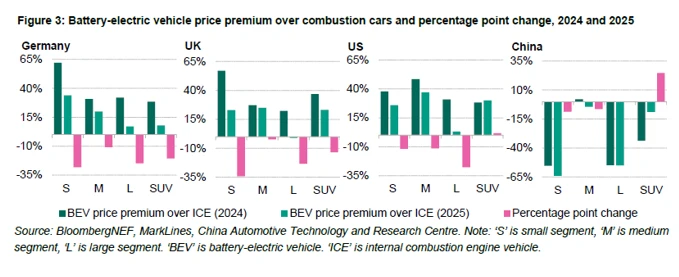
Batteries remain the main cost component of EVs and in many markets remain too expensive for BEVs to match combustion cars on price. While the push for battery supply chain localization is accelerating globally, matching China’s battery manufacturing costs remains a challenge. China continues to benefit from a mature manufacturing supply chain, lower input costs, favorable financing conditions and intense competition, resulting in the world’s lowest EV battery prices. Differences in manufacturing scale and supply-chain integration with regions like North America and Europe mean higher prices are likely to persist.
Aleksandra O’Donovan, Head of Electric Vehicles at BloombergNEF, said: “While EV adoption continues to advance globally, the pace of the transition is becoming increasingly uneven across markets, driven largely by policy changes in the US and a maturing market in China. In spite of the unevenness, it is encouraging to see that the longer-term trend towards electrification remains intact, driven by improving vehicle economics, falling battery costs and rapid adoption across emerging markets.”
Despite rapid increase in EV sales, it is not until 2047 when electric passenger vehicles on the road outnumber ICE vehicles. Across all vehicle segments there are still over 1 billion tailpipe-emitting passenger cars on the road by 2040, while over 80%, 52%, 48% and 42% of the total fleets of trucks, vans, two-wheelers and buses, respectively, are still combustion engine vehicles by then.
Andrew Grant, Head of Intelligent Mobility at BloombergNEF, said: “Slow fleet replacement rates in many markets mean that there are still a lot of combustion vehicles on the global road in the long-term, creating a headache for policymakers aiming for net-zero transport. That said, even meeting the demands of the electric vehicles that our outlook sees on the road creates plentiful opportunities, including roughly $2.2 trillion in spending per year on vehicles alone by 2035, and another $524 billion in investment in the required charging infrastructure between now and 2035.”
Other key findings from the Electric Vehicle Outlook 2026 include:
BloombergNEF clients can find the full report and full data viewer on bnef.com and the Bloomberg terminal.