Просмотр новости
Найдите то, что Вас интересует
 Спутники
 РН
РН SpaceX
 Роскосмос
 NASA
NASA
СпутникиРНSpaceXРоскосмосNASAWeather data have helped estimate the density of flying insects in U.S. skies. That could help track climate change’s impact on insects.
Mayflies mate in mid-air. Monarch butterflies make cross-continental flights. And dragonflies hunt as they soar. But despite how much insect activity happens in the air, scientists haven’t had a clear sense of insects’ abundance there. Now a team has found a way to estimate the density of insects in airspace using weather radar data. The approach could provide new clues about climate change’s impact on insects.
“Using radar to look at insects is a great moment to wonder about the rich animal life that is above our heads,” says Elske Tielens. An aero-ecologist, she studies interactions between organisms in the air. She works at the Swiss Federal Institute for Forest, Snow and Landscape Research in Zurich.
Scientists have long spied on tiny objects in the air using radar. Radar stations across the contiguous United States surveil the air for water drops, snow and hail. “But using it for insects, somehow, is something that we haven’t thought too much about,” Tielens says.
Radar sends out radio waves and analyzes the waves that bounce back. The technique can distinguish some types of particles based on certain properties, such as shape. Rain, for instance, is usually spherical. Insects tend to be rounded but longer in one dimension. These differences let meteorologists filter animals out of the data, Tielens says. Her team flipped that approach to remove rain.
The team used 10 years of weather radar data from almost 140 sites across the United States. That gave the researchers daily estimates of insect density in the air. “It’s the biggest time series data set that we have for insects in the U.S.,” Tielens says. The team found that U.S. skies host around 100 trillion flying insects on a typical summer day.
This new approach could also provide hints about overall insect abundance, Tielens says. Researchers have noticed dwindling numbers of insects at certain locations. That’s led some to worry about an insect apocalypse — the idea that insects everywhere could be faltering. But there hasn’t been enough data over a long time or large area to test the idea.
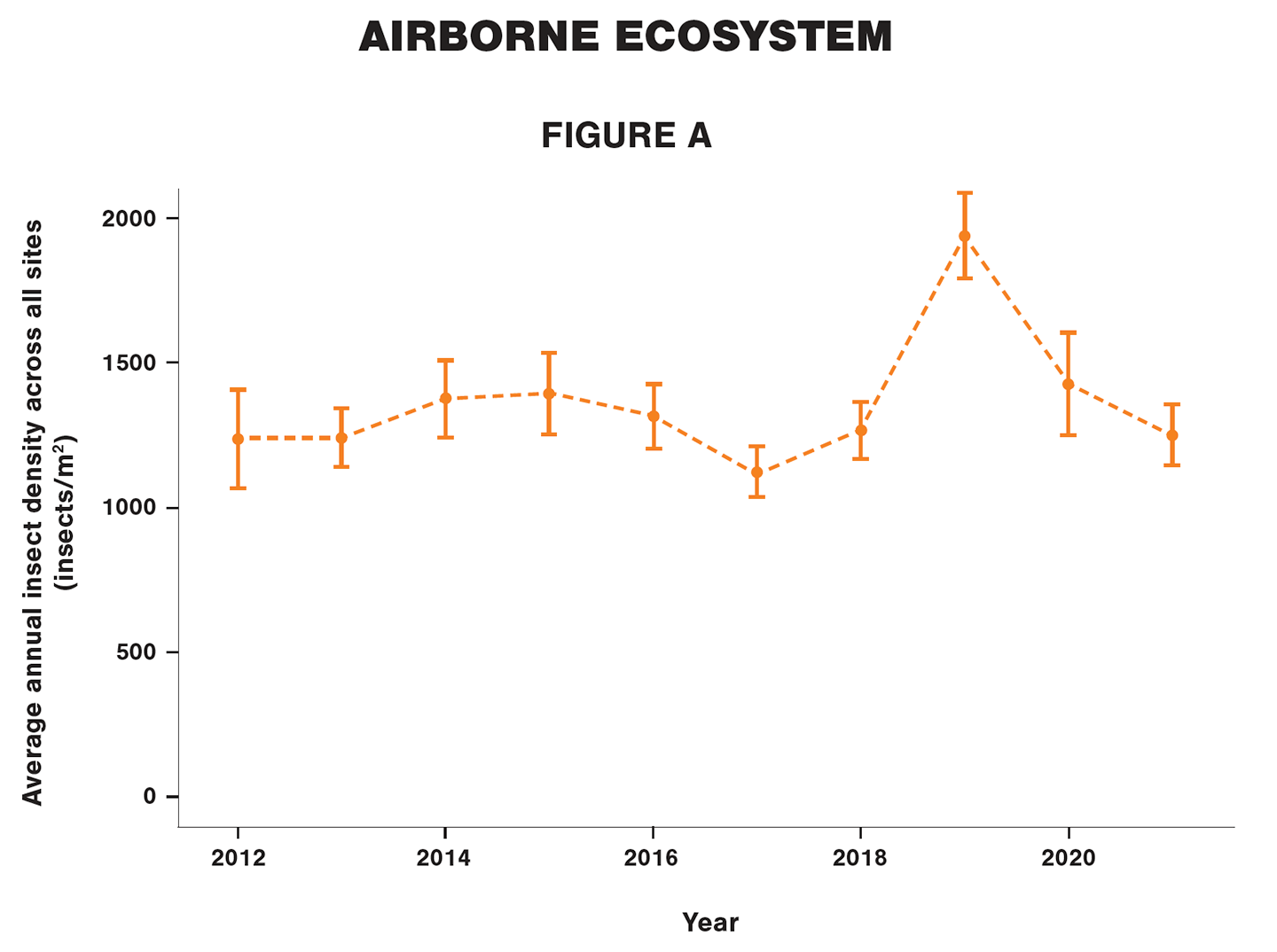
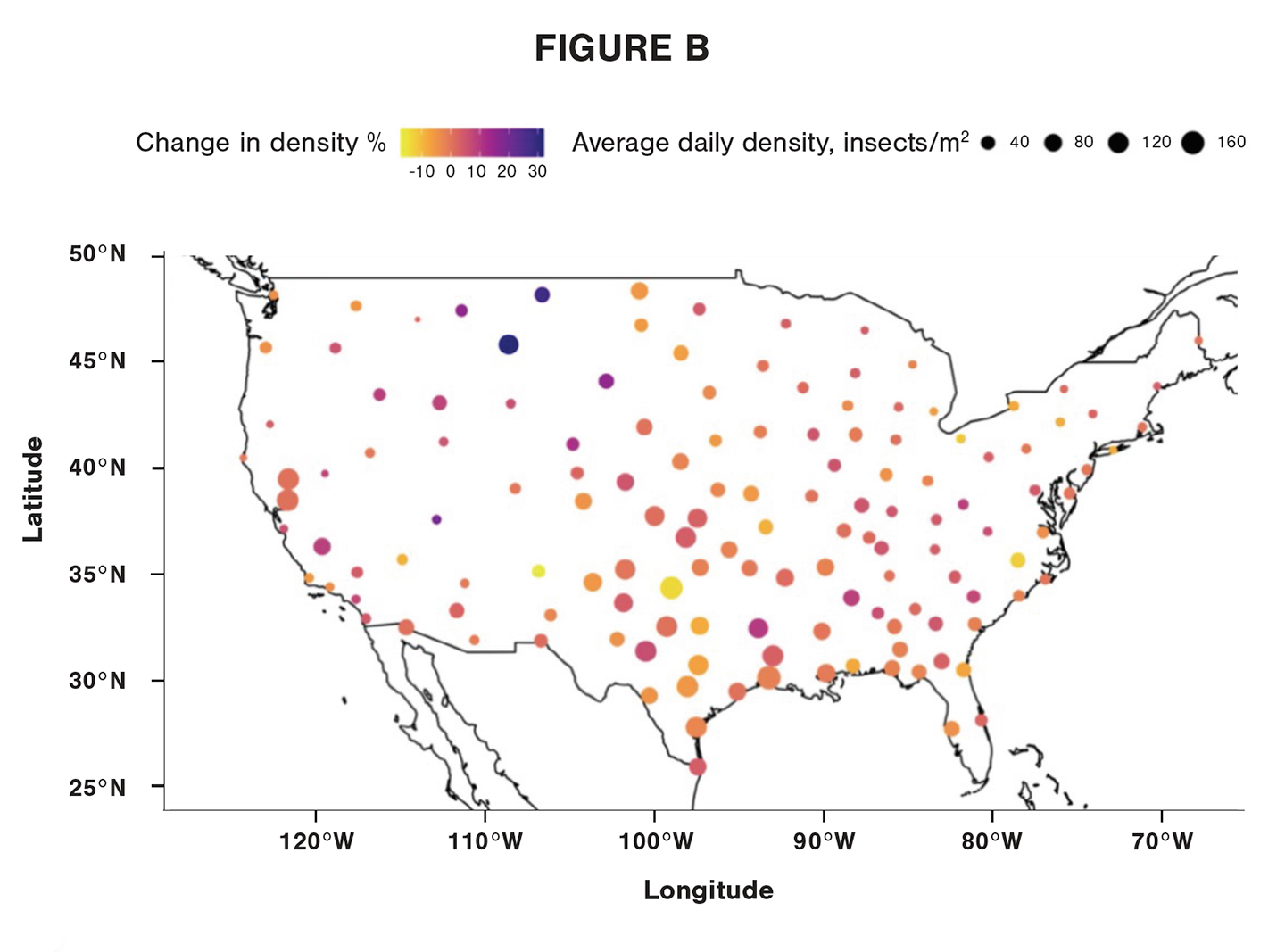
The team didn’t observe an overall decline in insect density over the United States from 2012 to 2021. At some sites insect density increased, while at others it decreased. The scientists shared their results in November 2025 in Global Change Biology.
Places with warming winters tended to see decreases in insect density. So did areas that had more buildings and roads. Other scientists could use the new study’s information to investigate local trends. Tielens plans to work with European countries to collect data on insect trends there.
This work shows how data gathered for one purpose can help answer other questions, Tielens says. “It turns out you can use [radar] in many more ways than that you expected.” Other data sets, too, might hold opportunities for creative reuse.
Researchers studied insect abundance using weather radar data. At each of nearly 140 sites, scientists used a radar scan taken at noon every day of the year. They removed the rain, snow and hail from these weather scans. That allowed them to see the density of insects above each site each day. Then they added up all the scans from one site for a whole year. That let them see the annual insect density at every site. They averaged these values across all the sites and plotted that average every year from 2012 to 2021 (Figure A).
They also studied the average density of insects at each site over the 10-year period (size of dots in Figure B) and the change in density during that time (color of dot).
 both: E.K. Tielens, P.M. Stepanian and J.F. Kelly/Global Change Biology 2025
average: (in science) A term for the arithmetic mean, which is the sum of a group of numbers that is then divided by the size of the group.
biology: The study of living things. The scientists who study them are known as biologists.
climate change: Long-term, significant change in the climate of Earth. It can happen naturally or in response to human activities, including the burning of fossil fuels and clearing of forests.
data: Facts and/or statistics collected together for analysis but not necessarily organized in a way that gives them meaning. For digital information (the type stored by computers), those data typically are numbers stored in a binary code, portrayed as strings of zeros and ones.
density: The measure of how condensed some object is, found by dividing its mass by its volume.
dimension: Descriptive features of something that can be measured, such as length, width or time.
factor: Something that plays a role in a particular condition or event; a contributor.
federal: Of or related to a country’s national government (not to any state or local government within that nation). For instance, the National Science Foundation and National Institutes of Health are both agencies of the U.S. federal government.
filter: (v.) The process of screening some things out on the basis of traits such as size, density, electric charge.
forest: An area of land covered mostly with trees and other woody plants.
information: (as opposed to data) Facts provided or trends learned about something or someone, often as a result of studying data.
insect: A type of arthropod that as an adult will have six segmented legs and three body parts: a head, thorax and abdomen. There are hundreds of thousands of insects, which include bees, beetles, flies and moths.
meteorologist: Someone who studies weather and climate events.
organism: Any living thing, from elephants and plants to bacteria and other types of single-celled life.
particle: A minute amount of something.
population: (in biology) A group of individuals (belonging to the same species) that lives in a given area.
radar: A system for calculating the position, distance or other important characteristic of a distant object. It works by sending out periodic radio waves that bounce off of the object and then measuring how long it takes that bounced signal to return. Radar can detect moving objects, like airplanes. It also can be used to map the shape of land — even land covered by ice.
radio: Referring to radio waves, or the device that receives these transmissions. Radio waves are a part of the electromagnetic spectrum that people often use for long-distance communication. Longer than the waves of visible light, radio waves are used to transmit radio and television signals. They also are used in radar. Many astronomical objects also radiate some of their energy as radio waves.
radio waves: Waves in a part of the electromagnetic spectrum. They are a type that people now use for long-distance communication. Longer than the waves of visible light, radio waves are used to transmit radio and television signals. They also are used in radar.
spherical: Adjective for something that is round (as a sphere).
trillion: A number representing a million million — or 1,000,000,000,000 — of something.
wave: A disturbance or variation that travels through space and matter in a regular, oscillating fashion.
weather: Conditions in the atmosphere at a localized place and a particular time. It is usually described in terms of particular features, such as air pressure, humidity, moisture, any precipitation (rain, snow or ice), temperature and wind speed. Weather constitutes the actual conditions that occur at any time and place. It’s different from climate, which is a description of the conditions that tend to occur in some general region during a particular month or season.
Carolyn Wilke is a former staff writer at Science News Explores. She has a Ph.D. in environmental engineering. Carolyn enjoys writing about chemistry, microbes and the environment. She also loves playing with her cat.