Просмотр новости
Найдите то, что Вас интересует
 Спутники
 РН
РН SpaceX
 Роскосмос
 NASA
NASA
СпутникиРНSpaceXРоскосмосNASACommissioned in May 2015, the Edmonton Rail Terminal is one of the largest crude oil loading facilities in North America. It will accommodate up to three unit trains per day comprised of 150 railcars each. The facility is capable of loading 76 individual railcars at one time, achieving an ultimate capacity of approximately 250,000 barrels ... Read more
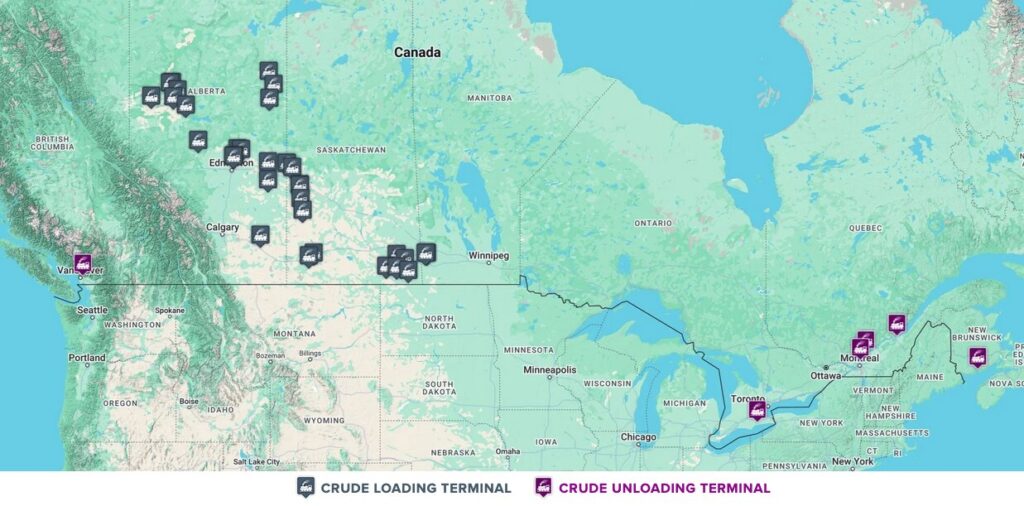
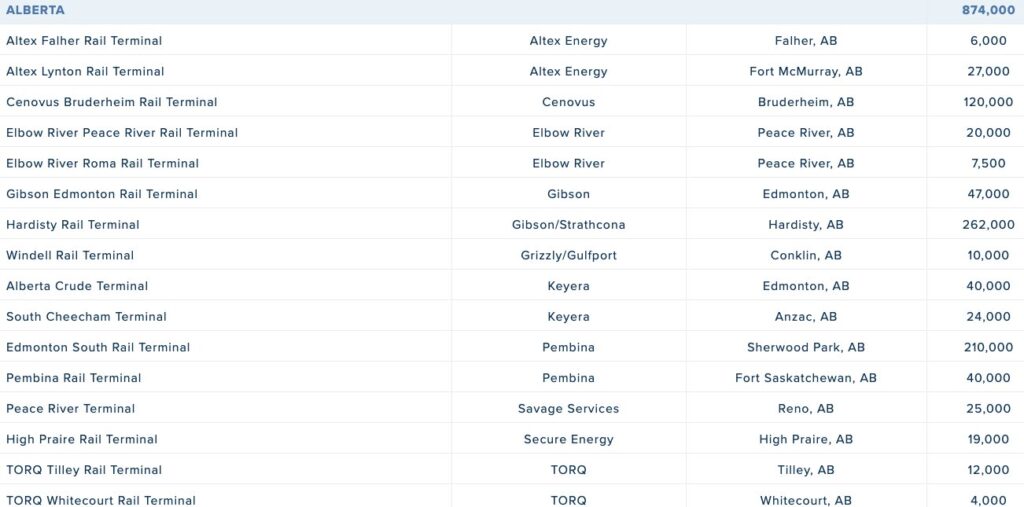
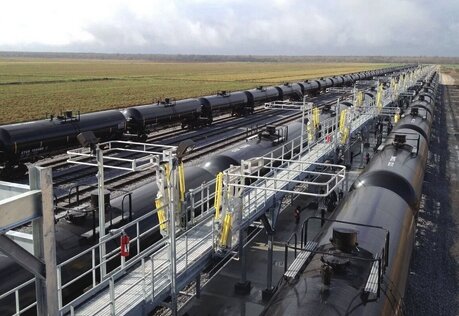
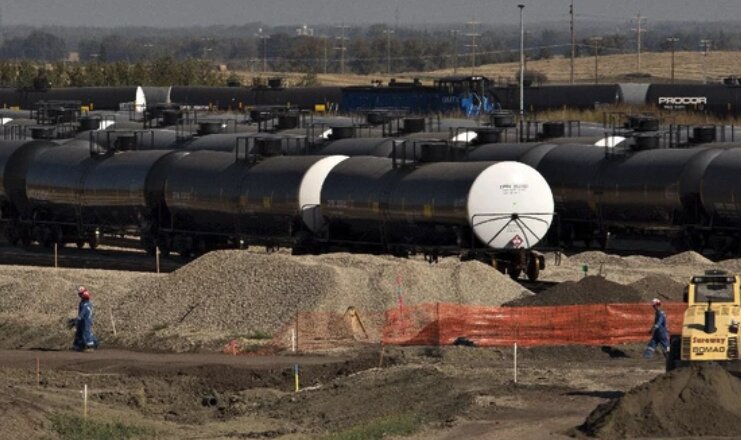
Commissioned in May 2015, the Edmonton Rail Terminal is one of the largest crude oil loading facilities in North America. It will accommodate up to three unit trains per day comprised of 150 railcars each. The facility is capable of loading 76 individual railcars at one time, achieving an ultimate capacity of approximately 250,000 barrels per day. There are over a dozen oil loading terminals in Alberta and over a dozen in Saskatchewan. The major oil loading terminal cost about $200-400 million to build per terminal. Major movement of oil by rail means getting it off tanker trucks for about 5 times more efficiency by rail. Rail is still about $20 per barrel less efficient than pipeline or ship. Canada’s oil movement by rail infrastructure costs several billion dollars and took many years to build. The rail and facilities have to be upgraded and maintained.
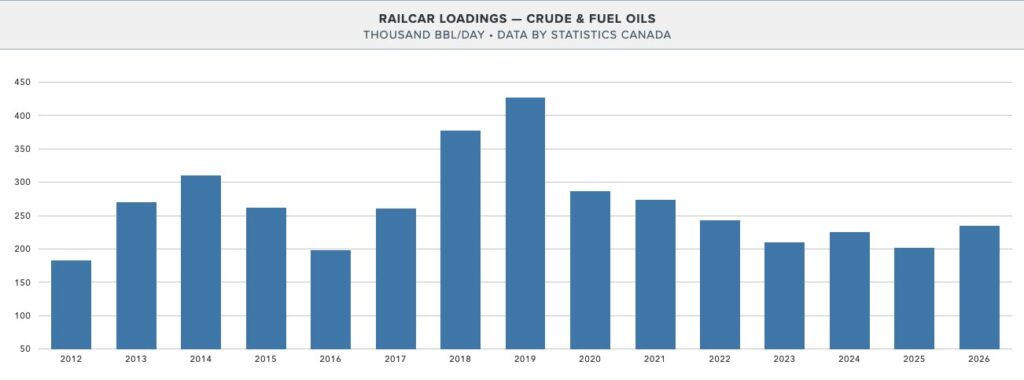
In February 2018, Canada shipped a daily average of 134,100 barrels of oil to the United States on trains. While not an insignificant amount, it was nowhere close to the historical high of December 2014 — when oil-by-rail exports hit 175,600 barrels per day (bpd) due to pipeline constraints.
Moving 300,000 barrels per day from Canada to the USA would mean about 1400 tanker cars. The transit time from Canada to US destinations is about 5-10 days for western Canada. They are closer in eastern Canada for 3 days. It takes 15 days for Iran to China as the rail. This means it takes 30 days round trip for the Iran oil. The tanker railcars do not return to reload for a month.
 Screenshot
 Screenshot
 Screenshot
It is difficult and inefficient to move oil from Iran to China via rail. This could move maybe 100,000-200,000 barrels per day during peacetime. Israel and the United States blew up over ten rail bridges to prevent the movement of missiles via rail.
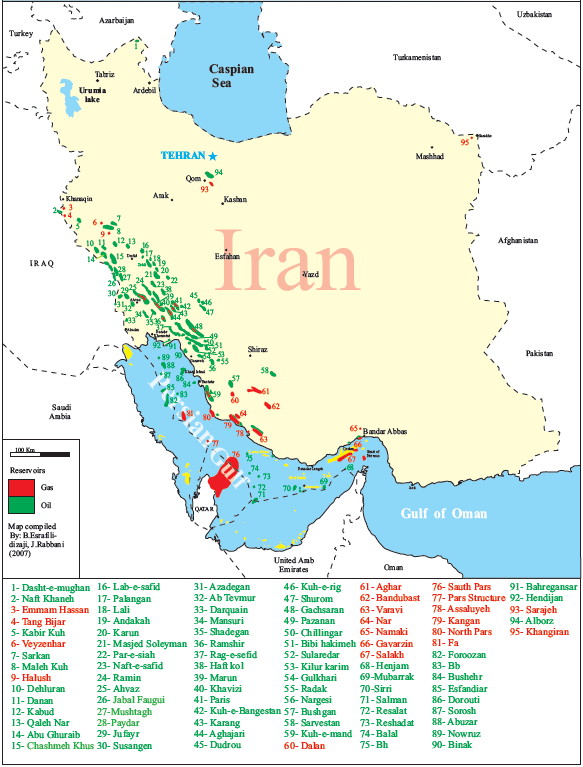
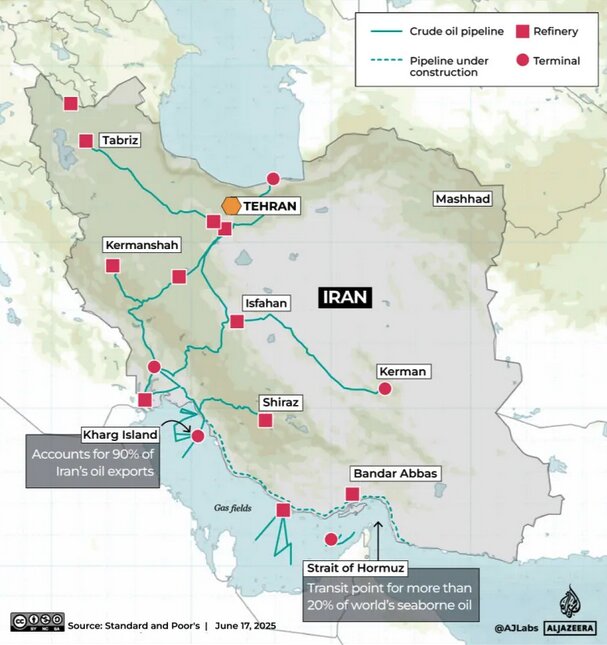
The oil fields in Iran are all on the western side of the country. Movement of anything by rail is disrupted. There is no oil and for sure no meaningful oil moving from Iran to China.
There is different gauge rail in Iran versus the x-Soviet countries between Iran and China.
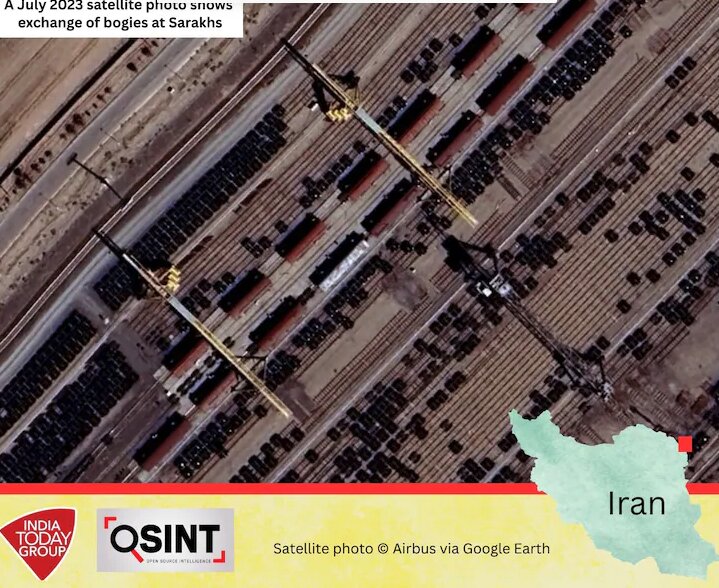
Oil shipments have to be unloaded and reloaded at border points. In the China–Iran corridor, at least four break-of-gauge points exist across the Kazakhstan–China and Iran–Turkmenistan interfaces. Break-of-gauge sites require transshipment, bogie exchange, or gauge-conversion technology. You either move to another railcar or you convert the width of each of the special rail cars. Make the railcar wheels narrower or wider.
Iran trains seem to use bogie exchanges.
Bogie exchange is a railway engineering method designed to facilitate the transfer of rolling stock, such as wagons and locomotives, across networks with differing track gauges by replacing the bogies—the undercarriage assemblies consisting of wheels, axles, and frames—with compatible ones for the new gauge. The main oil tank has to be lifted from one set of bogies onto another.
 Screenshot
 Screenshot
 Screenshot
 Screenshot

Brian Wang is a Futurist Thought Leader and a popular Science blogger with 1 million readers per month. His blog Nextbigfuture.com is ranked #1 Science News Blog. It covers many disruptive technology and trends including Space, Robotics, Artificial Intelligence, Medicine, Anti-aging Biotechnology, and Nanotechnology.
Known for identifying cutting edge technologies, he is currently a Co-Founder of a startup and fundraiser for high potential early-stage companies. He is the Head of Research for Allocations for deep technology investments and an Angel Investor at Space Angels.
A frequent speaker at corporations, he has been a TEDx speaker, a Singularity University speaker and guest at numerous interviews for radio and podcasts. He is open to public speaking and advising engagements.
| # | Наименование новости | Тональность | Информативность | Дата публикации |
|---|---|---|---|---|
| 1 | «РЖД Логистика» организовала перевозку керамогранита из Ирана в Россию по западной ветке МТК «Север-Юг» | 1 | 13.37 | 30-07-2026 |
| 2 | The Northern Advantage: Why Canada needs a second gateway beyond Lower Mainland | 0 | 11.02 | 15-08-2026 |
| 3 | Экономика: Российский газ нашел новый путь в Азию | 0 | 7 | 14-07-2026 |
| 4 | Russian Railways ready to develop grain transportation to Iran — CEO | 5 | 7 | 03-07-2026 |
| 5 | На терминале «Порт Фавор» завершили строительство 8,4 км железнодорожных путей | 0 | 5 | 08-06-2026 |
| 6 | Лавров заявил о скором прогрессе в реализации коридора «Север – Юг» | 5 | 6 | 17-07-2026 |
| 7 | Tehran offers Japanese companies to purchase Iranian oil — Kyodo | 2 | 6 | 04-07-2026 |
| 8 | В Крыму предложили перевозить нефть Ирана через порты республики | 0 | 0 | 27-08-2019 |
| 9 | РЖД планируют перевезти около 56 тыс. т загрязненной нефти в июне | 0 | 0 | 06-06-2019 |