Просмотр новости
Найдите то, что Вас интересует
 Спутники
 РН
РН SpaceX
 Роскосмос
 NASA
NASA
СпутникиРНSpaceXРоскосмосNASAUnitree, a leading Chinese robotics company, has priced its Shanghai initial public offering (IPO) at 150.80 yuan per share, aiming to raise 6.1 billion yuan ($904 million). If su...
Unitree, a leading Chinese robotics company, has priced its Shanghai initial public offering (IPO) at 150.80 yuan per share, aiming to raise 6.1 billion yuan ($904 million). If successful, the listing would make Unitree the first humanoid robot manufacturer to be listed on mainland China’s stock market.
Unitree said Monday its retail tranche was more than 8,000 times oversubscribed, underscoring intense investor enthusiasm in China for humanoid robotics. The IPO values Unitree at 219 times its 2025 earnings and 36 times sales.
Below are some facts about Unitree and why it is leading several other Chinese robotics companies toward public listings.
What is Unitree?Founded in 2016 by engineer Wang Xingxing, Hangzhou-based Unitree first became known for relatively inexpensive quadruped robots – or robot dogs.
Its G1, H1 and R1 humanoids have gone on to attract global attention through viral demonstrations showing them running, dancing and performing martial arts.
The company competes with Tesla, Boston Dynamics and a growing field of Chinese startups seeking to build machines that can eventually work in factories and homes.
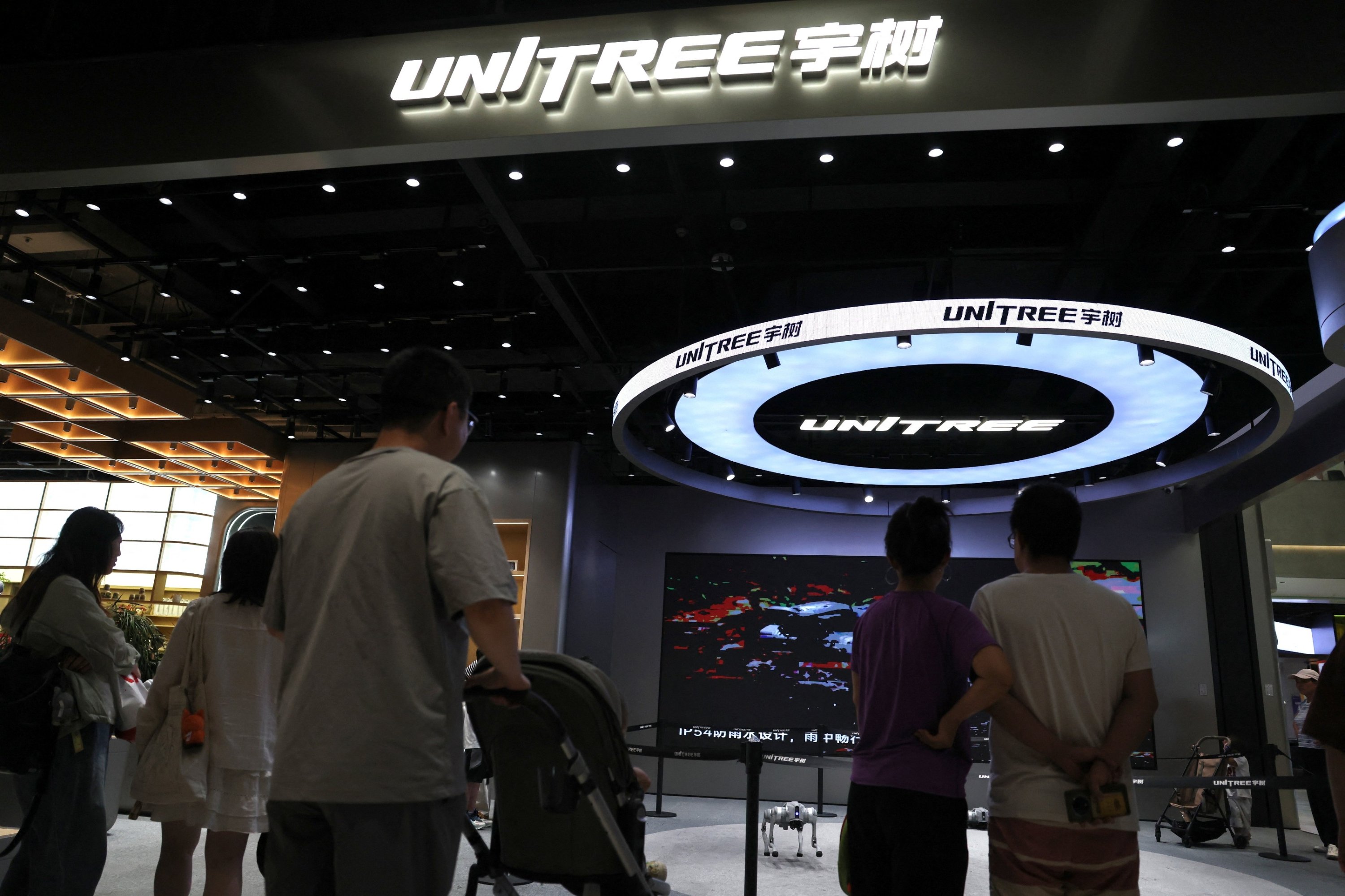 People watch a Unitree's GO2 robot performing at a Unitree store in Beijing, China Aug. 1, 2026. (Reuters Photo)
Unitree's revenue rose more than fourfold to nearly 1.7 billion yuan ($252 million) in 2025. Unlike many humanoid startups, it is profitable, reporting adjusted net profit of about 600 million yuan. Its overseas revenue accounted for more than 40% of sales during each of the reporting periods disclosed in its prospectus.
The humanoid maker has warned that geopolitical tensions and potential U.S. trade, procurement, or sales restrictions could weigh on its international expansion.
Who are Unitree's major backers?Chinese food delivery giant Meituan is Unitree's largest outside investor, holding 9.65% through several affiliates. Two of China's best-known startup investors, HSG and MPCi, hold 7.11% and 5.45%, respectively.
Tencent, Alibaba Group, Ant Group, China Mobile and Geely also invested through affiliated vehicles in a June 2025 funding round, linking Unitree to some of China's largest internet, telecoms and auto groups.
The prospectus identifies just 0.67% of Unitree's shares as directly state-owned, held by Shenzhen Capital Group and its wholly owned subsidiary Shenzhen Innovation Capital.
But a wider group of state-backed funds holds meaningful stakes, led by the Beijing Robotics Industry Development Fund at 3.83% and the China Internet Investment Fund at 2.11%.
Founder Wang is Unitree's controlling shareholder.
Why is Unitree important?Unitree has shown that China can manufacture sophisticated robots at prices far below many overseas competitors, drawing on the country's extensive supply chains for motors, sensors, batteries and other components.
It has also become a symbol of Beijing's drive to dominate embodied intelligence, an emerging field that combines AI models with machines capable of navigating and interacting with the physical world.
But its commercial success does not yet prove humanoids can replace workers. Current demand mostly stems from universities and government-backed projects using robots for education, research and demonstrations. Humanoids still struggle with reliability, dexterity and performing varied tasks for long periods without human intervention.
Unitree's prospectus says large-scale commercial adoption remains uncertain, citing challenges including task generalisation, endurance, safety, and the ability to operate reliably in unstructured environments.
Why are robot makers seeking listings?Developing humanoids requires heavy spending on engineers, robot-training data, AI models and manufacturing capacity – years before demand from factories or households is certain.
Therefore, public markets offer companies the capital to keep developing their technology while government support and investor interest remain strong.
Unitree plans to use the IPO proceeds to support embodied-AI model development, robot-body research, and manufacturing expansion.
Leju Robotics, which makes the Kuavo humanoid, filed an application in May to list on Shenzhen's ChiNext market. Shanghai-based AgiBot, another leading humanoid producer, began preparations for a Hong Kong IPO in July.