Просмотр новости
Найдите то, что Вас интересует
 Спутники
 РН
РН SpaceX
 Роскосмос
 NASA
NASA
СпутникиРНSpaceXРоскосмосNASAProfessor Ana Namburete, in the Department of Computer Science, has published a policy brief on a study presenting the ‘Fetal Brain Atlas’, the first digital atlas mapping how the human brain develops in the womb
Posted: 5th March 2024
Professor Ana Namburete, in the Department of Computer Science, has published a policy brief on a study presenting the ‘Fetal Brain Atlas’, the first digital atlas mapping how the human brain develops in the womb. Led by the University of Oxford, the study involved a team of more than 200 researchers from health and science across the world.
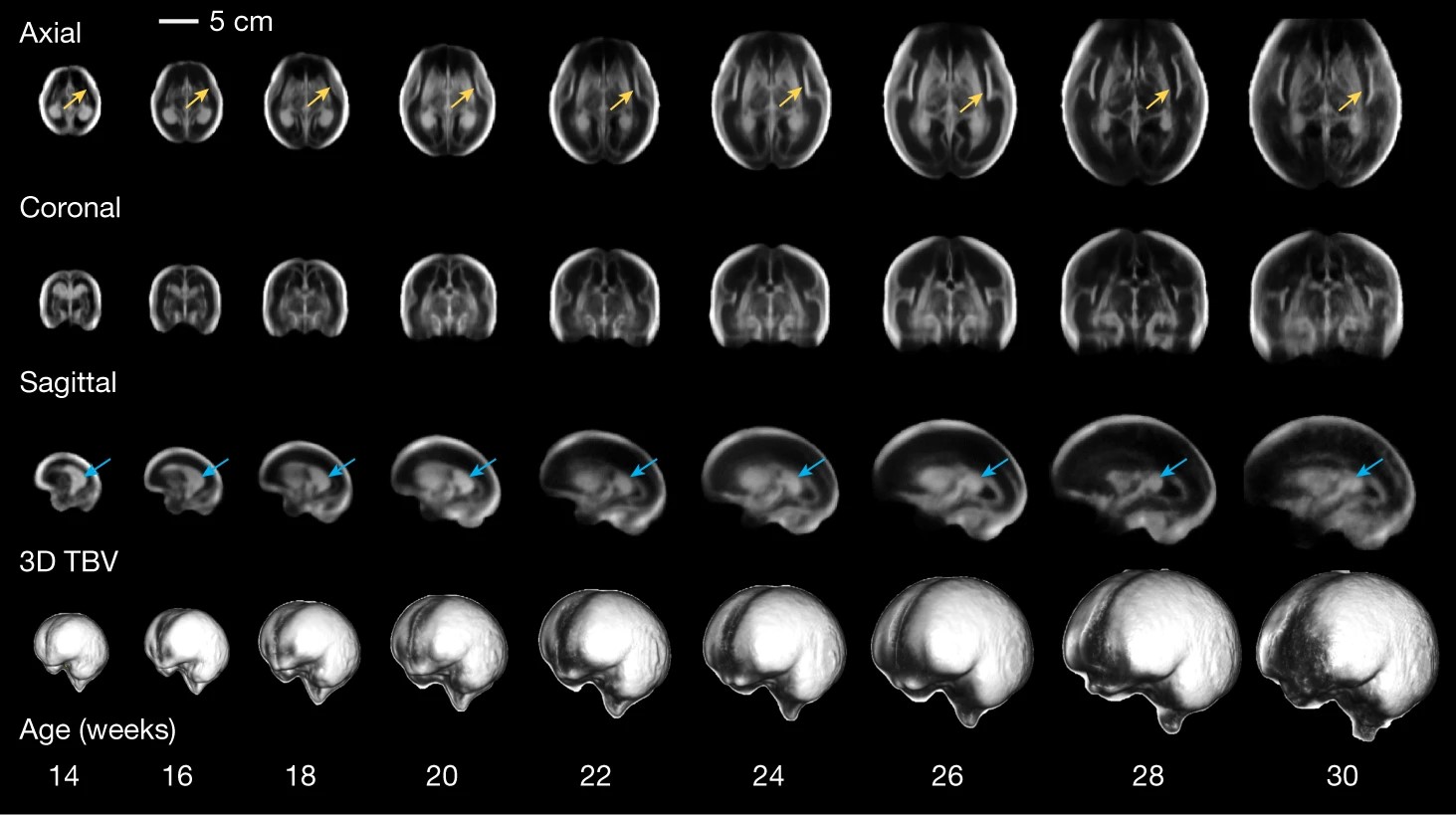 3D + time atlas templates depicting the fetal brain at even gestational weeks for the axial (top), coronal (middle) and sagittal (bottom) views. Image credit: Nature
Artificial intelligence in the form of machine learning methods developed by the Department of Computer Science were essential to the research, which marked an important scientific advance in the field of fetal neuroscience. Professor Namburete, first author of the study, explained more about the brain atlas:
Using AI we enhanced the visibility of brain structures in the 3D US images and generated an average depiction of the brain at each week of pregnancy during a critical period of development. Uniquely, our atlas captured patterns of brain growth from as early as 14 weeks’ gestation - filling a 6-week knowledge gap in our understanding of early fetal brain maturation. We also revealed significant asymmetries in brain maturation: for example, in the region associated with language development, which peaked at 20-26 weeks’ gestation and persisted thereafter without any differences between the sexes. Professor Ana Namburete
The study was originally published in the journal Nature. As the effects continue to resonate, Ana has since appeared as a guest on the Royal Institution Christmas Lectures in December, joining fellow Computer Science Professor Mike Wooldridge who fronted the lectures. She explained the theory behind the use of AI during pregnancy to generate 3D ultrasound images to measure how the human brain develops. You can watch Ana’s segment on BBC iPlayer (34.33 - 38.42) (if outside the UK, you can watch on YouTube).
View the brain atlas at: https://intergrowth21.com/research/brain-atlas-project
| # | Наименование новости | Тональность | Информативность | Дата публикации |
|---|---|---|---|---|
| 1 | Digital atlas of human foetal brain | 0 | 4.94 | 25-10-2023 |
| 2 | A digital environment fit for childhood | 0 | 4.73 | 05-12-2017 |
| 3 | DPhil the Future: Why We Need Fallible Humans in AI Alignment | 0 | 5.92 | 20-10-2025 |
| 4 | Smooth Instead of Folded—Brain Development in Primates | 0 | 10 | 23-09-2026 |
| 5 | Accessible video explaining quantum computing published | 0 | 7.35 | 29-07-2024 |
| 6 | Paula Boddington in print on code of ethics | 0 | 5.78 | 14-12-2017 |
| 7 | White Paper drives a responsible future for Quantum Computing | 0 | 5.1 | 06-06-2024 |
| 8 | Assistant Professor in Cognitive Science, AI & the Mind | 0 | 5 | 08-04-2026 |
| 9 | Fortune might favour the brave, but bravery is easier for the fortunate | 0 | 8.57 | 04-06-2026 |
| 10 | Tackling the blight of fake news | 0 | 7.12 | 07-12-2017 |