Просмотр новости
Найдите то, что Вас интересует
 Спутники
 РН
РН SpaceX
 Роскосмос
 NASA
NASA
СпутникиРНSpaceXРоскосмосNASAA Laotian “spirit city” with more than 200 residents
The post Buddha Park appeared first on Tricycle: The Buddhist Review.
CultureMagazine | Sacred Sites
A Laotian “spirit city” with more than 200 residents
By Kami Nguyen Fall 2026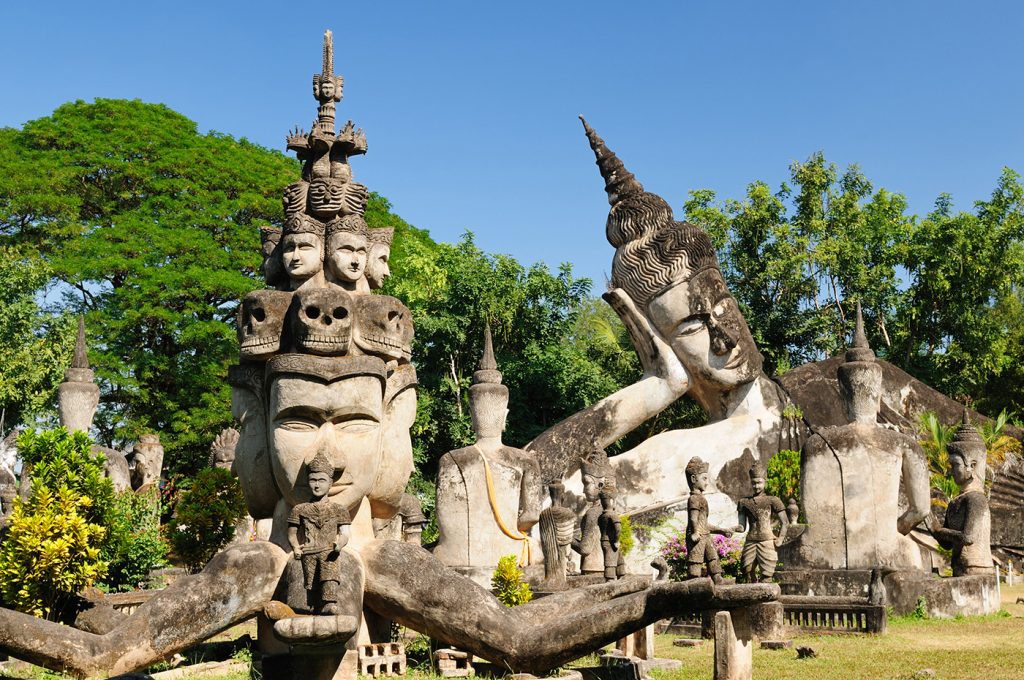 Photo from RCHphoto / iStock
When he was a child, Thai Lao mystic and sculptor Luang Pu Bunleua Sulilat (1932–1996) fell into a cave. Inside, he met a hermit monk named Keoku—the man who would become his lifelong spiritual teacher. Under Keoku’s guidance, Sulilat studied both Hinduism and Buddhism. In 1958, he blended the two in what would be his first major art project: a sculpture garden called Buddha Park, or Xieng Khuan in Lao, which means “spirit city.”
Buddha Park is situated outside of Vientiane, Laos, and contains more than 200 statues of figures that include the Buddha, Avalokiteshvara, Shiva, and Arjuna. One of the park’s most notable sculptures is a multilevel pumpkin-shaped shelter with a door resembling a demon’s head. Upon entering the demon’s mouth, visitors ascend floors that represent samsara’s hell and earth realms, then exit through the top, which offers a view of the entire Buddha Park. The park itself is meant to depict the heaven realm.
Despite having no formal art education, Sulilat designed all the sculptures in the park himself and led hundreds of inexperienced volunteers in casting them. Each piece is made of reinforced concrete provided by the abundant cement factories along the Mekong River. Since their creation in 1958, most of the sculptures have become patinated and moss-covered, making them appear ancient despite their relatively recent construction.
Sulilat fled to his birth country of Thailand in 1975 amid the political turmoil of the Laotian Civil War. In 1978, he began the construction of a new religious sculpture park right across the border from the original one. This park was named Sala Keoku—paying homage to Sulilat’s hermit teacher—and is even larger and more fantastical than Buddha Park. The main building, Sala Keoku pavilion, is at the park’s center and topped with large domes that resemble a mosque. After falling off one of his giant sculptures, Sulilat became ill and passed away in 1996. His body was subsequently mummified, and is housed on the third floor of Sala Keoku pavilion.

Thank you for subscribing to Tricycle! As a nonprofit, we depend on readers like you to keep Buddhist teachings and practices widely available.
This article is only for Subscribers!
Subscribe now to read this article and get immediate access to everything else.
Already a subscriber? Log in.
| # | Наименование новости | Тональность | Информативность | Дата публикации |
|---|---|---|---|---|
| 1 | The Buddhist Traveler in Washington, D.C. | 0 | 6.57 | 09-05-2026 |
| 2 | Buddhism By the Numbers: Croatia | 0 | 8.43 | 08-08-2026 |
| 3 | The Buddhist Traveler in Zagreb | 0 | 8.6 | 08-08-2026 |
| 4 | What We’re Plugged Into | 0 | 9.2 | 08-08-2026 |
| 5 | What We’re Reading | 0 | 10.41 | 08-08-2026 |
| 6 | Reincarnating the Buddhas of Bamiyan | 0 | 10.98 | 10-06-2026 |
| 7 | Visiting Teacher: Peggy Rowe Ward | 0 | 10.39 | 08-08-2026 |
| 8 | Breaking the Trance | 0 | 13.29 | 08-08-2026 |
| 9 | A guide to Mount Phousi: Luang Prabang’s sacred hill | 0 | 8.34 | 05-08-2026 |
| 10 | A guide to Mount Phousi: Luang Prabang’s sacred hill | 0 | 8.34 | 04-08-2026 |