Просмотр новости
Найдите то, что Вас интересует
 Спутники
 РН
РН SpaceX
 Роскосмос
 NASA
NASA
СпутникиРНSpaceXРоскосмосNASAThorsby's alien worlds and creatures do not exist for their own wacky sake. His stories align on two highly specific axis: Elaborate explanations of evolutionary biology, and classical farces based on this biology, often in the style of Oscar Wilde.
The post The peculiarly logical webcomics of Øyvind Thorsby appeared first on The Comics Journal.
William Schwartz | August 5, 2026
Back in the webcomic era — late nineties, early aughts — a great many ambitious artists tried their hands at the infinite canvas of the Internet. The results were, to be blunt, quite mediocre more often than not, often quite obviously the work of untrained artists appealing to niche audiences like video game and tabletop gaming fans.
Nevertheless, this was an exciting time in comics, as the Internet made even the most arcane, nerdy interests seem all too accessible. Øyvind Thorsby, whose work started in 2001, has a crude, stilted art style and a peculiar niche that to this day maintains and even exceeds that classic Web 2.0 aesthetic. Thorsby's alien worlds and creatures do not exist for their own wacky sake. His stories align on two highly specific axis: Elaborate explanations of evolutionary biology, and classical farces based on this biology, often in the style of Oscar Wilde.
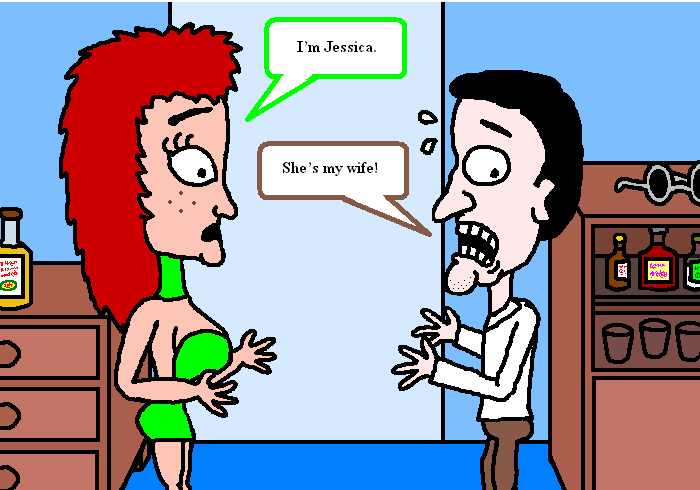 Panel from Lies, Sisters and Wives.
Despite being a mundane strip, the best introduction to Thorsby's work is Lies, Sisters and Wives, a short 34-page strip which lacks any biological world-building. It centers entirely around the abortive efforts of Jim to hide the existence of his mistress when various friends and family members unexpectedly come to his home, forcing him to maintain an elaborate web of lies that do not technically contradict one another. The situation keeps getting worse as other characters act upon the information they learn from Jim.
Throsby's protagonists are often not all that sympathetic. In The Accidental Space Spy, a much longer form comic, a normal human is abducted under the mistaken premise that he is the legendary space spy Plume, whose knowledge of alien worlds makes him an ideal candidate for a mission centered around tracking down the assistant of a professor who was engaged in an extended survey of alien dating cultures. Here the farce is inverted. Our hapless, unnamed hero (forced to take on Plume's moniker) is sorely lacking in the information he needs to accurately understand how the aliens think. Consequently, simple requests for information rapidly and unnecessarily become dangerous crises, due to the mismatch in understanding between the space spies and the alien worlds they visit.
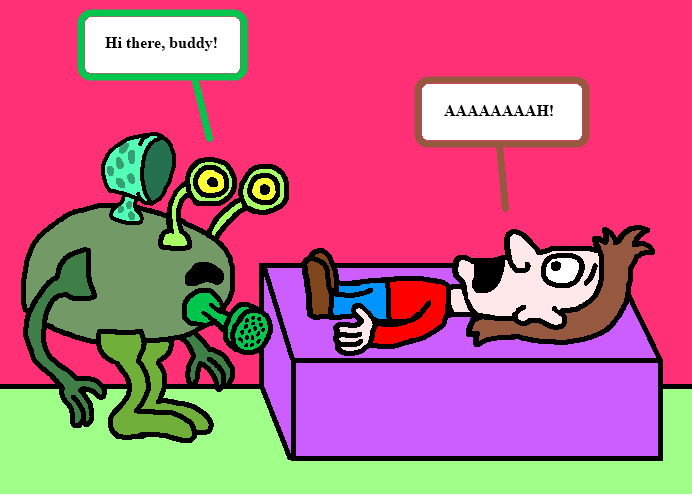 Panel from Accidental Space Spy.
This kind of highly functional worldbuilding, with less of an emphasis on the creativity involved in the worlds rather than the often weird behaviors they inadvertently incentivize, is an even more old-fashioned form of comics storytelling than Thorsby's strange mix of squiggly character profiles and highly geometric shapes. Yet his work is forward facing in one quite surprising way. His panels are organized vertically. This makes them very easy to read on mobile devices, although perhaps more significantly, the individual panels make full use of the infinite canvas. They're as long or as short, as wide or as tall, as necessary to get to the next cliffhanger. The same logic also determines how many panels appear in any given page. It could be anywhere from a single panel to several dozen depending on how long it takes Thorsby to get to the next cliffhanger.
But more than the technical specs, what's impressive about Thorsby's work is how well the logic holds up when character motivations are finally explained. These explanations run the gamut from dry and glib to overly convoluted. The titular Hitmen For Destiny, for example, only work for a paycheck. While it is eventually explained what exactly is meant to be a hitman for destiny, this is never a short-term concern. Likewise, while the titular Trixie Slaughteraxe of Trixie Slaughteraxe for President does plan to use a socialist political agenda to save Diabolica in the long-term, it's seldom ever relevant or helpful in the near term. In one of the more ironic comics in Thorsby's ouevre, Trixie accidentally saves her fellow adventurers by getting them all killed in a class war.
You'll have to take my word for it that this does in fact make sense in context. Thorsby's comics function as strange little logic puzzles in that manner. The addictive draw of Thorsby's stories is trying to figure out the solution to whatever the current farcical problem is based on the existing tools, which frequently have unfortunate corollaries. Thorsby is one of the few authors I've ever seen call attention to the fact that an invisible person or animal would not be able to see anything, for example, as eyes also work by reflecting light. Such a weakness has, as it turns out, significant comedic potential, whether it's in regard to something as simple as a blind person fumbling to get their clothes off so they can't be seen, or as hilariously grotesque as a dimorphic mating ritual.
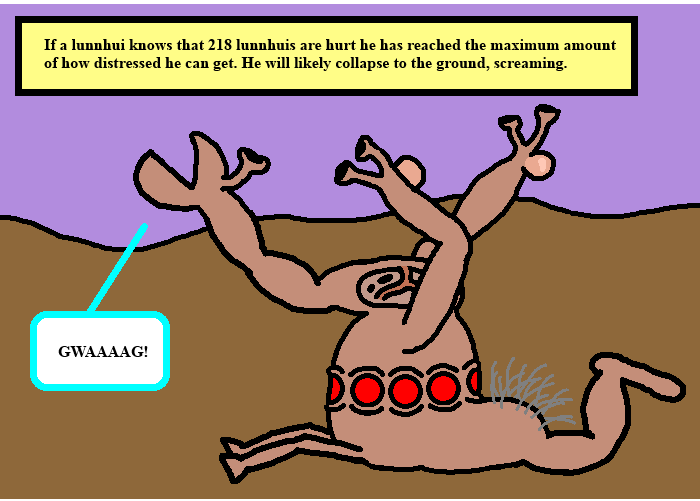 The lunnhuis, explained.
The specific form of Thorsby's particular deadpan situational humor is well adapted to the art style, as the story is always fundamentally a comedy, and the generally grotesque art tends to add to that more often than not. It also helps that the often gratuitous exposition is layered on quite thick regardless of which aspects might actually be important in the next turnabout. Sometimes, Thorsby dedicates a whole page to an aspect of alternate means of evolution that isn't directly relevant to the problem the main characters are currently dealing with, but could have been. Take this page explaining the fate of the lunnhuis, an intelligent alien race that feels emotional anguish in proportion to the quantity of people they know to have been harmed. In Thorsby's conceptualization, an inability to rationalize widespread suffering is anathemic to being an intelligent race. Which isn't to say that such an intelligent race couldn't evolve, they just wouldn't and couldn't be significant players in intergalactic space drama.
There are clear political undertones to Thorsby's work, in case that wasn't obvious from the fact that one of his few genuinely heroic protagonists is a socialist. But to his credit these political arguments never take over the comic, and the assumptions they present never quite get to the level of soapboxing. Transdimensional Brain Chip, for example, eventually sees its hero meet an obvious cult. Thorsby's general dislike of tribalism can also be seen in International Space Spy with brief interludes that take an idea as simple as intercultural conflict and work out the underlying logic to such an elaborate degree that by the end the argument has warped into claim that dangerous objects are more beautiful.
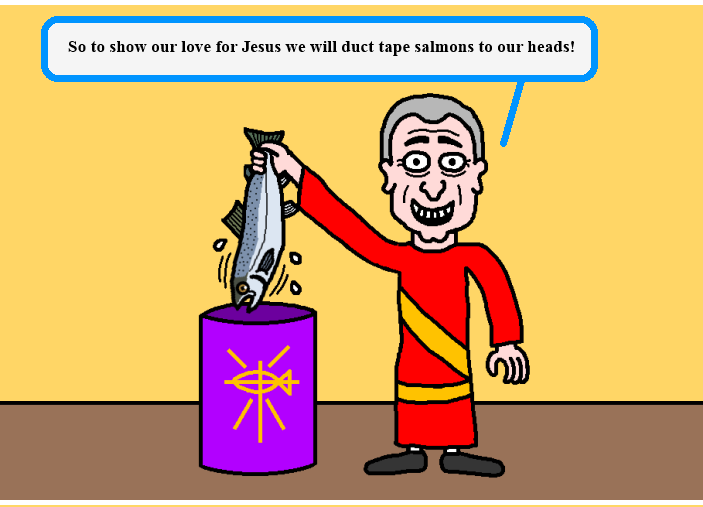 Panel from Transdimensional Brain Chip.
The sheer coherence of the logic has allowed Thorsby's work to age surprisingly well, even when dealing with something as incisive as an alternate explanation for the evolutionary rationale of homosexuality and suicide. Thorsby's science is entirely sincere even when it sounds ridiculous. Lines like, “Oh yeah, I remember you kissing a bunch of dudes earlier. Guess you can live,” have a definite charming resonance because their blunt presentation gets across the odd ways people think and rationalize that our language so often obscures. It's oddly reminiscent of Strange Planet, while being genuinely weird in a way the more publication-friendly comic can only scratch the surface of. Once again, the infinite canvas is as much an exploratory vehicle for Thorsby's ideas as the sheer weirdness of those ideas. Even if Strange Planet wanted to do a deep dive into evolutionary biology, there's just no way to satisfactorily exposit that level of elaborate logic in the context of a four panel comic.
Thorsby is quite easy to understand despite his lack of polish, to the point that his work stands as a reminder of big ideas with imperfect presentation heavily reliant on circumstance is about as human as art can get. Thorsby's characters are often stupid, and sometimes even seem to have a death wish. Yet their apparent irrationality always seems to hinge around certain rational rules, is why his worlds always feel so plausible.
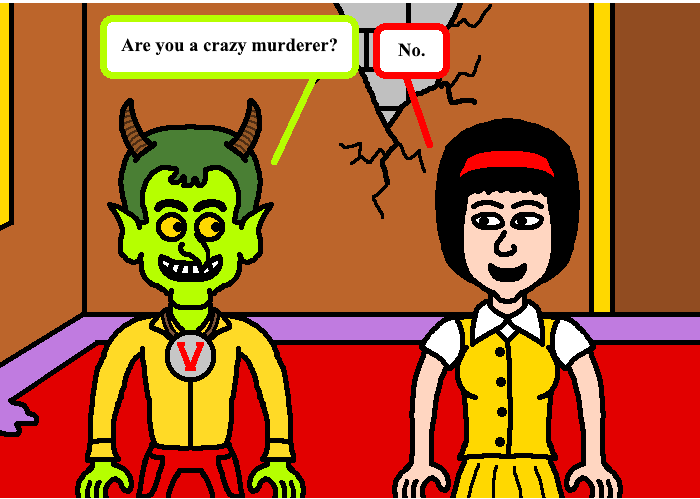 Panel from My Other Brain Is an Idiot.
Thorsby's currently ongoing strip My Other Brain Is An Idiot is more of a melting pot than his previous work, centering around aliens with quirks although this biology is as normal to them as ours is to us. As of this writing, My Other Brain Is An Idiot is in the midst of its second seemingly random digression, having completed a safari featuring ever more strange and bizarre monsters and now moving back to the theater. It's still not at all clear how Thorsby intends to tie everything together, as a smuggling operation in the first part and political assassinations in the second part have no obvious relation to our heroine, a serpent-like humanoid who's advised by mentors. Yet even without a grand narrative or a clear central conflict, these episodic stories maintain their usual appealing weirdness.
What makes Thorsby's work so intriguing is that these elaborate explanations are always eventually going somewhere. Condensed to few enough words to function in the comic format, and the grotesque punctuation of sudden action to do most of the heavy lifting. Thorsby doesn't write stories about moral righteousness or power levels. Just cold, hard, logical science, where love can motivate people to do very stupid things. It's all just very weird, in the best possible way.
| # | Наименование новости | Тональность | Информативность | Дата публикации |
|---|---|---|---|---|
| 1 | Revving at Full Throttle — This Week’s Links | 0 | 10.33 | 07-08-2026 |
| 2 | The Wild Colonial Boy Conquers Rome | 0 | 8.77 | 01-07-2026 |
| 3 | A Gigantic Nuclear Furnace — This Week’s Links | 0 | 11.71 | 10-07-2026 |
| 4 | Will Franz, Conscientious Writer (1950-2026) | 0 | 8.52 | 27-07-2026 |
| 5 | Ted White (1938–2026) | 0 | 17.36 | 10-08-2026 |
| 6 | Southside Riddim — This Week’s Links | 0 | 14.78 | 17-07-2026 |
| 7 | Let Your Yeah Be Yeah — This Week’s Links | 0 | 9.73 | 14-08-2026 |
| 8 | Her Wit Flowed Long: Two Recent Jane Austen Graphic Biographies | 0 | 5.94 | 02-07-2026 |
| 9 | The Rocket Ships of La Jolla — This Week’s Links | 0 | 8.92 | 24-07-2026 |
| 10 | Archie Bongiovanni on Queer Spaces and Severe Winters: ‘If it’s trying to appeal to everyone, it doesn’t really appeal to anyone!’ | 0 | 7 | 13-07-2026 |