Просмотр новости
Найдите то, что Вас интересует
 Спутники
 РН
РН SpaceX
 Роскосмос
 NASA
NASA
СпутникиРНSpaceXРоскосмосNASA
Launched in 2022, this project aimed to accelerate the industrialisation of additive manufacturing technologies in order to optimise train maintenance and reduce its costs through the production of components on a piece-by-piece or small-batch basis.
Additive manufacturing: a promising process for the rail sector
The industrial equivalent of 3D printing, additive manufacturing combines digital design with the rapid production of mechanical parts through the successive addition of layers of material.
This process offers numerous advantages. Lead times for prototyping, tooling and procurement are significantly reduced, thereby paving the way for improved train availability for service. It is also possible to reduce spare parts stock, and thus the costs associated with them (train maintenance involves 150,000 different parts, many of which are produced in small batches).
Additive manufacturing makes it possible to produce certain parts that are no longer manufactured throughout the trains’ operational lifespan, which can be as long as forty years.
Beyond simple remanufacturing, additive manufacturing opens up new possibilities for improving components, customising them and making them more reliable, lighter or quieter than the originals.
From design to full-scale demonstrator
Within the consortium, the research teams at the Research Institute in Civil and Mechanical Engineering (GeM) at Centrale Nantes have contributed their expertise in the design of parts suited to large-scale metal additive manufacturing. Using the digital model and the mechanical constraints defined by the SNCF, they developed a new concept for a bogie side member (a structural component that connects the axles and supports part of the train) by exploiting the possibilities offered by the WAAM (Wire Arc Additive Manufacturing) process, a metal 3D printing technology using wire deposition.
This design work culminated in the production of a full-scale demonstrator: a 3.2-metre-long component manufactured by depositing nearly 400 kg of metal. This achievement demonstrates the feasibility of producing large-scale metal components for railway applications using additive manufacturing. It represents a significant step towards the industrialisation of this technology for train maintenance.
A breakthrough for the railway industry
Beyond this first, the project confirms the potential of additive manufacturing to transform railway maintenance. By enabling certain parts to be produced or repaired on demand, this technology opens up new possibilities for optimising train maintenance, reducing lead times and supporting more sustainable maintenance.
This breakthrough also illustrates the role of Centrale Nantes in developing innovative solutions for industry, by combining academic research, scientific expertise and technology transfer into practical applications.
Additive4Rail is a project arising from the CORIFER 2021 AMI (Call for Expressions of Interest) managed by BPI France, supported by the French government as part of the France 2030 initiative.
The Additive4Rail project, which brought together teams from Centrale Nantes, the SNCF, VLM Robotics and 4D Pioneers, came to a close on 23 June at the Ferrocampus in Saintes.
Launched in 2022, this project aimed to accelerate the industrialisation of additive manufacturing technologies in order to optimise train maintenance and reduce its costs through the production of components on a piece-by-piece or small-batch basis.
Additive manufacturing: a promising process for the rail sectorThe industrial equivalent of 3D printing, additive manufacturing combines digital design with the rapid production of mechanical parts through the successive addition of layers of material.
This process offers numerous advantages. Lead times for prototyping, tooling and procurement are significantly reduced, thereby paving the way for improved train availability for service. It is also possible to reduce spare parts stock, and thus the costs associated with them (train maintenance involves 150,000 different parts, many of which are produced in small batches).
Additive manufacturing makes it possible to produce certain parts that are no longer manufactured throughout the trains’ operational lifespan, which can be as long as forty years.
Beyond simple remanufacturing, additive manufacturing opens up new possibilities for improving components, customising them and making them more reliable, lighter or quieter than the originals.
From design to full-scale demonstrator 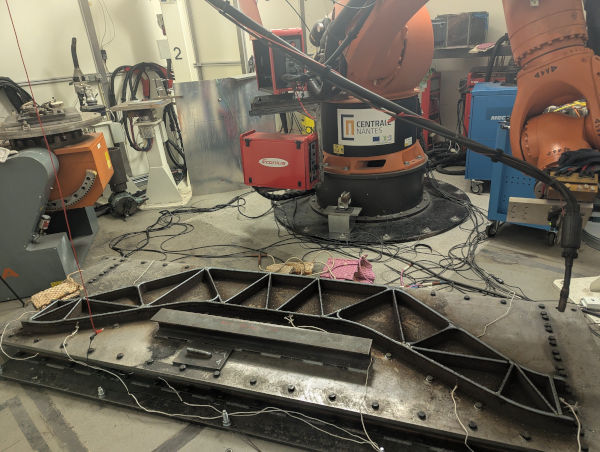
This design work culminated in the production of a full-scale demonstrator: a 3.2-metre-long component manufactured by depositing nearly 400 kg of metal. This achievement demonstrates the feasibility of producing large-scale metal components for railway applications using additive manufacturing. It represents a significant step towards the industrialisation of this technology for train maintenance.
A breakthrough for the railway industryBeyond this first, the project confirms the potential of additive manufacturing to transform railway maintenance. By enabling certain parts to be produced or repaired on demand, this technology opens up new possibilities for optimising train maintenance, reducing lead times and supporting more sustainable maintenance.
This breakthrough also illustrates the role of Centrale Nantes in developing innovative solutions for industry, by combining academic research, scientific expertise and technology transfer into practical applications.
Additive4Rail is a project arising from the CORIFER 2021 AMI (Call for Expressions of Interest) managed by BPI France, supported by the French government as part of the France 2030 initiative.
| # | Наименование новости | Тональность | Информативность | Дата публикации |
|---|---|---|---|---|
| 1 | La fabrication additive pour transformer la maintenance ferroviaire | 0 | 6.83 | 07-07-2026 |
| 2 | Launch of the European AIMPERES project: AI to help decarbonise maritime transport | 0 | 13.37 | 21-06-2026 |
| 3 | How the US Navy embraced AM in 2025 | 5 | 6 | 24-01-2026 |
| 4 | Centrale Nantes has been awarded the jury’s special prize at the 2026 Eco-mobility Awards | 0 | 14.69 | 28-06-2026 |
| 5 | Wabtec Expands Locomotive Services Capabilities in India | 0 | 13.73 | 16-01-2026 |
| 6 | MMB Volum-e signs three-year contract with amsight | 0 | 5 | 23-01-2026 |
| 7 | Julien Réthoré has been awarded an ERC Advanced Grant for 2025 to advance our understanding of material fracture | 0 | 12.32 | 28-06-2026 |
| 8 | МГТУ имени Баумана продвигает технологию 3D-печати, в которой непрерывное углеродное ... | 0 | 6.44 | 06-08-2026 |
| 9 | ЦАТ осваивает 3D-печать высокотемпературной керамикой для изготовления деталей авиадвигателей | 0 | 11.7 | 11-08-2026 |
| 10 | Mastrex démocratise l’accès à la fabrication additive métallique grâce à ses systèmes DMLS | 0 | 6.58 | 18-05-2026 |