Просмотр новости
Найдите то, что Вас интересует
 Спутники
 РН
РН SpaceX
 Роскосмос
 NASA
NASA
СпутникиРНSpaceXРоскосмосNASA(1) OOPS. Smithsonian Magazine assures readers, “Typos Have Plagued Us for Centuries. Just Ask the Publishers Who Printed the Seventh Commandment as ‘Thou Shalt Commit Adultery’ in 1631”. James Joyce wrote the manuscript of Ulysses with a steel pen over seven years. By his … Continue reading →
(1) OOPS. Smithsonian Magazine assures readers, “Typos Have Plagued Us for Centuries. Just Ask the Publishers Who Printed the Seventh Commandment as ‘Thou Shalt Commit Adultery’ in 1631”.
James Joyce wrote the manuscript of Ulysses with a steel pen over seven years. By his typists’ accounts, the Irish author’s penmanship was atrocious, and his revisions were overwhelming. When the book was published in 1922, it was full of mistakes. In a letter to his wife, he wrote, “The edition you have is full of printer’s errors.”
The following year, Joyce’s editors compiled a massive list of the book’s errors to be fixed in new editions. Joyce rejected some of the corrections, saying, “These are not misprints but beauties of my style hitherto undreamt of.” Even so, some future printings of the book came with a seven-page errata sheet listing more than 200 mistakes.
Errors like those in Ulysses are the subject of a new exhibition at Yale. “‘Beauties of My Style’: Errata and the Printed Mistake,” which opens at the university’s Sterling Memorial Library on March 30, examines the history of typos across five centuries….
… The exhibition features an infamous 1631 edition of the Bible, which lists “Thou shalt commit adultery” as the Seventh Commandment. (The omission of the word “not” earned this edition the nickname “the Wicked Bible.”) By the time the mistake was discovered, 1,000 copies had been printed. The British king Charles I reprimanded the publishers, fined them £300 and stripped them of their printing license. In the centuries that followed, rumors circulated speculating that a rival printer had introduced the error. But as Chris Jones, a medieval studies scholar at the University of Canterbury in New Zealand, told the Guardian’s Eva Corlett in 2022, the more likely explanation is that the printers hadn’t wanted to spend money on copy editors.
Nearly all the Wicked Bibles were destroyed, and only about 20 known copies survive. In the copy on view at the Beinecke, someone fixed the error by hand, adding “not” to “Thou shalt commit adultery.”…
(2) “NO GAMES FOR GENOCIDE”. [Item by Steven French.] Keza MacDonald reports on gaming companies’ concerns about Microsoft’s relationship with Israel’s Defence Force in the latest “Pushing Buttons” newsletter: “Why an up-and-coming indie developer is returning Microsoft’s money” in the Guardian.
Video games are in a funding crisis. Investor money flowed freely during the pandemic gaming boom, but now the well has run dry. It is increasingly difficult, for indie developers especially, to get the capital to make games. It is extremely unusual, then, to hear of a developer returning an investor’s money. Yet that is what Speculative Agency, developers of All Will Rise, have just done.
Last year, All Will Rise, a deck-building game about a team of activists fighting for the future of their oligarch-run city, received money from Microsoft as part of a developer acceleration programme. In late-2025, however, the team became aware of No Games for Genocide, a collective of developers, journalists, union organisers and others that came together as a result of Israeli assault on Gaza to protest against “material and commercial ties between the games industry and enabling genocide, war crimes, and the military industrial complex”.
No Games for Genocide has urged the games industry and players to boycott Microsoft and Xbox because of the US tech giant’s ties to Israel’s Defence Force and the technology it has provided during Israel’s war on Gaza, which a United Nations commission last year declared a genocide. As the Guardian reported last August, the Israeli spy service had been using Microsoft’s Azure cloud to carry out mass surveillance on Palestinian civilians. (Microsoft responded by terminating the Israeli military’s access to this service, though the IDF remains a client and still uses other Microsoft services.) The company’s continued relationship with the IDF has driven widespread protests, including from its own employees – some of whom were fired – and Microsoft is on the Palestinian-led Boycott, Divestment and Sanctions (BDS) list….
(3) TRIPODS EVOLUTION. [Item by SF Concatenation’s Jonathan Cowie.] The NutBug YouTube channel explores SF’s most iconic universes. It has recently looked at the evolution of the cinematic portrayals of the Martian tripods in H. G. Wells’ War of the Worlds.
In H. G. Wells’ The War of the Worlds, the Martian fighting machines—often called Martian Tripods—are the main weapons used by the invading Martians. They come from Mars along with the Martians themselves, landing on Earth inside large metal cylinders. Once the Martians emerge, they build and use these machines to move across the countryside and defeat human armies.
You can watch the 11-minute video here or below…
(4) NICHOLAS BRENDON (1971-2026). “Buffy the Vampire Slayer actor Nicholas Brendon dies aged 54” reports BBC. (Subscription required by readers outside UK.)
US actor Nicholas Brendon, renowned for his starring role in the cult TV series Buffy the Vampire Slayer, has died aged 54.
Brendon’s family confirmed in a statement on social media that “he passed in his sleep of natural causes”.
His family added: “He was passionate, sensitive, and endlessly driven to create. Those who truly knew him understood that his art was one of the purest reflections of who he was.
“Most people know Nicky for his work as an actor and for the characters he brought to life over the years. In recent years Nicky has found his passion in painting and art.”
Brendon played Xander Harris in Buffy the Vampire Slayer over seven seasons between 1997 and 2003 – best friend of the titular character played by Sarah Michelle Gellar. A planned reboot of Buffy was cancelled, Gellar announced to fans on Instagram earlier this month.
Following news of her co-star’s death, Gellar, quoting a famous monologue by his character in the series, wrote: “They’ll never know how tough it is to be the one who isn’t chosen. To live so near to the spotlight, and never step in it. But I know. I see more than anybody realizes, because nobody’s watching me.”
“I saw you Nicky,” she added. “I know you are at peace, in that big rocking chair in the sky.”
The Los Angeles-born actor received three Saturn nominations for his role in Buffy, two for best TV actor and one for best TV supporting actor….
(5) PHILIP CASTLE (1942-2026). [Item by Ersatz Culture.] Artist Philip Castle seems to have passed a month ago, but only publicized in the March 20th Guardian’s “Philip Castle obituary”. Per that article, film posters that File 770 readers would recognize include Clockwork Orange and Flash Gordon.
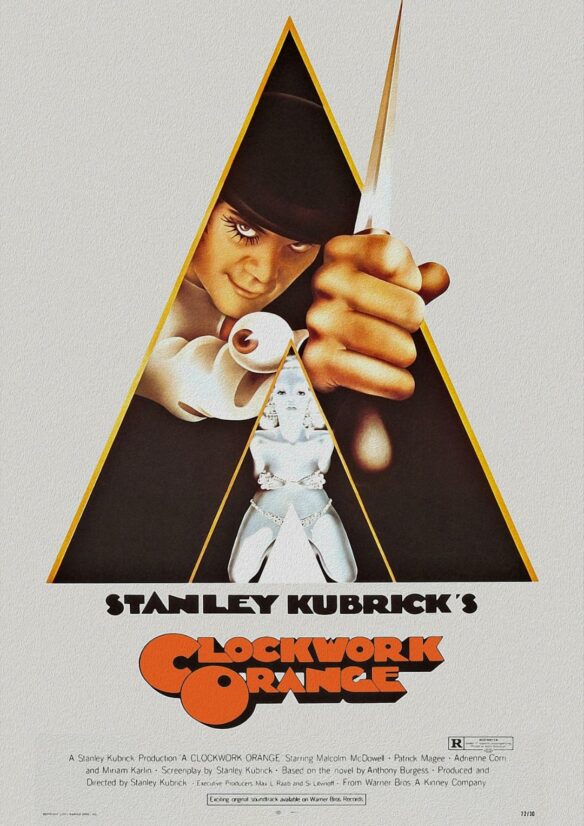
One of the best-known British film posters of the 20th century began life in the Borehamwood house of Stanley Kubrick, in a sketch drawn by the airbrush artist Philip Castle, who has died aged 83. Then a recent graduate of the Royal College of Art, who had advertised his services in the Daily Express, Castle was invited to meet the director at his home, where Kubrick played him a rough cut of his new film, A Clockwork Orange, without sound, and asked him to create a poster for it. “It was just incredible,” Castle told the Times in 2000. “My favourite film was Dr Strangelove, followed by 2001 [A Space Odyssey]. I was just the biggest fan.”
In the director’s home theatre, he drafted images in his notebook of Malcolm McDowell, who played the gang leader Alex DeLarge in Kubrick’s 1971 adaptation of Anthony Burgess’s novel. McDowell stares menacingly out of the page, holding a knife, with a floating eyeball nearby. This notebook – shown at two recent exhibitions in London, Daydreaming With Stanley Kubrick at Somerset House (2016) and Stanley Kubrick: The Exhibition at the Design Museum (2019) – holds most of the elements of the finished film poster, before Castle filled the final image with paint from an airbrush. This was the tool that allowed him to develop his distinctive style….
There’s also the cover for the computer game Elite that is very recognizable to UK nerds of my age, I dunno if it was also on US copies? It’s a rare cover in that it’s accurate to the original designs. IIRC commenter Cliff Ramshaw was a UK computer journalist around the time that came out. Image source is ISFDB, which also has a few book covers, including Andre Norton’s Witch World series and Leiber’s The Wanderer.

(6) MEMORY LANE.
[Written by Cat Eldridge.]
Heinlein’s The Moon Is a Harsh Mistress
Heinlein’s The Moon Is a Harsh Mistress is one of my favorite SF works. I knew it had won a well-deserved Hugo at NyCon 3 but I hadn’t realized that it was nominated the previous year at Tricon. Isn’t that a tad unusual?
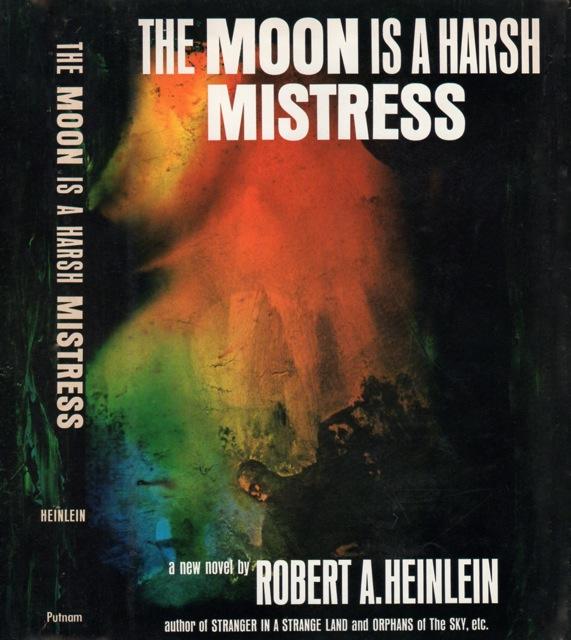
It had been first published in If magazine in five parts starting in the December 1965 issue. It was then published in hardcover by G. P. Putnam’s Sons in 1966. The Penguin Publishing Group has it for sale at the usual suspects as does what I suspect is one pirate publisher as it has no copyright information.

Now I really think that everyone here has read this novel but keeping with our very firm policy of absolutely no spoilers, I won’t say anything beyond the fact that I think that this is one of his best novels and I’ve thoroughly enjoyed it each and every time I’ve experienced it. Characters, stetting and story — what’s not to really like here?
So now to our most superb Beginning…
I SEE IN Lunaya Pravda that Luna City Council has passed on first reading a bill to examine, license, inspect—and tax—public food vendors operating inside municipal pressure. I see also is to be mass meeting tonight to organize “Sons of Revolution” talk-talk.
My old man taught me two things: “Mind own business” and “Always cut cards.” Politics never tempted me. But on Monday 13 May 2075 I was in computer room of Lunar Authority Complex, visiting with computer boss Mike while other machines whispered among themselves. Mike was not official name; I had nicknamed him for Mycroft Holmes, in a story written by Dr. Watson before he founded IBM. This story character would just sit and think—and that’s what Mike did. Mike was a fair dinkum thinkum, sharpest computer you’ll ever meet.
Not fastest. At Bell Labs, Buenos Aires, down Earthside, they’ve got a thinkum a tenth his size which can answer almost before you ask. But matters whether you get answer in microsecond rather than millisecond as long as correct?
Not that Mike would necessarily give right answer; he wasn’t completely honest.
When Mike was installed in Luna, he was pure thinkum, a flexible logic—“High-Optional, Logical, Multi-Evaluating Supervisor, Mark IV, Mod. L”—a HOLMES FOUR. He computed ballistics for pilotless freighters and controlled their catapult. This kept him busy less than one percent of time and Luna Authority never believed in idle hands. They kept hooking hardware into him—decision-action boxes to let him boss other computers, bank on bank of additional memories, more banks of associational neural nets, another tubful of twelve-digit random numbers, a greatly augmented temporary memory. Human brain has around ten-to-the-tenth neurons. By third year Mike had better than one and a half times that number of neuristors.
And woke up.
(7) JIMMY WEBB – AMERICAN SONGWRITER CONNECTED TO GENRE FICTION. [Item by Dann.] Jimmy Webb is a songwriter, composer, and singer with a long and storied history within the music business. The son of a US Marine veteran of the WWII island-hopping campaign against Imperial Japan and Baptist preacher, Jimmy began his career working by crafting songs for various Motown artists.
 Jimmy Webb
His work was performed by a wide range of artists including Vikki Carr, The 5th Dimension, and The Supremes. He developed a close relationship with singer Glen Campbell whose performances of “Galveston”, “By The Time I Get To Phoenix”, and “Wichita Lineman” became standards in the American songbook.
Glen Campbell also popularized the Jimmy Webb song “Highwayman” which includes an interstellar reference:
I fly a starship
Across the Universe divide
And when I reach the other side
I’ll find a place to rest my spirit if I can
Jimmy’s relationship with genre figures includes the late Richard Harris who was the first incarnation of Dumbledore in the Harry Potter movies. It was Richard Harris’ recording of “MacArthur Park” that first popularized that song. Harris was nominated for a Grammy Award in 1968 for the best pop male vocal performance of “MacArthur Park”. [Also nominated were Glen Campbell for another Jimmy Webb song “Wichita Lineman” and the ultimate winner in the category José Feliciano who covered The Doors’ “Light My Fire“.]
Harris’ version of “MacArthur Park” went to number 2 on the Hot 100 chart. Jimmy Webb’s only number one hit in his career was when Donna Summer’s version went to the top of the chart.
Jimmy Webb proceeded to write and produce two full albums of music performed by Richard Harris. The first album released in 1968 was the Grammy nominated A Tramp Shining album. The second album “The Yard Went On Forever” was released later the same year.
As evidenced by the starship reference in “Highwayman”, Jimmy has had a long relationship with genre fiction.
A long-time fan of Robert A. Heinlein, Webb proceeded to write “The Moon Is A Harsh Mistress”. Robert Heinlein offered no opposition to using that name for the song.
The song is more of a love song than a paean to science fiction with the moon representing a woman who is hard to hold in love.
The moon’s a harsh mistress
And the sky is made of stone
The moon’s a harsh mistress
She’s hard to call your own
The song was first performed by Joe Cocker and has been subsequently recorded 30 times by artists including Glen Campbell (natch!), Pat Metheny, Linda Ronstadt, Joan Baez, and Maureen McGovern.
Jimmy Webb talked about his relationship with genre fiction and Robert A. Heinlein specifically in a 2009 interview for Penny Black Music by Lisa Torem.
Penny Black Music: Another beautiful ballad ‘The Moon is a Harsh Mistress’ (1977, ‘El Mirage’, Rhino Handmade) was inspired by science- fiction literature. Does literature often inspire you?
Jimmy Webb: Well, it always has. In that particular case, you know, Robert Heinlein, was a kind of early mentor of mine. I started reading his books when I was eight years old. He really wrote juvenile novels – ‘Starship Trooper.’ But, he had a lot of political content and sociological content. I guess I was really getting more of my education out of science-fiction than out of public school. I was reading Ray Bradbury and Isaac Asimov and learning a great deal about the patois of the language itself and how these words were being used to create emotions. I was learning this from writers without even knowing it.
And since science-fiction is my cup of tea and I don’t think I turned out to be wrong – I think it’s dominated the film industry over the past few years and it turned out to be a legitimate form of expression.
When I first started reading sci-fi they were debating whether it as a legitimate art-form. I’m not going to get into that…
This isn’t really art – these are just stories that people make up. People like Arthur C. Clarke invented the communications satellite and Jules Verne – as a visionary – what they were was futurists. And so what I was doing was looking with a glazed look on my face and my father would say, “Where are you now, Jimmy?”
But, I guess I always knew that. ‘The Moon is a Harsh Mistress’ was one of the best titles I’ve ever heard in my life. I really am guilty of appropriating something from another writer. In this case I had contact with Robert A. Heinlein’s attornies. I said, “I want to write a song with the title, ‘The Moon is a Harsh Mistress.’ Can you ask Mr. Heinlein if it’s okay with him?” They called me back and he said he had no objection to it.
(8) TODAY’S BIRTHDAY.
[Written by Cat Eldridge.]
March 21, 1946 – Timothy Dalton, 80
Timothy Dalton made his film debut fifty-eight years ago as Philip II of France in The Lion in Winter. I remember him distinctly in that role. Of course, I’ve watched that film enough times that I think I’ve memorized much of the script.
He would do two Bond films, The Living Daylights and Licence to Kill. He made a decent Bond, but then I think the only true Bond was Connery.
Now doing a dive into his genre roles, he was Prince Barin in Flash Gordon, and had a major role as film star Neville Sinclair, one of baddies in The Rocketeer. An absolutely amazing film which is why it got a nomination for a Hugo at MagiCon.
And he was Lord President Rassilon in “The End of Time”, the last Tenth Doctor story. He made a rather impressive Time Lord indeed.
I’ll finish up with his role as the Chief on the DC Universe/Max Doom Patrol series. It was a great role for him, and a most excellent series indeed.
 Timothy Dalton
(9) COMICS SECTION.
(10) ADVANCE ‘STRANGER THINGS’ SCREENINGS. “First 2 Episodes of ‘Stranger Things: Tales from ’85’ Coming to Theaters” reports Animation Magazine. It’s happening on April 18 – see availability below.
Netflix is inviting fans to return to Hawkins via a big screen portal for “Stranger Saturday,” with a special theatrical engagement for the first two episodes of new animated series spin-off Stranger Things: Tales from ’85! Fans can plunge into the new adventure, brought to life by showrunner Eric Robles, in select theaters ahead of the series streaming premiere on April 23.
The screenings will take place on April 18 at 12 p.m. and 3 p.m. local time, in 34 theaters across the U.S. in partnership with AMC Theatres. Screenings will also take place at the Paris Theater in New York (ParisTheaterNYC.com) as well as Netflix House Philadelphia (Netflix.com/House).
Tickets will go on sale on Wednesday, March 18 at 8 a.m. PT. To choose from the full list of theaters and showtimes in your area, and to download tickets, visit AMCTheatres.com.
(11) WHEN CRAFT COLLIDE. [Item by Andrew Porter.] As I commented on Daytonian in Manhattan’s post “The 1914 Municipal Building – 1 Centre Street”:
“The Second Deluge,” a 1912 science fiction novel by Garrett P. Serviss details a catastrophic, world-ending flood caused by the Earth passing through a watery nebula (they were misunderstood at the time, and thought to be within the Milky Way). As the oceans rise, a massive ark to save a remnant of humanity is built. The novel details how the ark floats and destroys the Municipal Building, the highest structure in NYC. It’s a classic of early science fiction, known for its vivid descriptions, exploration of survival themes, and its blend of scientific speculation with adventure.

(12) FELINE LISTENERS. BBC tells how “Guernsey students improve skills by reading to rescue cats”. (Subscription required by readers outside the UK.)
Students from a Guernsey secondary school are practising their literacy skills by reading to cats at the island’s animal shelter.
Les Beaucamps pupils read to the cat Mr B, who was found as a stray with high blood pressure which led to him losing his sight.
Student Neva said: “It’s been wonderful, he’s been very calm and he’s been purring.”
Lisa Harvey, inclusivity manager at Beaucamps, said: “The reading out loud really helps with their fluency, it also really helps with their social communication and interaction skills.”
Anna Paint, head of the cattery at the GSPCA said there are benefits for the cats as well as the students.
“The cats tend to quite enjoy it, they normally all come to the front of the pens and they sit quite quietly,” she said.
“So, Mr B, even though he is blind he can still hear so he enjoys having socials with the children.
“And its the tone of voice as well, so when they’re reading the tone is sort of quite quiet and very relaxing and peaceful.”
Harvey said the idea came from another type of animal therapy the school uses.
“We have a wag therapy dog that comes throughout the week and that was really successful so we’ve kind of expanded on that and then they come and read with the cats which has proven really successful.”
(13) THE SCIENCE OF PROJECT HAIL MARY. [Item by SF Concatenation’s Jonathan Cowie.] The cinematic adaptation of Andy Weir’s novel Project Hail Mary got its general release in western Europe and N. America 20th March.
Of course Andy Weir is noted for the excellent novel The Martian which is a masterpiece of mundane SF. The cinematic adaptation of which won a Best Dramatic Presentation – Long Form Hugo in 2016 (and which [ahem] previously those of us at SF² Concatenation cited as one of the best SF films of 2015). It also subsequently won Germany’s Curt Siodomak Prize.
With Project Hail Mary we enter more speculative SF territory with an existential threat to Earth in the form of a dying Sun… But let’s not get ahead of ourselves as the film has yet to come out in a full general release.
Nonetheless, Oxford-based astrophysicist Becky Smethurst (who specialises in black holes – or ‘frozen stars’ if you are of a Russian, Sov Blok, bent and a certain age) has taken a look at the science of Project Hail Mary over at her Dr Becky YouTube channel. She is joined with the film’s star Ryan Gosling and author Andy Weir. Together they discuss: what makes stars dim; the science behind astrophage; special relativity and time dilation; what we know about the real stars t-ceti and 40 Eridani and their planets; and the science of alien life, but not as we know it. It would have been good if they had had a biologist onboard for this last (I’m firmly with Brit Cit biologist and SF fan Jack Cohen on this one – chosen consultants on alien life are all too often astronomers and not biologists: biology is not, some say, a proper science).
By the way, of SFnal note 40 Eridani is the star around which Star Trek’s Spock’s home planet of Vulcan orbits, and around which it was thought an exoplanet had been detected, but alas in 2023 logic decreed it was a found to be false positive identification. Them’s the breaks.
Becky also sat down with Project Hail Mary’s directors, Phil Lord and Christopher Miller, about how you visually communicate difficult concepts like relativity on screen, whilst keeping the human story at the heart. It’s got alien life, interstellar travel, astrophysics, molecular biology and more, but how much of the science in Project Hail Mary works in the real Universe…?
Becky also says that at a future date there will be additional interview videos with her guests.
There are mild spoilers, but nothing that hasn’t already been revealed in the trailers…
You can see the 21-minute video below…
Time to tread boldly…
[Thanks to John King Tarpinian, Cat Eldridge, SF Concatenation’s Jonathan Cowie, Mark Roth-Whitworth, Kathy Sullivan, Steven French, Mike Kennedy, and Andrew Porter for some of these stories. Title credit belongs to File 770 contributing editor of the day Randall M.]
Subscribe to get the latest posts sent to your email.