Просмотр новости
Найдите то, что Вас интересует
 Спутники
 РН
РН SpaceX
 Роскосмос
 NASA
NASA
СпутникиРНSpaceXРоскосмосNASAJackson, a longtime lawmaker, consolidated support among Democrats at weekend caucuses thanks to his campaign's organization and policy overlaps with Graham Platner. He's almost certain to be the nominee.
 Former Maine Senate President Troy Jackson speaks during a rally at Thompson’s Point in Portland in May. (Daryn Slover/Staff Photographer)
Graham Platner had yet to announce his withdrawal from Maine’s U.S. Senate race when Jason Shedlock’s phone started blowing up with calls from friends and acquaintances looking to strategize about how Democrats could move forward to try and defeat Sen. Susan Collins.
It was just a few hours after news broke about a former girlfriend accusing Platner of sexual assault, and people were assuming that Platner would certainly be dropping out of the race even though he won the Democratic primary in June and denied the accusation.
Shedlock, a labor organizer and union leader, started talking with current and former union members as well as elected officials about a possible replacement for Platner: Troy Jackson.
“Almost to a person it was, ‘Troy should do it,’ and, ‘What can I do to help?” Shedlock said.
Less than two weeks later, Jackson, a longtime lawmaker and former president of the Maine Senate, commanded a resounding victory at county meetings where Democrats gathered to elect the delegates who will choose the party’s Senate nominee this weekend.
While the 601 delegates headed to the convention are unpledged, Jackson won enough support among those elected that four of his top rivals announced Sunday they were dropping out of the race. He still needs to formally get the nomination, but with only a handful of lesser-known candidates left in the race, Jackson’s victory seems all but assured.
Jackson’s decisive emergence as the presumptive nominee came as a surprise at the county caucuses — the first major step in a hastily drawn-up process Democrats developed while facing a July 27 deadline to name a replacement after Platner dropped out.
But behind the scenes, Jackson’s campaign and supporters — both locally and nationally — were working quickly to build on the groundwork he had laid in his recent campaign for governor. They were organized, and it helped that Jackson appeared to have the most policy overlap with Platner. (Both men were endorsed by progressive Sen. Bernie Sanders, I-Vt., last fall, and in May, Platner announced that Jackson was his top choice in the governor’s race.)
Now, Jackson’s supporters say his strong showing over the weekend will bode well for a November match-up with Collins, a Republican and five-time incumbent, though it remains to be seen how much he’ll be able to build on Platner’s success.
In some ways, Jackson, a 58-year-old logger from the north woods, is a more authentic working-class candidate than Platner, a 41-year-old oyster farmer whose largest client was his mother’s restaurant.
But Jackson may struggle to appeal to voters desperate for a political outsider.
The well-spoken and well-read Platner wooed crowds with blistering broadsides against the Republican and Democratic political establishment alike. And he had never held elected office before.
Jackson served in the state Legislature for two decades, beginning in 2002. His service ended in 2024 after an six-year run as the Senate president, putting him next in line for the governorship.
He also has a long voting record that will most assuredly be picked apart and litigated in the coming weeks and months.
ORGANIZATION AND POLICIES WERE KEYJackson’s campaign did not respond Monday to questions about the delegate-nominating process and the work it did to secure support from delegates.
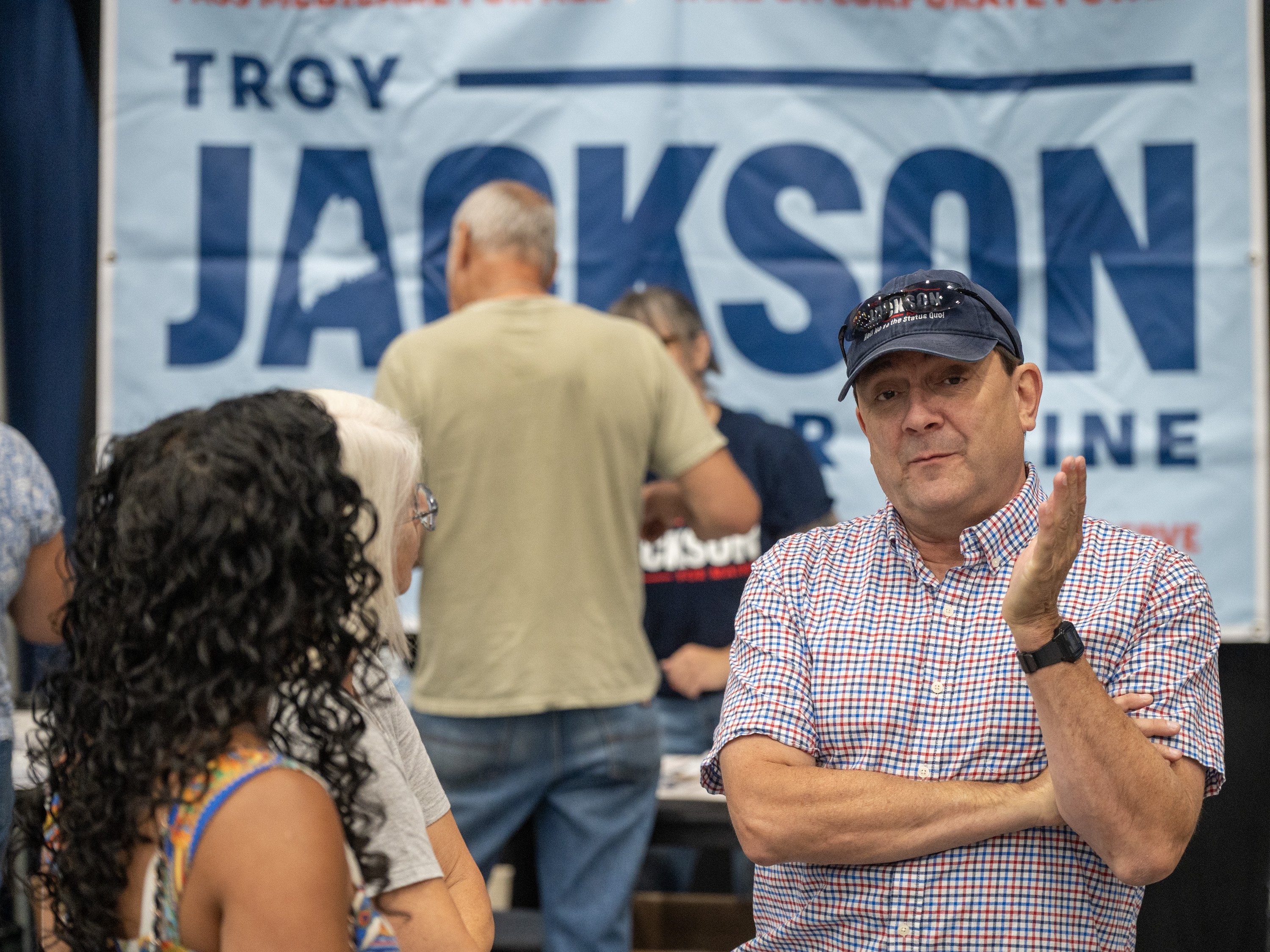 Democratic U.S. Senate candidate and former Maine Senate President Troy Jackson chats with a visitor to his campaign booth at Saturday’s meeting of Kennebec County Democrats in Augusta. (Joe Phelan/Staff Photographer)
In remarks to reporters at York County’s delegate nominating meeting Sunday, Jackson gave an abbreviated take on how things worked out, attributing his strong showing over the weekend to two factors: the strength of his political organizing operation, and his supporters’ conviction in his policy preferences.
Jackson boasted strong support from labor unions both while running in the Democratic primary for governor earlier this year (he finished third in the five-way race in June) and in his Senate campaign. He said his supporters were motivated to see a candidate who backs organized labor and Medicare for All win.
“The last seven or eight days, people just crushed it,” he said. “They were on the phone all the time. I was calling, people were calling to find out where people stood and see if they needed more information about me.”
“This is a real good example of how we really went out and tried to talk to everybody who was going to be a part of this and give them the option of coming our way, and obviously it worked,” he added.
State Sen. Joe Rafferty, D-Kennebunk, who was elected as a delegate at the York County meeting, was surprised to see Jackson shore up support so quickly. He said he, and other Democrats, went into the weekend of caucuses with no idea how things would turn out.
“I was kind of blown away, to be honest,” Rafferty said. “I thought the weekend was going to be long and everyone was going to wonder what was going on. Instead, it happened fast.”
Rafferty, who supported Jackson for governor, entered the meeting planning to also support him in the Senate race, but said he was also keeping an open mind about other candidates. Little did he know that the other major candidates would drop out before the day was over.
Rafferty agreed with Jackson’s take on how he succeeded, saying it seems to have been a mix of his campaign’s organization and his policy overlaps with Platner.
“A lot of people were looking for an answer once Platner got out, and he looked like the closest and strongest (candidate) in terms of policies,” Rafferty said.
While those progressive policies are popular with die-hard Democrats, Jackson will soon be charged with selling them to more moderate voters needed to win a statewide race, including independents, who comprise about a third of the state’s electorate.
Platner supporters and volunteers want to ensure those policies are not abandoned in a general election, where statewide candidates tend to moderate their positions.
Jackson was among three candidates to sign onto Platner’s policy platform through an effort organized by the Maine People Powered Movement. That group planned to hold a forum with former Platner organizers and Jackson on Monday.
At the weekend meetings, several candidates for delegate said they were looking for someone to carry forward Platner’s message of economic populism, and thought Jackson could do it.
Joseph Travis, an addiction treatment counselor from Saco who supported Platner, said he likes that Jackson is a lifelong Mainer, that he is pro-union and that he “is a regular guy who would be for the working man.”
There wasn’t any particular outreach from the campaign that prompted him to run as a delegate in support of Jackson. But Travis, who was elected, said he’s always been interested in politics and decided to get involved “because I’m so frustrated with the system and didn’t want to just stew over it.”
“I believe Troy has the best chance to beat Susan Collins,” he said.
LABOR AND PROGRESSIVE GROUPS HELPFor supporters like Shedlock who had been behind Jackson in the governor’s race and were disappointed with the outcome, the opening in the Senate race provided a chance for a “do-over,” he said. What happened next was “basically an old-fashioned phone tree” of supporters calling each other, making connections and holding each other accountable for tangible actions, like signing up to be delegates.
Shedlock serves as president of the Maine Building Trades Council and as an officer with the Laborers’ International Union of North America, two groups representing construction workers.
He said his members were “hungry for someone that looks like and represents them.” But the effort was also bigger than that, with other constituencies like veterans and students also getting involved, he said.
The Maine AFL-CIO, a federation of over 200 labor unions around the state, helped recruit people to run for delegate and turn them out for caucus meetings. Many of the people who ended up running as part of Jackson’s preferred “slate” of delegates were union members who are “rank and file” firefighters, nurses and construction workers, said AFL-CIO Executive Director Matt Schlobohm.
He said helping the campaign organize was a natural move for labor groups that had supported Jackson’s run for governor.
“We were fresh off a primary where we had 300 volunteers knock on 25,000 doors in support of Troy,” he said. “That network of folks were pretty immediately mobilized.”
National groups were involved too. Our Revolution, a group founded by Sanders with the goal of electing progressives, said it ran phone banks and text outreach, provided thousands of its members in Maine with instructions on how to register for and attend their county meetings, and staffed the meetings with volunteers.
Two other national progressive organizations, We Are Somebody and Progressive Democrats of America, also ran phone and text outreach encouraging support for Jackson.
If, as expected, Jackson formally secures the party’s nomination at Saturday’s convention in Bangor, he will have to pivot to building a campaign against Collins with just over three months until Election Day. Jackson said Sunday that he was planning to spend this week laying the groundwork for his campaign, and would be especially focused on fundraising efforts.
Collins announced last week that she raised $5.7 million in the second quarter of 2026 and has $11 million in cash on hand — twice the amount her campaign had at the same point in 2020, the last year in which she ran for reelection.
Outside groups are also planning to spend tens of millions of dollars between now and the Nov. 3 election. Republican groups have booked more than $61 million in ads, while Democrats have booked more than $20.3 million, according to Ad Impact.
In a news release Monday, Collins’ campaign poked fun at Democrats’ process in “one of the more unusual Senate primaries in Maine history.” The campaign did not name Jackson, referring to him only as “Graham Platner’s choice.”
Jackson has not yet reported any fundraising in the Senate race, according to federal campaign finance filings, though he trailed his Democratic opponents in the primary for governor this past spring. His supporters are hoping this past weekend’s results will give him a boost.
“I think this will show donors that, hey, this isn’t just a ragtag group of folks trying to make a statement,” Shedlock said. “This is how you build a campaign.”
| # | Наименование новости | Тональность | Информативность | Дата публикации |
|---|---|---|---|---|
| 1 | Maine Democrats largely stand by Graham Platner amid D.C. worries | 0 | 35.91 | 06-06-2026 |
| 2 | In Maine’s mini-primary, to run for Senate is to run from Graham Platner | 0 | 5 | 09-07-2026 |
| 3 | Troy Jackson files to explore Senate run in case Graham Platner drops out | 0 | 5 | 07-07-2026 |
| 4 | Democrats unite behind Troy Jackson as their next U.S. Senate candidate | 0 | 38.28 | 25-07-2026 |
| 5 | Democrats crown Troy Jackson with a show in Bangor, and few surprises | 0 | 35.91 | 25-07-2026 |
| 6 | 2 more drop out of Maine Senate race | 0 | 43.36 | 20-07-2026 |
| 7 | Graham Platner suspends bid for Maine Senate seat amid sexual assault scandal | 0 | 5 | 09-07-2026 |
| 8 | For rural healthcare and reproductive justice, Troy Jackson gets our vote | Opinion | 0 | 36.78 | 15-07-2026 |
| 9 | Maine Democrats must now check their egos at the door | Opinion | 0 | 37.31 | 24-07-2026 |
| 10 | Graham Platner clinches Democratic nomination to take on Susan Collins in Maine Senate race | 0 | 36.43 | 10-06-2026 |