Просмотр новости
Найдите то, что Вас интересует
 Спутники
 РН
РН SpaceX
 Роскосмос
 NASA
NASA
СпутникиРНSpaceXРоскосмосNASAServer Side Request Forgery (SSRF) tricks your own server into fetching malicious URLs — leaking cloud credentials, exposing internal services, and bypassing firewalls entirely. This guide walks through a real vulnerable Python app, explains every attack vector including DNS rebinding, and builds a production-ready fix with six layers of defense.
The post Server Side Request Forgery (SSRF) Explained for Developers appeared first on CodeSamplez.com.
You are here: Home / Development / Server Side Request Forgery (SSRF) Explained for Developers
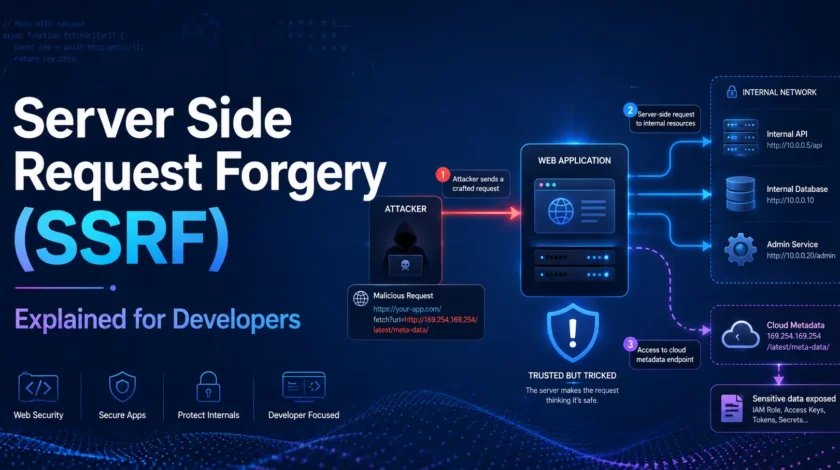
Imagine you are building a “URL preview” feature — the kind that fetches a link and shows a thumbnail, like Slack or Twitter does (or e.g. a free screenshot service). You shipped it on a Friday. By Monday, an attacker had used it to quietly pull the AWS credentials off the server’s metadata endpoint. The entire cloud account was compromised. No malware. No exploit kit. Just one unvalidated URL parameter. 🔥
That incident is one of the clearest examples of Server Side Request Forgery (SSRF) you can think of, and it’s exactly why this vulnerability is now listed in the OWASP Top 10 as its own dedicated category. If you’re building anything that fetches URLs, talks to APIs, or reads remote content on behalf of a user, you need to understand SSRF before you ship.
Server Side Request Forgery (SSRF) is a web security vulnerability where an attacker tricks a server into making HTTP requests to an unintended location — often an internal service or cloud metadata endpoint — by supplying a malicious URL as input.
That’s the short answer. Now let’s unpack what that actually means in practice.
When your application fetches a remote URL on behalf of a user (think: “paste a link and we’ll import it”), your server is the one making that HTTP request. The request originates from inside your infrastructure, which means it can reach internal services, private IP ranges, and cloud provider metadata APIs that are completely inaccessible from the public internet.
The attacker doesn’t break in — they redirect your own server to do the fetching for them.
Normal flow:
  User → [App Server] → api.example.com  (intended)

SSRF flow:
  User (attacker) → [App Server] → 169.254.169.254   (AWS metadata — NOT intended)
                                 → http://localhost:6379  (internal Redis)
→ http://192.168.1.1 (internal admin panel)SSRF isn’t just a theoretical CTF puzzle. It shows up in real production systems more often than you’d think, and the consequences range from embarrassing to catastrophic.
1. Cloud Environments Make SSRF Extremely High-RiskEvery major cloud provider — AWS, GCP, Azure — exposes a link-local metadata endpoint at 169.254.169.254. This endpoint responds to any request originating from within the instance. It hands out IAM credentials, SSH keys, instance configuration, and more — with zero authentication required.
An SSRF vulnerability in a cloud-hosted app means an attacker can hit:
http://169.254.169.254/latest/meta-data/iam/security-credentials/…and get back temporary AWS access keys. Game over. This exact attack vector was central to the 2019 Capital One breach — a misconfigured WAF with an SSRF flaw led to 100 million customer records being exposed.
2. SSRF Bypasses Your Firewall EntirelyYour firewall probably blocks external traffic to internal services. But SSRF doesn’t come from outside — the request comes from your own server. Internal services like Redis, Elasticsearch, Kubernetes API servers, and admin dashboards that assume “internal = trusted” are all suddenly exposed.
3. SSRF Enables Lateral Movement and Data ExfiltrationOnce an attacker can make your server issue arbitrary requests, they can:
Example Vulnerability and Protection MechanismsReflective question: Does your application fetch any URL that a user provides — even partially? If the answer is yes, keep reading.
Let’s build a realistic “URL content fetcher” — a feature you’d find in any link-preview, webhook tester, or RSS reader — and see exactly how it goes wrong, then fix it properly.
The Vulnerable Version# vulnerable_fetcher.py
# ⚠️ DO NOT USE IN PRODUCTION — this is intentionally broken for learning purposes
import requests
from flask import Flask, request, jsonify
app = Flask(__name__)
@app.route("/fetch", methods=["GET"])
def fetch_url():
# 🚨 CRITICAL: The user controls `url` completely — no validation at all.
url = request.args.get("url")
if not url:
return jsonify({"error": "url parameter required"}), 400
# 🚨 CRITICAL: requests.get() will happily fetch:
# - http://169.254.169.254/latest/meta-data/ (AWS metadata)
# - http://localhost:6379/ (local Redis)
# - http://192.168.1.1/admin (internal router)
# - file:///etc/passwd (local files, in some libs)
response = requests.get(url, timeout=5)
return jsonify({
"status": response.status_code,
"body": response.text[:500] # Still leaks data even with truncation
})
if __name__ == "__main__":
app.run(debug=True)Bash
An attacker hits this with:
# Steal AWS credentials in one request
curl "http://your-app.com/fetch?url=http://169.254.169.254/latest/meta-data/iam/security-credentials/MyRole"

# Probe internal services
curl "http://your-app.com/fetch?url=http://localhost:6379/"

# Read local files (if the HTTP library supports file:// — some do)
curl "http://your-app.com/fetch?url=file:///etc/passwd"
Bash
Fixing SSRF requires multiple layers. One check isn’t enough.
# safe_fetcher.py
# ✅ Production-ready SSRF-protected URL fetcher

import ipaddress
import socket
import requests
from urllib.parse import urlparse
from flask import Flask, request, jsonify

app = Flask(__name__)

# ---------------------------------------------------------------------------
# Layer 1: Define an explicit allowlist of permitted schemes and hostnames.
# Always prefer allowlisting over denylisting — blocklists are bypassable.
# ---------------------------------------------------------------------------
ALLOWED_SCHEMES = {"https"}            # Force HTTPS only; reject http, file, ftp, gopher, etc.
ALLOWED_HOSTS   = {
    "api.example.com",
    "cdn.example.com",
    "partner-webhooks.trusted.com",
}

# ---------------------------------------------------------------------------
# Layer 2: Private/reserved IP ranges that must NEVER be reached.
# This is your backstop if an allowed hostname resolves to an internal IP
# (DNS rebinding attack) or if the allowlist is accidentally too broad.
# ---------------------------------------------------------------------------
PRIVATE_RANGES = [
    ipaddress.ip_network("10.0.0.0/8"),
    ipaddress.ip_network("172.16.0.0/12"),
    ipaddress.ip_network("192.168.0.0/16"),
    ipaddress.ip_network("127.0.0.0/8"),        # Loopback
    ipaddress.ip_network("169.254.0.0/16"),     # Link-local (AWS metadata lives here!)
    ipaddress.ip_network("::1/128"),            # IPv6 loopback
    ipaddress.ip_network("fc00::/7"),           # IPv6 unique local
]

def is_private_ip(hostname: str) -> bool:
    """
    Resolve the hostname to its IP and check whether it falls in a private range.
    This catches attacks like:
      - Directly supplying 169.254.169.254 as the host
      - Using a DNS name that resolves to an internal IP (DNS rebinding)
    """
    try:
        # getaddrinfo returns all addresses — check every one of them.
        resolved = socket.getaddrinfo(hostname, None)
        for result in resolved:
            ip = ipaddress.ip_address(result[4][0])
            if any(ip in network for network in PRIVATE_RANGES):
                return True
        return False
    except (socket.gaierror, ValueError):
        # If we can't resolve it, deny it — fail closed, not open.
        return True


def validate_url(url: str) -> tuple[bool, str]:
    """
    Validate a user-supplied URL against our allowlist and IP blocklist.
    Returns (is_valid: bool, reason: str).
    """
    try:
        parsed = urlparse(url)
    except Exception:
        return False, "Malformed URL"

    # Check 1: Scheme must be in allowlist (rejects file://, gopher://, etc.)
    if parsed.scheme not in ALLOWED_SCHEMES:
        return False, f"Scheme '{parsed.scheme}' is not permitted"

    # Check 2: Hostname must be in allowlist
    hostname = parsed.hostname
    if not hostname or hostname not in ALLOWED_HOSTS:
        return False, f"Host '{hostname}' is not on the allowlist"

    # Check 3: Resolve to IP and block private ranges (catches DNS rebinding)
    if is_private_ip(hostname):
        return False, f"Host '{hostname}' resolves to a private/reserved IP address"

    return True, "OK"


@app.route("/fetch", methods=["GET"])
def fetch_url():
    url = request.args.get("url", "").strip()

    if not url:
        return jsonify({"error": "url parameter required"}), 400

    # Run all validation layers before making any network request.
    is_valid, reason = validate_url(url)
    if not is_valid:
        # Log the rejected attempt for your security team — don't expose `reason` to the user.
        app.logger.warning("SSRF attempt blocked: %s | url=%s", reason, url)
        return jsonify({"error": "URL not allowed"}), 403

    try:
        response = requests.get(
            url,
            timeout=5,
            # Layer 4: Disable redirects entirely, or re-validate the redirect target.
            # Attackers use open redirects on allowed hosts to pivot to internal IPs.
            allow_redirects=False,
            # Layer 5: Use a custom User-Agent so you can identify your fetcher in logs.
            headers={"User-Agent": "MyApp-Fetcher/1.0"},
        )
    except requests.RequestException as exc:
        app.logger.error("Fetch failed: %s", exc)
        return jsonify({"error": "Could not retrieve URL"}), 502

    # Layer 6: Limit response size — don't buffer a 10 GB response in memory.
    MAX_BYTES = 1024 * 512  # 512 KB
    body = response.content[:MAX_BYTES]

    return jsonify({
        "status": response.status_code,
        "body": body.decode("utf-8", errors="replace"),
    })


if __name__ == "__main__":
    app.run(debug=False)  # Never run debug=True in production!
Bash
https. The file://, gopher://, and dict:// schemes have been used to exploit SSRF in various HTTP libraries.169.254.169.254 after your allowlist check passes.https://api.example.com/redirect?to=http://169.254.169.254/ would bypass a naïve host check. Disable automatic redirects and re-validate the Location header if you must follow them.Blind SSRF — The Invisible Attack 👁️Pro Tip: Consider using a dedicated egress proxy like Smokescreen by Stripe instead of rolling your own SSRF filter. It handles DNS rebinding, IPv6 bypass, and redirect chasing at the network level, so your application code stays simple.
Not all SSRF produces visible output. In Blind SSRF, the server makes the request but returns no response body to the attacker. They infer success by watching for:
192.168.1.1:80 vs. 192.168.1.1:81 reveals whether port 80 is open.Your defense is identical — allowlist, validate, and block private IPs before the request is ever made.
Troubleshooting & GotchasThese are the mistakes I see developers make most often when trying to fix SSRF.
Mistake 1: Using a Denylist Instead of an Allowlist# ❌ WRONG — denylist approach. Bypasses are endless.
BLOCKED = {"169.254.169.254", "localhost", "127.0.0.1"}
if parsed.hostname in BLOCKED:
return False, "Blocked"Bash
Attackers bypass denylists with:
http://2852039166/ — decimal representation of 169.254.169.254http://0251.0376.0251.0376/ — octal encodinghttp://169.254.169.254.nip.io/ — DNS that resolves to the target IPhttp://[::ffff:169.254.169.254]/ — IPv6-mapped IPv4 addressFix: Always allowlist. If you can’t enumerate valid destinations, you need to rethink the feature design itself.
Mistake 2: Checking the URL Before Following Redirects# ❌ WRONG — validates the initial URL but blindly follows redirects
is_valid, _ = validate_url(url)
if is_valid:
response = requests.get(url, allow_redirects=True) # Redirect target is unchecked!Bash
If the validated host issues a 302 Location: http://169.254.169.254/..., you’ve been exploited.
Fix: Set allow_redirects=False. If you must follow redirects, extract the Location header and run validate_url() on it before following.
Private IPv6 addresses (::1, fc00::/7) are just as dangerous as IPv4 private ranges. If your server has an IPv6 stack and your validator only checks IPv4 ranges, you have a gap.
Fix: Include IPv6 ranges in your PRIVATE_RANGES list — the production-ready code above already does this.
Silently dropping invalid requests means your security team never knows an attack is in progress. Log every blocked SSRF attempt with the full URL, timestamp, and requester IP so you can spot patterns and respond quickly.
Limitations / Caveats When the Allowlist Approach Doesn’t FitIf your product’s entire value proposition is fetching arbitrary user-supplied URLs — a general-purpose web scraper or a browser-based testing tool — you can’t use a tight allowlist. In that case:
Even resolving at validation time leaves a race window — the DNS TTL can expire between your check and the actual HTTP request. The only fully reliable fix is network-level egress filtering. Application-layer checks are a strong additional layer, not a complete solution on their own.
SSRF Isn’t Always About HTTPSome SSRF variants exploit protocols beyond HTTP: gopher:// can send raw TCP data to Redis or memcached, and dict:// can trigger commands on dict servers. Scheme allowlisting — only permitting https — closes these vectors cleanly.
Next StepsReflective question: If you inherited a codebase today, how would you quickly audit it for SSRF? Hint: search for
requests.get,urllib.request,curl,fetch, andhttp.get— then trace where their URL arguments come from.
You’ve got the fundamentals solid. Here’s where to go from here:
avatarUrl, webhookEndpoint) are common SSRF targets that frequently get missed in code reviews.Dockerfile instructions or webhook receivers can be SSRF vectors too — a frontier that’s increasingly targeted.Server Side Request Forgery is one of those vulnerabilities that’s deceptively simple to introduce and genuinely devastating to get wrong. It doesn’t require a sophisticated exploit — just an unvalidated URL and a server with network access to something sensitive. In a cloud environment, that combination is almost always present by default.
The good news: the fix is equally straightforward once you understand the attack. Allowlist your destinations, resolve DNS and check the resulting IP, disable automatic redirects, and fail closed. Those four steps eliminate the vast majority of SSRF risk in a standard web application.
Now go audit your codebase. Search for every place your application fetches a URL and ask yourself: can a user influence any part of this URL? If the answer is yes and you don’t have an allowlist in place, that’s your next pull request. Ship it before someone else finds it for you. 🚀
Subscribe to get the latest posts sent to your email.
| # | Наименование новости | Тональность | Информативность | Дата публикации |
|---|---|---|---|---|
| 1 | Into the Borg – SSRF inside Google production network | 0 | 11.2 | 20-07-2018 |
| 2 | Researchers Use Remote Spectre Attack to Leak JWT From Cloudflare Worker | 0 | 6.15 | 20-08-2026 |
| 3 | spoof: A Simple HTTP Server for Test Environments | 0 | 10 | 11-06-2026 |
| 4 | Beware the false false-positive: how to distinguish HTTP pipelining from request smuggling | 0 | 7 | 19-08-2025 |
| 5 | Cookie Chaos: How to bypass __Host and __Secure cookie prefixes | 0 | 7 | 03-09-2025 |
| 6 | Advanced Flash Vulnerabilities in Youtube – Part 2 | 0 | 11.14 | 30-08-2017 |
| 7 | The Fragile Lock: Novel Bypasses For SAML Authentication | 0 | 8 | 10-12-2025 |
| 8 | JSON vs JSONC vs JSON5: The Complete Guide for Devs | 0 | 10.49 | 15-04-2026 |
| 9 | Брешь в инфраструктуре Python, позволявшая подменить ссылки на релизы на сайте python.org | -2 | 8 | 27-06-2026 |
| 10 | Скам під час тестових на інтерв'ю | 0 | 10.1 | 06-06-2026 |