Просмотр новости
Найдите то, что Вас интересует
 Спутники
 РН
РН SpaceX
 Роскосмос
 NASA
NASA
СпутникиРНSpaceXРоскосмосNASADiscover how Portainer seamlessly integrates with various Kubernetes distributions, making cluster management easier and safer. Explore the compatibility with popular distros and the advanced features available.
For a while now, Portainer has offered a unified management control point for Kubernetes - any Kubernetes, anywhere - but recently we have been asked specifically if we know of any concerns or considerations with a few named distros such as; MicroK8s, Talos, Openshift, KOs, K3s, Rancher and Amazon EKS. I thought I would try them all out and I also tried; Azure AKS, Amazon EKS, Google GKE, Civo Kubernetes, Digital Ocean Kubernetes, Linode Kubernetes, Vultr Kubernetes.
As anyone who knows Portainer is likely aware, we do not provide any Kubernetes distribution; we focus solely on the managed Kubernetes configuration and consumption layer. By that I mean we make it really easy for Ops to configure a cluster (authentication, access, quota, security policy etc), and for Users (Devs) to consume the cluster (deploy apps, triage apps, configure GitOps pipelines etc). This has been our focus because we believe that raw Kubernetes requires too much specialist knowledge to operate, and we want to make it easier and safer. As a byproduct of that focus we are required to work on top of many different Kubernetes distributions, from the smallest to the largest, from community-supported to enterprise-supported. You name it, we likely have a customer using it.
Anyway, while we do a degree of QA against the most common distros, we cannot possibly test Portainer against all of them.
I decided it would be an interesting experiment to spin up as many of the distributions as I could, especially all of the ones our customers and/or users have mentioned to us in passing. So this is what I have done.
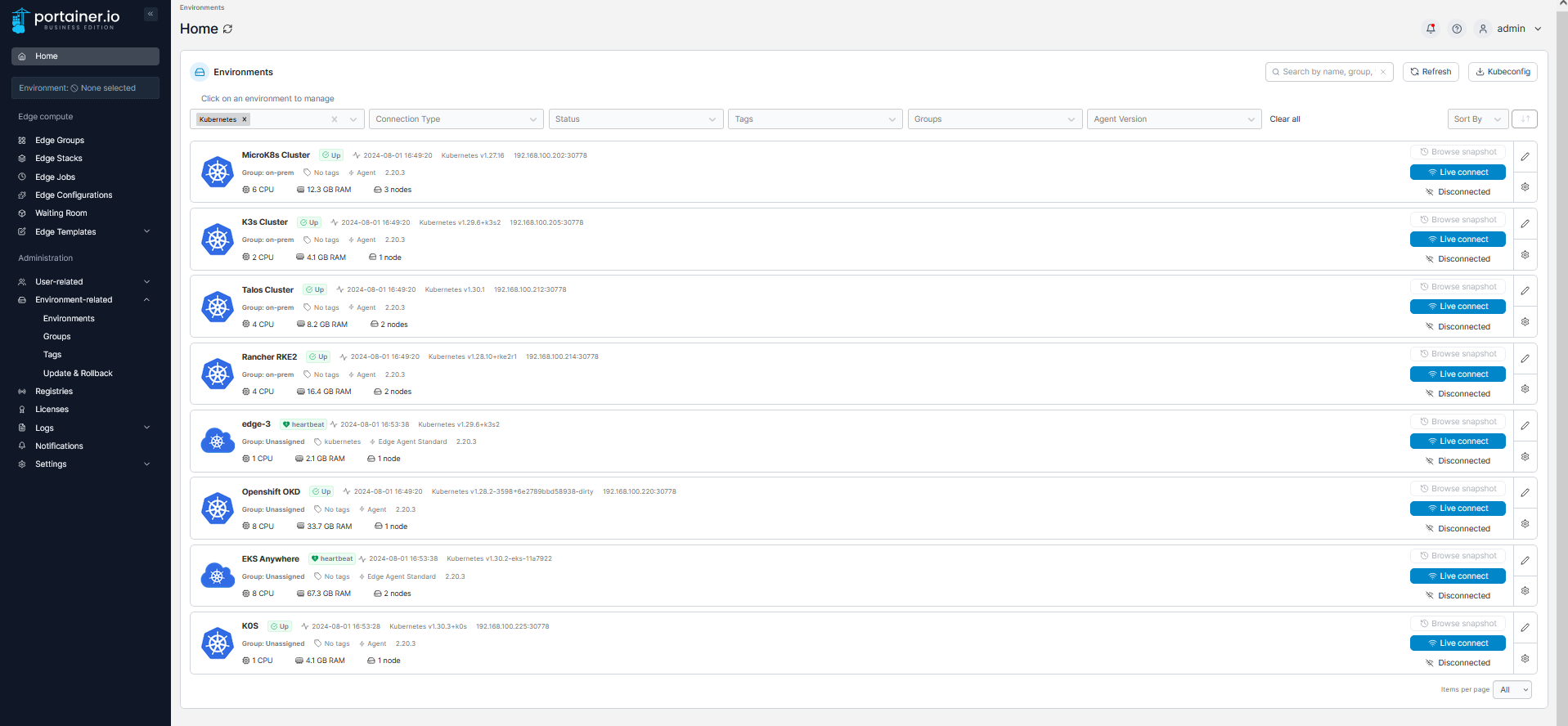
I now have an instance of Portainer that is managing the self-hosted distros:
Of course, I also spun up and connected Portainer to:
though I tore these Cloud ones back down again after testing, because of the cost.
FindingsRunning Portainer through its paces, I could use every single "Platform" feature, including our centralized user authentication and RBAC (creating users with corresponding roles and role bindings) in the managed clusters. I was able to enable advanced security for each cluster (which deploys and configures OPA Gatekeeper, with a number of pre-set policies). I was able to deploy and configure GitOps pipelines to each of the clusters using Portainer's integrated GitOps engine, and I was able to centrally access all of the clusters via Portainer's Kubernetes API proxy endpoint (meaning I did not need to expose the Kubernetes API externally on any of these clusters). I was able to view metrics and events, I was able to interact with the nodes to see cluster and node health, and I was able to do all of this from a single UI with a consistent UX regardless.
I would call that a win.
I plan to keep this environment running and add to the list as more distros become requested. I would also love to spin up VMware TKG, but its very big.
Are there any distros that I have not tested, and that you would like me to try out? Leave a comment and I will try it.
Infrastructure Moves Fast. Stay Ahead.
Subscribe to our monthly newsletter
Neil Cresswell is the co-founder and CEO of Portainer, a popular platform that simplifies container management for Docker, Kubernetes, and edge environments. A veteran of over 25 years in IT, he began his career with 12 years at IBM before leading VMware consulting at ViFX across Asia-Pacific and serving as CEO for cloud service providers. Frustrated by the lack of usable tooling for “containers as a service,” he created Portainer to make container technology accessible to everyone. Under his leadership, Portainer has grown from an open-source UI into an enterprise-ready platform used globally.
| # | Наименование новости | Тональность | Информативность | Дата публикации |
|---|---|---|---|---|
| 1 | From Rancher to Portainer: Your Step-by-Step Migration Blueprint | 5 | 7 | 22-01-2026 |
| 2 | Portainer: The Essential Tool for Docker Swarm Users Facing a Kubernetes Future | 5 | 7 | 20-02-2026 |
| 3 | Choosing the best Kubernetes dashboard for your Enterprise | 0 | 5 | 08-01-2026 |
| 4 | Kubernetes Platform Support: Reduce Operational Risk at Scale | 5 | 7 | 25-03-2026 |
| 5 | 7 Best Kubernetes Managed Service Providers for 2026 | 0 | 7 | 17-03-2026 |
| 6 | Portainer vs ArgoCD vs FluxCD: Key Differences & Use Cases | 0 | 7 | 31-01-2026 |
| 7 | Managed Kubernetes: What It Is, How It Works, and Use Cases | 0 | 8 | 10-03-2026 |
| 8 | Kubernetes Support: Services, Tiers & What Enterprises Need | 0 | 7 | 16-03-2026 |
| 9 | Why we rebranded Portainer | 5 | 7 | 05-03-2026 |
| 10 | 7 Best Kubernetes Deployment Tools in 2026: In-Depth Review | 5 | 7 | 02-05-2026 |