Просмотр новости
Найдите то, что Вас интересует
 Спутники
 РН
РН SpaceX
 Роскосмос
 NASA
NASA
СпутникиРНSpaceXРоскосмосNASASpaceX has identified a massive total addressable market (TAM) for Starlink Mobile … but many people have expressed doubts. Let’s look at the technical issues that matter. A detailed analysis […]
The post Starlink’s Link Budget Comes up Short for the D2D Opportunity appeared first on Via Satellite.
 Satellite-to-cell graphic. Photo illustration: Via Satellite
SpaceX has identified a massive total addressable market (TAM) for Starlink Mobile … but many people have expressed doubts. Let’s look at the technical issues that matter.
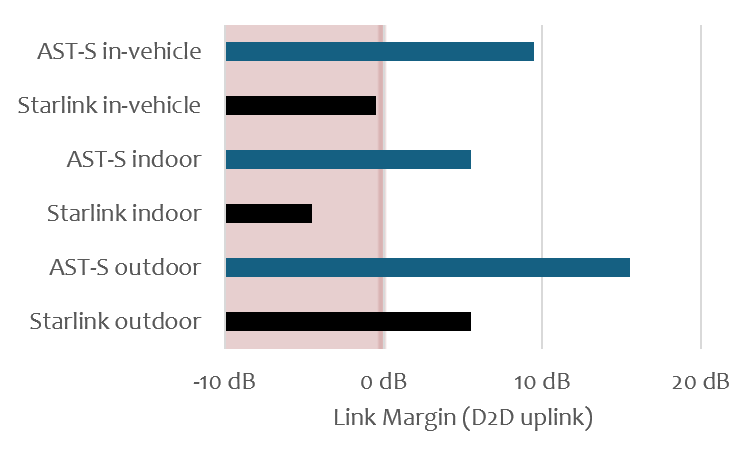
A detailed analysis of the link budget shows that the Starlink Direct-to-Cellular service will be significantly impaired for indoor services, and also for service in vehicles like cars and trains.
Gallons of ink have already been spilled on this topic, but very few people have actually looked at the key questions with quantitative analysis. With a goal of billions in revenue, the key questions include:
I recently went through these questions with detailed link budget calculations and hard-nosed analysis of average revenue per user (ARPU) in various world regions for a recent report. My conclusion: the opportunity in front of Starlink is MUCH smaller than Wall Street believes, in the current configuration of their satellites. The short answer is that Starlink’s market opportunity is only about $6 billion per year due to the poor penetration of uplink signals through a roof.
After all, more than 80% of mobile traffic is famously consumed indoors. That leaves 20% for outdoor users, right? Wrong. At least 75% of “outdoor” use happens in vehicles: cars, trains, buses, et cetera. These stats can be different for each country, but overall the percentage of mobile traffic available to Starlink D2D is only about 4% of mobile traffic overall.
There are some interesting ideas out there for network repeaters. A rancher in Brazil can put a repeater on his pickup truck, to use his phone normally inside the cab. Watch for this feature to be introduce in Tesla cars sometime over the next few years, and it may become standard in many cars. It’s not really “direct to device” anymore, but an inexpensive repeater can boost the addressable opportunity back up to about 20%, with a more complex product offering.
There are other factors that matter. Using lower frequency bands can help with propagation, and also for diffraction through windows and around corners. The power level allowed in the uplink will be an area where industry will push regulators for relief and hopefully get some concessions. Low orbital planes and huge numbers of satellites can also help in reducing the distance for signals to travel.
 Mobile Experts graphic
AST SpaceMobile illustrates another solution. Based on FCC and ITU filings, we expect much better performance from AST-S, with decent performance inside vehicles directly and even in single-story buildings. Forget about using it in the basement. But if Starlink and other players adopt gigantic antenna arrays like AST-S, the market opportunity could increase to more than $20 billion per year.
Link margin is not a “yes or no” answer: We’ve identified a level of performance that will work well for light data and possibly for voice calls. Weaker link budgets can also work for text messages, but the market opportunity is smaller for limited functionality. But the diagram shown above is our effort to illustrate the scenarios where Starlink and AST-S can provide a variety of useful services and where the reliability will be poor.
Back on Wall Street … where do we go from here?
SpaceX has completed their big cash fundraiser. It’s based on some pretty outrageous market estimates and aspirational hopes. But hey, now that it’s done, nobody can really hold them accountable and they will simply pursue whatever market is actually there.
My prediction is that Starlink will change their satellite design for a 10 dB+ improvement in the uplink. Yes, it will be a much bigger satellite and more expensive to launch. But the change in market opportunity is triple or more. All others in the market should scramble during the next two to three years to capture a share of the market before Starlink gets the right product in place.
Joe Madden founded Mobile Experts in 2007 leads the Mobile Experts team in analysis of wireless communications, AI, and Edge Computing.
| # | Наименование новости | Тональность | Информативность | Дата публикации |
|---|---|---|---|---|
| 1 | The Internet in Space: The Apps that Dominate Satellite Traffic and Why it Matters | 0 | 5.79 | 01-07-2026 |
| 2 | New Horizons for the Smallsat Industry | 0 | 4.71 | 26-07-2026 |
| 3 | Starlink запускает мобильную связь — как у T-Mobile и AT&T, но через спутники | 0 | 7 | 26-06-2026 |
| 4 | Starlink запускает мобильную связь — как у T-Mobile и AT&T, но через спутники | 0 | 7 | 26-06-2026 |
| 5 | Starlink Mobile бросает вызов AT&T и Verizon: у SpaceX есть ... | 0 | 7 | 27-06-2026 |
| 6 | In the AI Era, Constellations Emerge As a New Strategic Class of Assets | 0 | 5.91 | 27-07-2026 |
| 7 | Почему «#русский #Starlink» в любом случае нужно расширять? Если российский ... | 0 | 6.21 | 16-08-2026 |
| 8 | Starlink Unveils V5 Kit With Smaller, More Power-Efficient Design | 2 | 6 | 15-07-2026 |
| 9 | ‘We might rethink paying you’: Poland threatens Musk over Starlink | 0 | 14.76 | 13-08-2026 |
| 10 | Amazon Files for More Satellites in D2D Push | 0 | 8.21 | 27-07-2026 |