Просмотр новости
Найдите то, что Вас интересует
 Спутники
 РН
РН SpaceX
 Роскосмос
 NASA
NASA
СпутникиРНSpaceXРоскосмосNASASometimes, you just need an icebreaker and some classical music to make your day better.
 Credit: Library of Congress collection.
The Soviet Union now belongs largely to memory and history books, and many chapters of its history are outright unsavory, to say the least. But Operation Beluga (“Belukha” in Russian) isn’t one of them.
Operation Beluga wasn’t your typical Cold War operation. It involved sending an icebreaker into heavy pack ice and, according to Soviet reports, blasting music over its deck loudspeakers to coax thousands of trapped beluga whales toward safety off the Chukchi Peninsula.
In 1956, the Soviet Union contracted the Finnish company Wärtsilä to build two powerful polar icebreakers. The first, Moskva, was launched in January 1959 and delivered in 1960. Its 22,000-shaft-horsepower diesel-electric machinery was among the largest ever installed aboard a ship at the time.
In October 1961, after escorting more than 100 cargo ships through the Russian Arctic, Moskva crossed the ice-covered Northern Sea Route from Murmansk to Vladivostok in just ten days. The record-setting voyage demonstrated how modern icebreakers could extend the navigation season along the route.
Moskva could force its way through multiyear Arctic ice that stopped many earlier vessels. After its celebrated crossing, the ship was stationed in Vladivostok and sent to escort vessels along the eastern stretches of the Northern Sea Route.
But as fate would have it, this would not be the last time we heard of the Moskva’s adventures — ‘we’ here meaning us humans, as well as beluga whales.
Iced in, iced outEvery good heroic story needs someone in need, and in late 1984, thousands of such someones were found.
Along the frigid landscape of the Chukchi Peninsula — the easternmost reach of Russia, facing Alaska across the Bering Strait — live Indigenous Chukchi communities with generations of accumulated knowledge about sea ice and marine mammals. Soviet policies transformed life in the region during the 20th century, but hunting, fishing and reindeer herding remained important sources of food, income and cultural continuity. Research conducted with communities in Chukotka has since documented detailed local knowledge of beluga migration, feeding and responses to human noise.
Even after this point the Chukchi relied heavily on local wildlife for food and provided raw materials for some of those newly-minted industries in the form of fishing, hunting of marine mammals, or reindeer herding. Subsistence hunting (for the purpose of obtaining food) is still practiced by the Chukchi to this day, although it’s greatly reduced in scope.
In late 1984, local hunters discovered an enormous aggregation of belugas crowded around a shrinking network of breathing holes in Senyavin Strait. Later scientific accounts put the number of trapped animals at between 2,500 and 3,000.
 Map by Ocean Action
The hunters alerted the authorities. They initially thought it was going to be an easy hunt, but they realized that thousands of whales weren’t simply passing through the strait but had become enclosed by ice, with no obvious route back to open water. What might ordinarily have been a hunting opportunity had become an ecological emergency on an extraordinary scale.
To this day, it’s still unclear exactly how so many whales became trapped. Belugas sometimes follow fish into narrow, ice-covered waters, and a rapid freeze-up or wind-driven pack ice can suddenly close the route behind them. In this case, powerful winds reportedly compressed thick drift ice across the strait, leaving only scattered openings through which the animals could breathe.
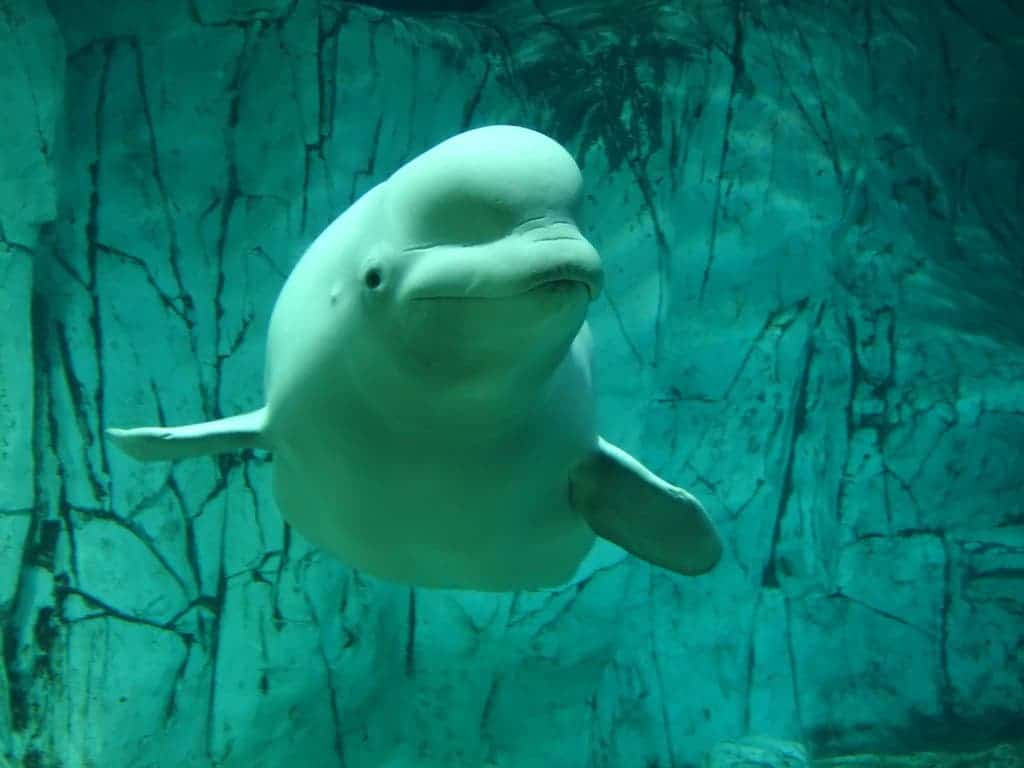 A beluga whale at the Oceanografic de Valencia, Spain. Image credits Salva Barbera via Flickr.
Belugas are capable divers and regularly travel beneath sea ice. But the distance to open water was apparently too great to cross on a single breath. With no continuous chain of breathing holes, the whales remained clustered around the few openings that had not frozen over.
Aircraft and specialists were dispatched to assess the scene. Helicopters dropped fish to the trapped animals to help keep them alive, while officials considered how to open an escape route through the ice.
Enter the Moskva The Moskva, photographed while being built in a dry dock. Image via Wikimedia.
The teams sent to the site concluded that the only plausible rescue was to cut a navigable corridor through the pack ice. Moskva, one of the few ships powerful enough for the job, was dispatched from the Soviet Far East.
When the icebreaker reached the area in February 1985, Captain Anatoly M. Kovalenko faced ice so dense that progress was painfully slow. By then, whales were already dying. Later scientific summaries estimate that about 1,000 of the 2,500–3,000 trapped belugas ultimately perished. The animals included juveniles as well as mature adults.
The episode unfolded in a region where beluga hunting was a long-established part of subsistence life, but the locals worked with the Soviet authorities to try and keep the surviving animals alive.
The Moskva’s crew repeatedly drove the icebreaker forward, reversed and advanced again, using the ship’s weight and engines to crush a passage through the ice. But reaching the herd was only the first part of the problem.
At first, the ship merely enlarged the animals’ breathing areas. Soviet newspaper reports described the belugas resting, feeding and becoming more active in the new pools — “playing, whistling, squealing, snorting.” But they would not enter the long channel behind the ship.
You want us to go where?That reluctance was understandable. To the whales, Moskva was an enormous, unfamiliar and extremely noisy object. The icebreaker moved to and from the herd, attempting to draw it toward the passage, but initially made little progress.
Then, according to Soviet accounts, someone recalled that dolphins and whales sometimes responded to music. The crew began playing recordings over the ship’s loudspeakers: popular songs, martial music and classical compositions. Reports later repeated by The New York Times claimed that classical music worked best and that the belugas began approaching the ship. Other retellings name Soviet pop music instead, so the precise soundtrack — and whether one genre really worked better — remains uncertain.
What happened next is better established. The crew made repeated forays into the ice, then waited for the herd to catch up. “We repeat this several times,” Kovalenko was quoted as explaining. “The belugas start to ‘understand’ our intentions and follow the icebreaker. Thus, we move kilometer by kilometer.”
The music may have helped the whales become accustomed to the vessel, partially masked some unfamiliar sounds or simply coincided with the moment when they learned to follow the channel. But this wasn’t a scientific study or a controlled experiment, so we can’t know precisely what role it played.
By late February, roughly 2,000 surviving whales had followed the route into open water. The famous image of a classical-music Pied Piper may have been embellished in the retelling, but the central claim is factual: Moskva broke open a channel, and the herd escaped through it.
A whale of a timeMost of what the outside world initially learned about Operation Beluga came through Soviet state media, whose accounts were later repeated by Western newspapers. That does not mean the story was invented. Obviously, this raises some big question marks. It suggests that the most cinematic details — especially the whales’ supposed preference for classical music — should be treated as reported observations rather than verified scientific findings.
But overall, Operation Beluga definitely happened.
Between 2,500 and 3,000 belugas became trapped in Senyavin Strait during the winter of 1984–85. Around 1,000 perished, while approximately 2,000 escaped after the icebreaker opened a route to the sea.
It’s a very heartwarming story of how humanity can foster and protect our cousins in the wild. It also showcases how behaviors that evolve over thousands of years can serve a species in general but fail them in particular situations they simply weren’t designed to deal with. In such conditions, our technology and ability to think on our feet can help solve the issue.
I enjoy thinking that humanity will, one day, take on the role of fostering the natural world around us. Stories like this one show how all of us stand to benefit: we get aww-inducing feel-good stories, feelings of fulfillment, and healthy ecosystems. The whales get to not starve to death. Definitely a win-win.
The article was published on September 18, 2025, and has been edited to include additional information.