Просмотр новости
Найдите то, что Вас интересует
 Спутники
 РН
РН SpaceX
 Роскосмос
 NASA
NASA
СпутникиРНSpaceXРоскосмосNASAA parasitic plant on a Japanese island has found an unlikely way to send its offspring into the world. It appears to enlist wandering hermit crabs. Hidden on the floor of coastal forests near Okinawa, Balanophora fungosa looks more like a fungus than a typical flowering plant. It has no green foliage to harvest sunlight. [...]
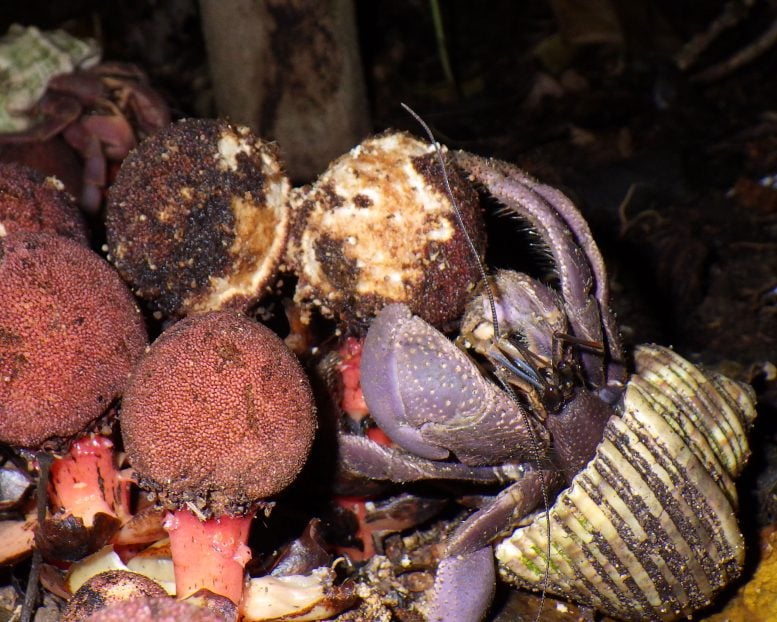 Scientists have been wondering who disperses the seeds of Balanophoraceae, a family of parasitic plants growing in the shaded and windless understories of Japanese tropical forests. In his newest study, Kobe University botanist SUETSUGU Kenji provides “the first empirical evidence that hermit crabs can function as both external and internal seed dispersers.” Pictured above is Coenobita brevimanus scraping off the fruits of Balanophora fungosa. Credit: Suetgetsu Kenji
A parasitic plant on a Japanese island has found an unlikely way to send its offspring into the world. It appears to enlist wandering hermit crabs.
Hidden on the floor of coastal forests near Okinawa, Balanophora fungosa looks more like a fungus than a typical flowering plant. It has no green foliage to harvest sunlight. Instead, it survives by tapping into the roots of other plants for nutrients. When mature, it can produce as many as a million extremely small seeds, each contained inside a tiny, dry fruit. Members of the genus Balanophora produce some of the smallest fruits known among flowering plants.
For years, one basic question remained unresolved: Where do all those seeds go?
The obvious explanations were not especially convincing. “Many people assumed that they simply fall by gravity and are carried away by the wind, but the humid and windless forest floor makes this seem rather implausible,” says Kobe University botanist Kenji Suetsugu.
Hermit Crabs Reveal the Missing LinkThe answer, reported in the journal Ecology, came from cameras placed in the forest. They recorded land hermit crabs, Coenobita brevimanus, using their pincers to scrape fruit from mature plants. The feeding could be intense. In some cases, a crab stripped nearly all of a plant’s fruit during a single night.
That behavior matters because the crabs do much more than eat.
Some of the fruits stick to a crab’s pincers, body, and shell as it feeds. Researchers later found fruit-carrying crabs several meters from the parent plants, showing that the animals can physically transport seeds across the forest floor. Observations in the study included crabs carrying fruits more than 5 meters (16 feet) from the plants.
Other seeds take a very different route.
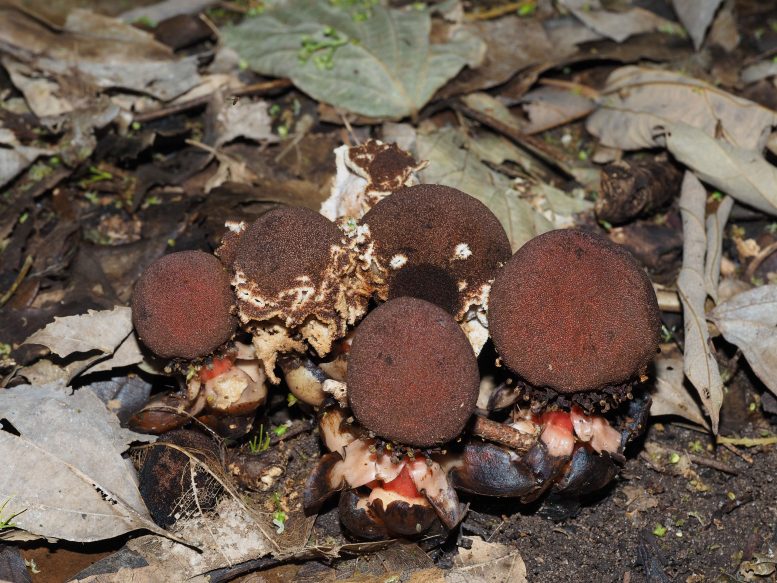 Balanophora fungosa has dull colors, a yeasty scent, and easily detachable fruits, so Kobe University botanist SUETSUGU Kenji suspected the dispersers to be ants. But when he covered the plants with nets that let through ants but not larger animals, he found that the plant’s fruits were no longer picked up. Credit: Suetgetsu KenjiHermit Crabs Disperse Seeds Inside and Out
After the crabs swallow the fruit, some seeds pass through the digestive tract intact and remain viable afterward. That gives the plant a second potential transportation system. Land hermit crabs can move as far as 100 meters (328 feet), meaning a seed swallowed beside its parent could eventually be deposited much farther away.
Together, those two mechanisms make the discovery unusual. The crabs can act as external dispersers by carrying fruits on their bodies and as internal dispersers by consuming them and later passing viable seeds.
“This study provides the first empirical evidence that hermit crabs can function as both external and internal seed dispersers,” Suetsugu writes.
Two Surprising Ways Crabs Spread SeedsFor animals better known as scavengers, omnivores, and seed eaters, that is a surprising ecological role.
“I was excited to find this because these animals have usually been regarded as omnivores, scavengers, or seed predators rather than potential plant partners,” says Suetsugu.
Hermit crabs were not Suetsugu’s first suspects.
An Unexpected Ecological PartnershipHis previous work had shown that other members of the Balanophoraceae family rely on small animals, including ants, crickets, and cockroaches, to move their fruits. Their muted colors and yeasty odors are very different from the bright, fleshy fruits commonly associated with birds and mammals.
Because B. fungosa produces fruits that detach easily, Suetsugu initially suspected ants.
He tested the idea by covering plants with mesh that ants could pass through but larger animals could not. If ants were doing the work, the fruits should still have disappeared.
They did not.
Cameras Expose the Real Seed DisperserOnce larger animals were excluded, fruit removal largely stopped. That result sent Suetsugu looking for a bigger visitor, and time-lapse cameras eventually revealed the hermit crabs.
But identifying the crabs raised another question: Were they simply taking advantage of an easy meal, or was there a more specific relationship at work?
A Yeasty Scent May Attract Hermit CrabsSuetsugu observed the crabs around mature B. fungosa plants but not immature ones. Mature plants produce a yeasty odor, raising the possibility that the scent acts as a chemical advertisement to hungry animals moving across the forest floor.
For a plant living in a dark understory, smell may be particularly useful. Bright visual displays offer limited value close to the ground beneath a dense canopy, while an odor can travel through the surrounding air and alert animals to food they cannot yet see.
The crabs do not need to be specialized partners for the strategy to work. Their broad diets may actually make them useful. An omnivore searching constantly for edible material can encounter fruits, eat them, and then continue traveling, unintentionally carrying the plant’s next generation with it.
Small Invertebrates Could Shape ForestsSeed dispersal research has traditionally emphasized birds, mammals, and other vertebrates, but the new finding adds to evidence that small invertebrates can also shape where plants grow.
“When it comes to seed dispersal, large vertebrates have received most of the attention, but small-bodied invertebrates are often overlooked. Nevertheless, they may also help maintain seed movement, especially on islands, in fragmented habitats, and on shaded forest floors,” explains Suetsugu.
That could be especially important for plants such as B. fungosa. Its tiny seeds develop close to a humid, relatively still forest floor where wind offers little help. A mobile animal can cross obstacles and move seeds to places that gravity alone never could.
The discovery may also extend beyond a single plant and crab species. As Suetsugu notes, “Their abundance in coastal forests and omnivorous feeding habits suggest that this may represent a more general pattern.”
Reference: “Unexpected allies: Land hermit crabs and cockroaches contribute to seed dispersal in a non-photosynthetic plant” by Kenji Suetsugu, 11 August 2026, Ecology.
DOI: 10.1002/ecy.70462
This research was funded by the Japan Science and Technology Agency (grant JPMJPR21D6).
Never miss a breakthrough: Join the SciTechDaily newsletter.
Follow us on Google and Google News.
| # | Наименование новости | Тональность | Информативность | Дата публикации |
|---|---|---|---|---|
| 1 | Scientists Just Found Something Weird Inside Moss | 0 | 19.34 | 20-06-2026 |
| 2 | “Weird Clams” Reveal a New Invasion Along the U.S. Northeast Coast | 0 | 17.48 | 18-07-2026 |
| 3 | Coffee’s Most Destructive Pest Is Accidentally Helping the Ants That Hunt It | 0 | 18.71 | 03-08-2026 |
| 4 | Scientists Find Remarkable New Snail Species in Montenegro’s Mountains | 0 | 16.51 | 08-08-2026 |
| 5 | World’s Largest Island Rodent Eradication Sparks Remarkable Invertebrate Comeback | 0 | 19.34 | 28-06-2026 |
| 6 | Scientists Are Turning Empty Roadsides Into Butterfly Habitats | 0 | 20.83 | 24-07-2026 |
| 7 | Scientists Rediscover Rare Island Fox Not Seen for More Than 20 Years | 0 | 16.28 | 23-06-2026 |
| 8 | This Giant Deep-sea Creature Survives Five Years Without Food, Thanks to a Borrowed Bacterial Gene | 0 | 20.88 | 16-07-2026 |
| 9 | Researchers discover new beetle species hiding just steps from their lab | 0 | 7.3 | 19-06-2026 |
| 10 | Scientists Discover Wild Orangutans May Be Treating Themselves With Medicinal Plants | 0 | 19.2 | 03-07-2026 |