Просмотр новости
Найдите то, что Вас интересует
 Спутники
 РН
РН SpaceX
 Роскосмос
 NASA
NASA
СпутникиРНSpaceXРоскосмосNASAMore than 3 million hectares have burned to date (Natural Resources Canada, 2026), prompting a Level 4 National Preparedness response (GoC, 2026, ciffc). Although the season began with below-average wildfire activity, prolonged hot, dry weather through July has driven a rapid escalation in fire activity across the country (CBC, 2026). At the time of writing, … Continue reading "Climate change means extreme fire seasons in Canada are here to stay"
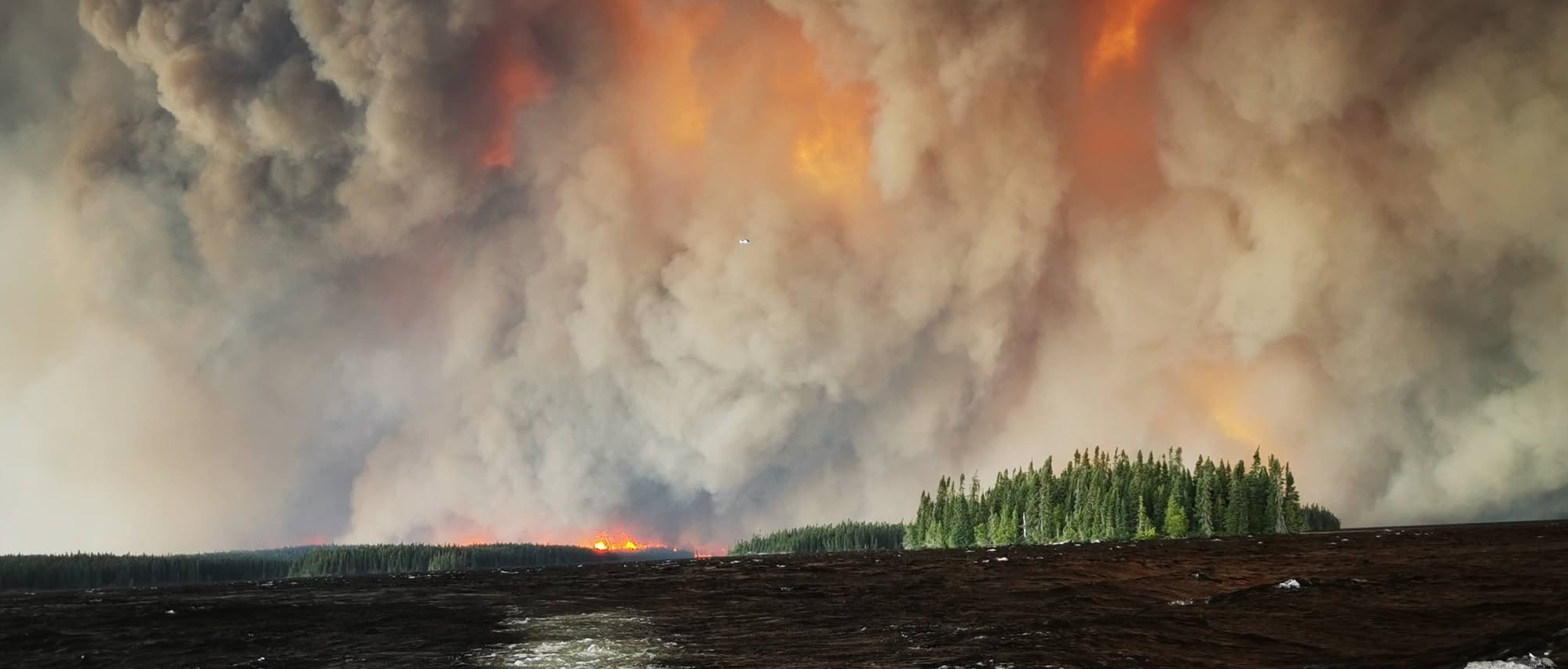 Wildfires in Canada. Credit: Wayne Wastaken.
More than 3 million hectares have burned to date (Natural Resources Canada, 2026), prompting a Level 4 National Preparedness response (GoC, 2026, ciffc). Although the season began with below-average wildfire activity, prolonged hot, dry weather through July has driven a rapid escalation in fire activity across the country (CBC, 2026). At the time of writing, Ontario and the Northwest Territories have been especially affected regions in Canada’s 2026 wildfire season, with hundreds of active fires, many of them out of control (The Guardian, 2026).
What was particularly remarkable this year was the exceptionally rapid rate at which burned area accumulated over a very short period of time. Estimates indicate that approximately 94% of the total area burned occurred during the five weeks between end of June and end of July (CWFIS, 2026). Early-season fire hotspots were concentrated in British Columbia and the Northwest Territories, with fire intensity comparable to 2014 and 2023 (Copernicus, 2026). By mid-July, wildfire activity had intensified in Ontario due to extreme heat, dry conditions and strong winds (GoC, 2026). Widespread lightning storms during the week beginning 20 July triggered numerous new fires, while continued high temperatures, low humidity and dry vegetation allowed existing fires to expand rapidly, further challenging suppression efforts (The Guardian, 2026a, Reuters, 2026).
Over 120 million people in the Midwest and Northeast U.S. were affected by dangerous air quality, with alerts stretching from Minnesota to New Hampshire (CNN, 2026). Exposure to elevated concentrations of wildfire smoke has been associated with increased emergency healthcare utilisation, particularly for respiratory and cardiovascular conditions, as well as increases in all-cause mortality (AJMC, 2026), while also prompting public health warnings, large-scale evacuations, disruption to transport and economic activity, and considerable pressure on firefighting resources (Medical Daily, 2026). In particular, many remote and Indigenous communities have been displaced, with some communities suffering extensive damage or destruction as fires spread rapidly under extreme weather conditions (Medical Daily, 2026).
Scientists from Canada, the US, the Netherlands and the United Kingdom collaborated to assess to what extent human-induced climate change altered the likelihood and intensity of the weather conditions at the time of the fires, and how the conditions will be affected with further warming.
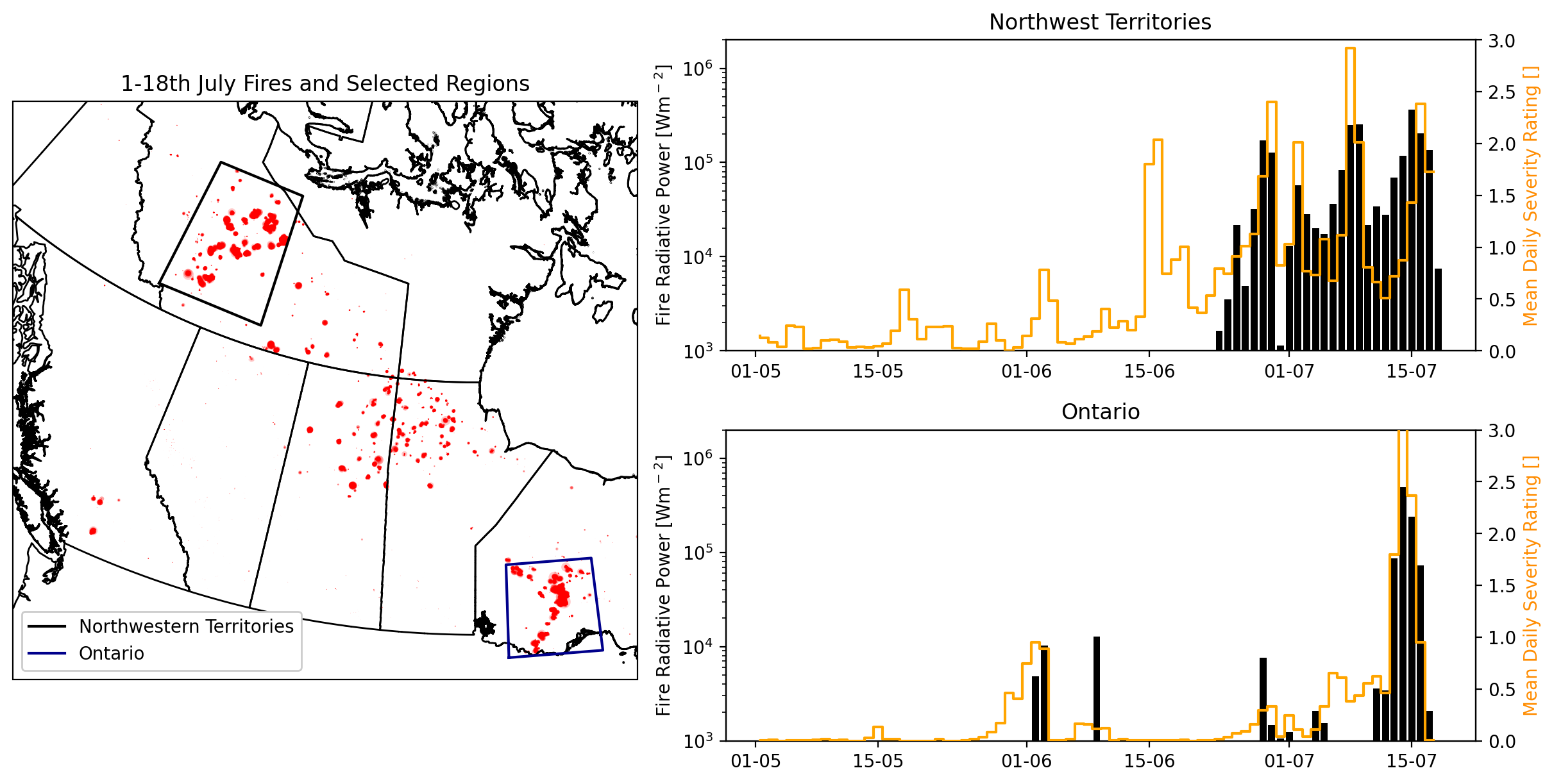
Figure 1: left, detected FRP activity (VIIRS) for July 1-18th with the event study regions overlaid. Right, fire activity characterised in black bars (FRP) and the spatially averaged daily severity rating in orange lines (DSR) for the Northwest Territories (top) and Ontario (bottom) regions.
To capture the extent and duration of the extreme fire weather across the region, we use the cumulative Daily Severity Rating (DSR). The DSR is a scaled power transformation of the Canadian Fire Weather Index (FWI), and reflects how difficult a fire is to suppress once ignition has occurred; it is commonly used for assessing fire weather on multi-day timescales. Both indices (FWI and DSR) have been used extensively to characterize fire weather in Canada (e.g. Jain et al., 2024, Barnes et al., 2025). Here we focus on the DSR for the 7 days of most intense fire weather conditions (henceforth DSR7x) and the monthly value, DSR30x in the regions of the worst fires in the Western Territories and Ontario ( Fig. 1). In addition we analyse the 24 months effective precipitation (rainfall minus potential evapotranspiration) to assess the role of climate change in the drought conditions preceding the fires.
| # | Наименование новости | Тональность | Информативность | Дата публикации |
|---|---|---|---|---|
| 1 | Experts: Wildfires | 0 | 13.72 | 27-05-2026 |
| 2 | Climate Change Made Canada’s Ferocious Fire Weather Twice as Likely, Attribution Study Finds | 0 | 7.4 | 06-08-2026 |
| 3 | Климатолог спрогнозировала рекордные пожары в Канаде в 2026 году | 0 | 9.97 | 29-07-2026 |
| 4 | Лесные пожары в Канаде могут стать самыми масштабными за несколько десятилетий | -5 | 7 | 21-07-2026 |
| 5 | "Fire Climate": Hot, Dry, Windy Days Are Becoming Common, Making Wildfires Harder to Control | 0 | 8.42 | 06-08-2026 |
| 6 | В Канаде площадь лесного пожара превысила 66 тыс. га | 0 | 14.17 | 27-07-2026 |
| 7 | В Канаде назвали нынешний сезон лесных пожаров худшим в истории | 0 | 0 | 06-07-2023 |
| 8 | Climate change created conditions for Canada fires, scientists say, as Trump blames mismanagement | 0 | 7.22 | 06-08-2026 |
| 9 | Unavila vás klimatická změna? Vítejte ve věku ohně | 0 | 17.76 | 31-07-2026 |
| 10 | Wildfire Summer: Canadians Face Evacuations, Smoke Alerts from Ontario to B.C. | 0 | 7 | 16-07-2026 |