Просмотр новости
Найдите то, что Вас интересует
 Спутники
 РН
РН SpaceX
 Роскосмос
 NASA
NASA
СпутникиРНSpaceXРоскосмосNASAAs of 1st September, around 380,000 hectares (ha) have burned across Spain since the start of the year, according to the Copernicus European Forest Fire Information System (EFFIS).
As of 1st September, around 380,000 hectares (ha) have burned across Spain since the start of the year, according to the Copernicus European Forest Fire Information System (EFFIS).
So far, 2025 is the fifth year with the largest area burned since 1961, when records began. The year with the largest burned area was 1985 with nearly 485,000 ha; 1978 with about 439,000 ha; 1994 with nearly 438,000 ha; and 1989 with almost 427,000 ha (SGR, 2015; 2023). In the two decades from 1975 to 1994, the average annual area burned was around 232,000 ha (SGR 2015). In the last two decades, 2006-2024, the annual average fell to around 80,000 ha (EFFIS data), mainly thanks to improved prevention measures and harsher sentences for those responsible for starting fires.
However, in 2025, one region burned to a degree not seen for three decades, with the area affected being four times greater than the annual average for the previous two decades. Neighbouring Portugal has also experienced an extreme fire season, with 260,000 ha burned, nearly five times the average for this time of year. Portugal is proportionally the country most affected by fires in Europe, with a mean annual burnt area of around 115,000 ha since 1980 (Ramos et al., 2023). As in Spain, the average annual burned area has reduced in recent decades with an average of 100,000 ha from 2006-2024 (EFFIS), although there is large inter-annual variability, including particularly severe years such as 2003 (425,000 ha), 2005 (350,000 ha), and the all-time record value of 2017 (540,000 ha). In absolute terms, Portugal is also the country with the most hectares burned during the period 2006-2024, with more than 1.8 million ha, followed by Spain with more than 1.5 million ha, and Italy and Greece with around 1 million ha each (EFFIS).
Together, the fires have consumed 640,000 hectares – an area roughly four times the size of Greater London, representing around 1% of the Iberian Peninsula’s surface – with the majority of damage occurring in just a two-week span (BBC, 2025). At a European level, one million hectares of land have burned, which is the worst figure since EFFIS records began in 2006. Spain and Portugal account for two-thirds of this total. At least eight people have lost their lives (France 24, 2025), and the evacuation of many villages prevented a higher death toll. As of 28th August, almost 36,000 people have been evacuated in Spain (El País, 2025a), and around 1,000 people in Portugal as of 21st August (El País, 2025b) .
The fires have been most intense in forested regions of northern Portugal and northwestern Spain, particularly in Galicia, Asturias, and Castile and Leon. In Castile and Leon alone, more than 8,000 people were evacuated (Le Monde, 2025). Protected natural areas, including Picos de Europa (Spain) and Gerês (Portugal) National Parks, have been affected. The habitat of 395 endangered, vulnerable or specially protected species has been partially destroyed. In particular, 2,400 hectares critical to capercaillie, 773 hectares critical to black storks and 1,751 hectares critical to brown bears have been lost (SER, 2025). Significant stretches of the Camino de Santiago pilgrimage routes, which typically draw over 100,000 visitors during the summer have also been affected (BBC, 2025).
For the first time, Spain has activated the EU Civil Protection Mechanism to request assistance in fighting forest fires. By 15th August, the Mechanism had been activated 17 times – more than the total number of requests made during the 2024 fire season – with requests from Spain, Portugal, Greece, Bulgaria, Montenegro and Albania being issued within an eight-day period (EuroNews, 2025; Portugal.gov, 2025; EU Commission, 2025).
The fires occurred at a time when the whole of the Mediterranean region was gripped by a heatwave, meaning that the atmospheric conditions were such that vegetation would dry out extremely quickly, providing a lot of fuel for fires (Swain et al., 2025), a factor that is next to longer term droughts a key factor in large and hard to control fires to break out in the region (Carmo et al. (2023)). The heatwave in Spain was the most intense on record, lasting 16 days (3rd–18th August), with a positive anomaly of 4.6 °C, exceeding the 4.5 °C anomaly recorded in July 2022 (AEMET, 2025) and at its peak, producing the hottest ten-day period recorded in Spain since at least 1950 (Guardian, 2025). Since 1975, there have been 77 heatwaves (not counting the Canary Islands), of which only six have had an anomaly of 4 °C or more. Five of these have occurred since 2019. The fires occur at the peak of the fire season, after years of increasingly large fires (Fernandes et al., 2016; Fernandes, 2019).
WWA performed a super rapid analysis of trends in fire-conducive weather conditions in the affected area, analysing observations only. To capture the extent and duration of the extreme fire weather across the region, we use the cumulative daily severity rating (DSR). The DSR is a scaled power transformation of the Canadian Fire Weather Index (FWI), and reflects how difficult a fire is to suppress once ignition has occurred; it is commonly used for assessing fire weather on multi-day timescales. Both indices (FWI and DSR) have been used extensively to characterize fire risk in Iberia (e.g. Calheiros et al., 2020; Silva et al., 2023). Here we focus on the DSR for the 10 days of most intense fire weather conditions in the region of Northern Portugal and Northwestern Spain with maritime forests (Figs. 1 and 2). In addition we look at trends in maximum 10-day summer temperatures in the same region.
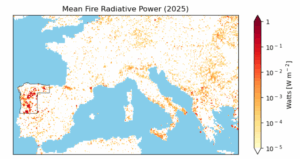 Figure 1: Mean Fire Radiative Power [W m-2] over southern and central Europe over 2025 up to 26th August 2025. Data sourced from the Copernicus Atmosphere Monitoring Service Global Fire Assimilation System (GFAS) (Kaiser et al., 2012). The study region is outlined in grey.
Key Messages
Figure 1: Mean Fire Radiative Power [W m-2] over southern and central Europe over 2025 up to 26th August 2025. Data sourced from the Copernicus Atmosphere Monitoring Service Global Fire Assimilation System (GFAS) (Kaiser et al., 2012). The study region is outlined in grey.
Key Messages
| # | Наименование новости | Тональность | Информативность | Дата публикации |
|---|---|---|---|---|
| 1 | Lo que no se nombra, no se combate | 0 | 6.79 | 30-07-2026 |
| 2 | Incendies: 14.000 hectares ont brûlés en quelques jours au Portugal | -3 | 7 | 05-07-2026 |
| 3 | Human-caused climate change made Spanish, French fires much more likely, scientists calculate | 0 | 11.64 | 30-07-2026 |
| 4 | España ya supera las 207.000 hectáreas quemadas por los incendios | 0 | 11.43 | 29-07-2026 |
| 5 | España arde | 0 | 10 | 04-08-2026 |
| 6 | España arde | 0 | 10 | 25-07-2026 |
| 7 | Última hora y actualidad sobre los incendios en España | 0 | 7.69 | 19-08-2026 |
| 8 | Última hora y actualidad sobre los incendios en España | 0 | 9.25 | 24-08-2026 |
| 9 | Última hora y actualidad sobre los incendios en España | 0 | 9.25 | 22-08-2026 |