Просмотр новости
Найдите то, что Вас интересует
 Спутники
 РН
РН SpaceX
 Роскосмос
 NASA
NASA
СпутникиРНSpaceXРоскосмосNASAArellano uses geochemical analyses to reconstruct deep ocean circulation in the North Atlantic Ocean.
From the day Apollonia Arellano first learned that scientists were tracking increases in atmospheric carbon concentrations throughout history, she was captivated. That high school lesson, Arellano says, “changed her life.” She went home to do her own research, and she has not stopped since.
Arellano, who holds a B.S. in environmental Earth and soil sciences from California Polytechnic State University, is now a doctoral student in Earth and environmental sciences and researcher at the Lamont-Doherty Earth Observatory, which is part of the Columbia Climate School. Here, she studies paleoceanography (the history of oceans in the geologic past) with adviser Jerry McManus and uses geochemical analyses to reconstruct deep ocean circulation in the North Atlantic Ocean. Read more about her journey in the interview below.
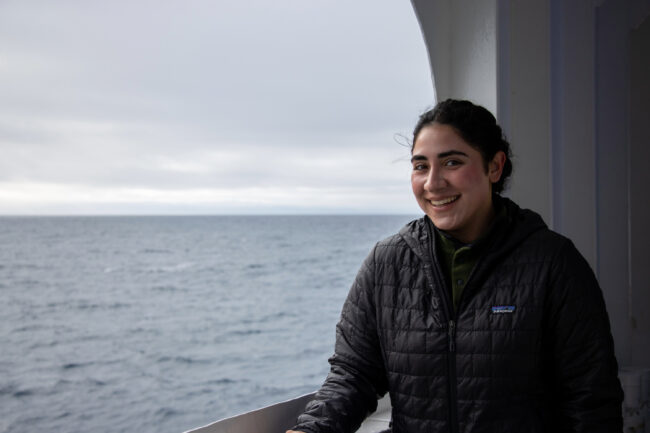 Apollonia Arellano on a research cruise aboard the RV Celtic Explorer, where she helped collect marine sediment cores along a transect from Ireland to Greenland. Credit: Allison Jacob
How did you get into science?
The day I learned about the Keeling Curve changed my life. I was sitting in an environmental science class in high school, listening to my teacher explain how we know the concentration of atmospheric CO2 has increased over time. She displayed the graph created by Charles David Keeling, and I was captivated.
After school that day, I returned home to do my own research and came across various similar curves displaying the concentration of this greenhouse gas over different timescales. The older the timescale, the more interested I became; and when I finally came across the graph showing CO2 over 800,000 years, I was hooked. I had so many questions, namely: How did scientists know the concentrations of this gas during portions of Earth’s history humans were not present for? These questions lingered in my mind, and in my quest to find answers, I was introduced to the fields of study I want to spend my life investigating: paleoclimatology and paleoceanography.
“My advice for younger women or girls who are interested in entering the field would be to ask for what you want.”
Is there a woman in science who inspired you?
My mother is a very passionate civil engineer who tried her best to produce other engineers in the family. Although she has yet to succeed in this endeavor, her encouragement and enthusiasm for STEM greatly benefited me. From the time I was three, she talked to me about her workday, showed me projects she was working on, and even brought me into the office or field when possible. Because of these experiences, the concept of someone like my mother being a successful engineer was normalized. In fact, I wasn’t even aware that women, particularly women of color like my mother, are underrepresented in most STEM fields. I am very fortunate to have had a role model and mentor at home. Although she is a civil engineer and I am a paleoceanographer, her perseverance and confidence continue to inspire and motivate me to be a better scientist.
Do you have any advice for younger women or girls who are interested in entering the field?
My advice for younger women or girls, particularly in high school or university and who are interested in entering the field, would be to ask for what you want. Even if it seems unlikely, a thoughtful cold email can get you far! I started working in a soil science lab group in my first year of college. I was desperate to gain research experience, so I cold-emailed the lead principal investigator, asking if I could assist the lab group in any way. I ended up working in that lab for the rest of my undergraduate career, and I gained such valuable experience! Additionally, summer internships, such as the NSF Research Experiences for Undergraduates program, are great ways to figure out what kind of work you like—or dislike.
| # | Наименование новости | Тональность | Информативность | Дата публикации |
|---|---|---|---|---|
| 1 | From Marie Tharp to Seabed 2030: Marine Geophysicist Vicki Ferrini on Mapping the Ocean Floor | 0 | 8.93 | 30-07-2026 |
| 2 | World Oceans Day Reimagines Our Relationship With the Water Around Us | 0 | 10.36 | 08-06-2026 |
| 3 | Ученый заявила о непредсказуемости влияния Эль-Ниньо на климат | 0 | 22.5 | 27-07-2026 |
| 4 | Eneko Villegas, Atarrabiako inauteriak | 0 | 0 | 08-02-2018 |
| 5 | La leonesa que transforma el liderazgo femenino en América Latina | 0 | 10 | 21-06-2026 |
| 6 | Scientists explain Arctic plankton's biological clock in darkness | 0 | 11.19 | 06-08-2026 |
| 7 | Metal deposits reveal how ice ages reshaped oxygen levels across Earth's oceans | 0 | 8.74 | 03-08-2026 |
| 8 | Geological evidence questions the role of Agulhas Leakage in Atlantic Ocean circulation | 0 | 5.06 | 03-08-2026 |
| 9 | Galactic archaeology reveals Milky Way's turbulent origins | 0 | 7.09 | 30-07-2026 |