Просмотр новости
Найдите то, что Вас интересует
 Спутники
 РН
РН SpaceX
 Роскосмос
 NASA
NASA
СпутникиРНSpaceXРоскосмосNASA
Buying a soft-shell rooftop tent to save money seems smart—until you're scrubbing mildew off the cover.
The post Hardshell vs. Soft-Shell Rooftop Tents: One Is Clearly Better appeared first on Outside Online.
Published June 16, 2026 06:00AM
Let’s get one thing clear up front: most of us don’t need a rooftop tent. Legend has it rooftop tents were originally created so adventurers could sleep off the ground away from dangerous wildlife. I live in the Southern Appalachians, so I’m not worried about lions and tigers, and car campers have survived for decades pitching tents on the ground. Rooftop tents aren’t strictly necessary.
But they’re appealing for a variety of reasons, the most important of which is that sporting a rooftop tent on your Subaru tells everyone in the Trader Joe’s parking lot that you do badass adventures on weekends. I’ve had a series of rooftop tents on vehicles over the years and developed some very strong opinions, which boil down to this: rooftop tents make car camping easier, especially if you get the right tent for you and your vehicle.
Having a popup tent already attached to my vehicle minimizes prep, gets me out the door faster on weekends, and means I’m more likely to go camping. Many rooftop tents are easier to set up than a traditional tent when you’re at camp, and just as easy to break down when it’s time to go home. Streamlining that process has resulted in my camping more often when I have a tent on my vehicle. And that’s the single best argument I can make for these expensive pieces of gear.
I also like getting off the ground. It rains all the damn time in the Southern Appalachians, and getting the tent off the ground and out of the muddy soup is an absolute delight. It also means you don’t have to spend 20 minutes clearing rocks and sticks before pitching your tent.
There are two basic types of rooftop tents: hardshell and soft-shell. The question you have to answer is which style is right for you. Keep reading and I’ll break down the pros and cons of each so you know exactly what you’re getting into before you drop your hard-earned cash on one of these tents.
Hardshell Rooftop Tents Are Easier—But You Pay for That Convenience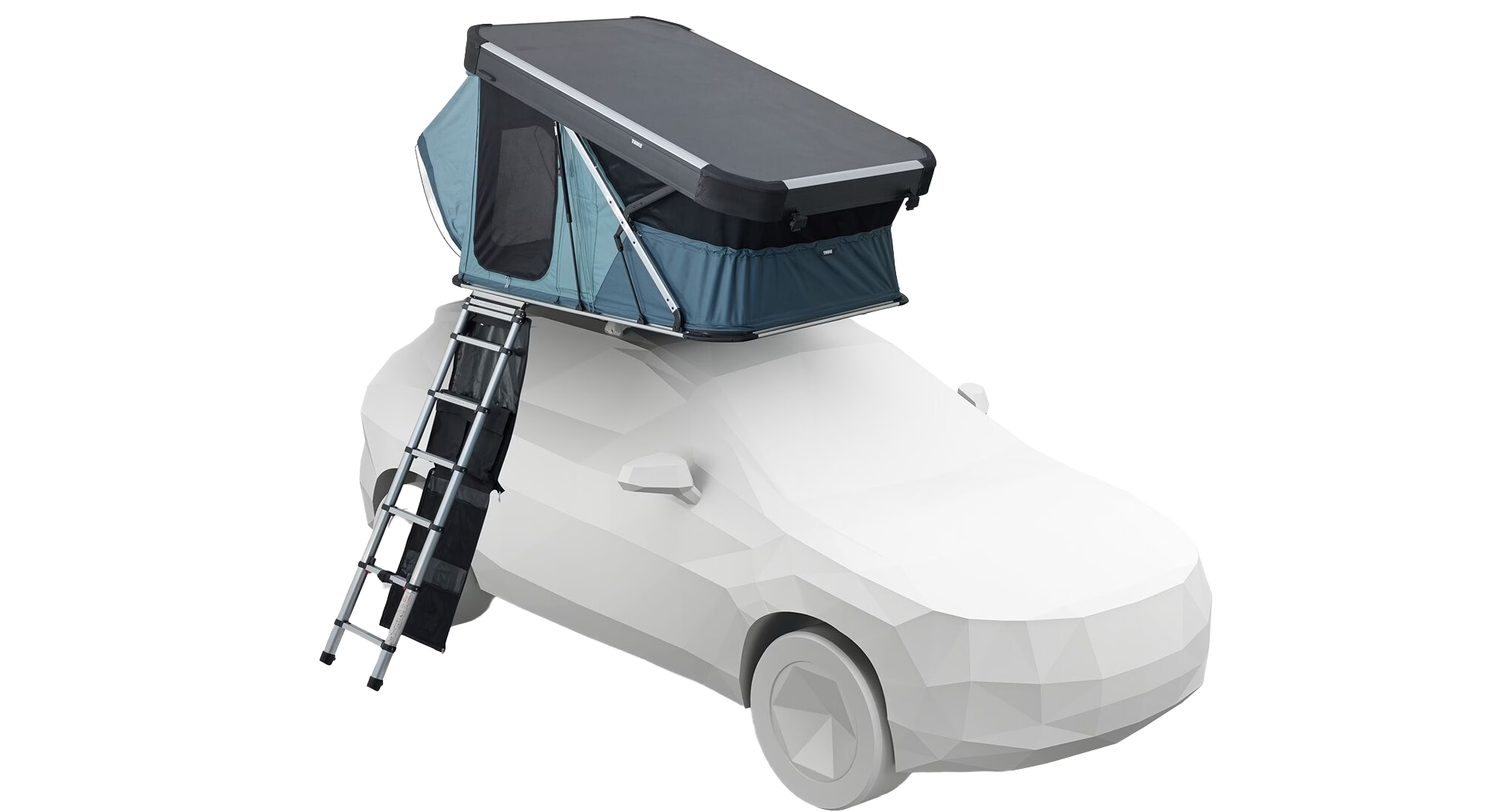 At $4,000, Thule’s new Widesky hardshell rooftop tent is pricey, but more weather-resistant and streamlined than a soft-shell rooftop tent. (Photo: Courtesy Thule)
Hardshell Rooftop Tent Pros and Cons
At $4,000, Thule’s new Widesky hardshell rooftop tent is pricey, but more weather-resistant and streamlined than a soft-shell rooftop tent. (Photo: Courtesy Thule)
Hardshell Rooftop Tent Pros and Cons
+ More aerodynamic while driving
+ Hardshell material withstands weather and aging well
+ Often easier to set up and break down
+ Many hard shell tents have cross bars on their exterior so you don’t lose any carrying capacity
– More expensive
– Often larger and don’t fit well on compact vehicles.
The hardshell rooftop tent is exactly what it sounds like: a tent sandwiched inside a hard shell built to withstand the elements. These shells are waterproof, and the black poly seems to withstand mildew better than soft-shell covers (more on that below). They’re also typically more aerodynamic with a lower profile than their soft-shell counterparts. The Sylvan Sport LOFT, which I tested earlier this year, is only eight inches deep when closed. That low profile helps minimize drag while driving.
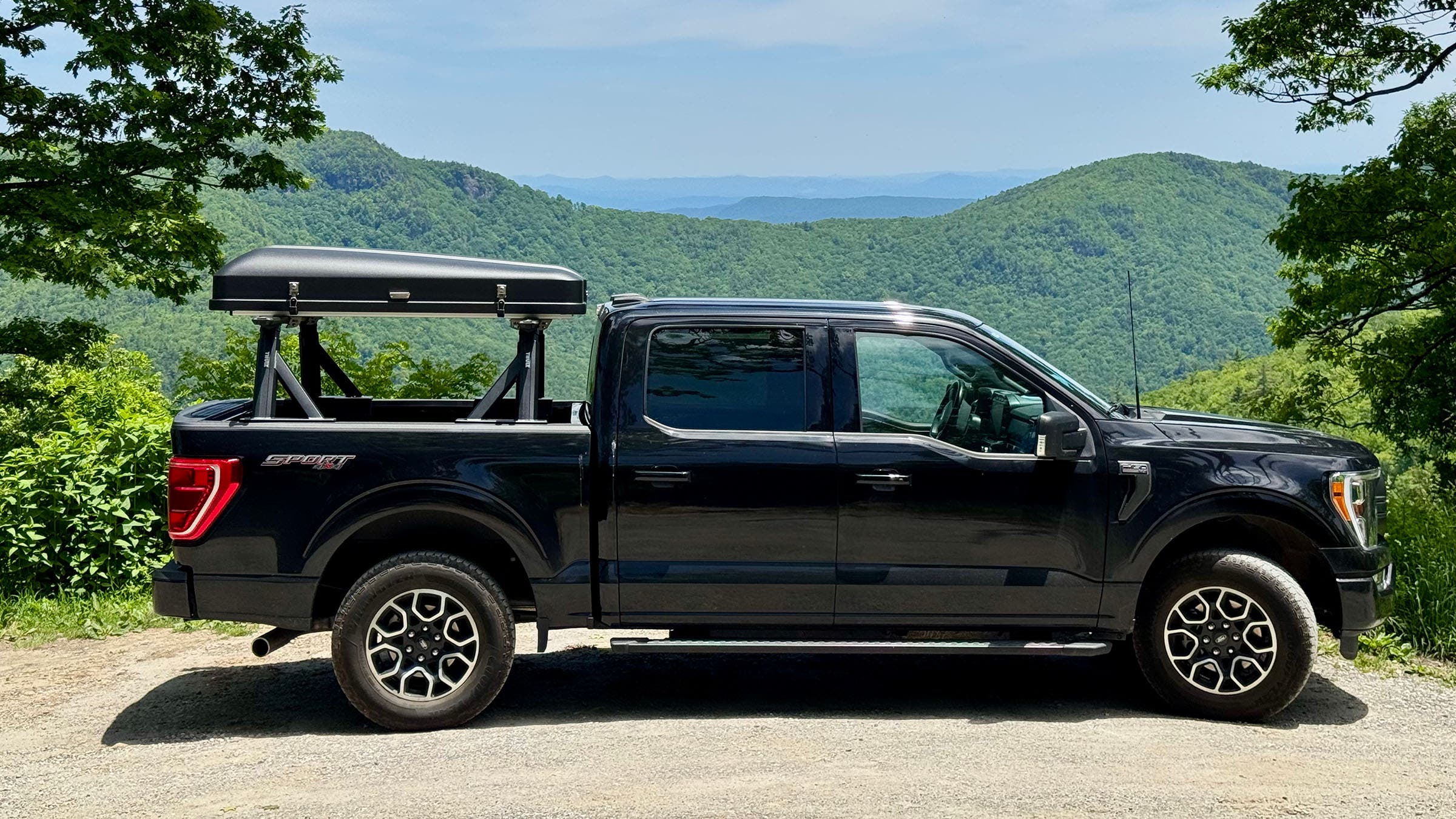 The Sylvan LOFT hardshell rooftop tent mounted on the author’s truck. (Photo: Graham Averill)
Hardshell tents are also generally easier to set up and break down, usually requiring nothing more than releasing a couple of latches before the hydraulic arms take over the heavy lifting. And one of my favorite things about hardshell tents is that some of them—not all—can accommodate crossbars, so you don’t have to sacrifice a roof rack to sport a rooftop tent.
Everything sounds great, right? But factor in the cost: hardshell rooftop tents are typically far more expensive than soft-shells. Take two new options from Thule. The Swedish company recently released a new soft-shell, the Approach 2 S, and a new hardshell, the two-person Widesky. They’re essentially the same size, but the soft-shell runs $2,499 and the hardshell $3,999. You’ll find tents across most budgets, but that price gap between hard and soft is about what you can expect.
The footprint of most hardshell rooftop tents is also larger than soft-shells, which means they might not fit well on your vehicle. I have an F-150 with a 5’6″ bed, and Thule’s Widesky is too large to center over that bed—I’d have to mount it so it extends over the cab or sticks out a foot past the tailgate. How a tent sits on your specific vehicle is worth thinking through if aerodynamics, gas mileage, and general aesthetics matter to you.
Soft-Shell Rooftop Tents Are Cheaper—But There Are Trade-offs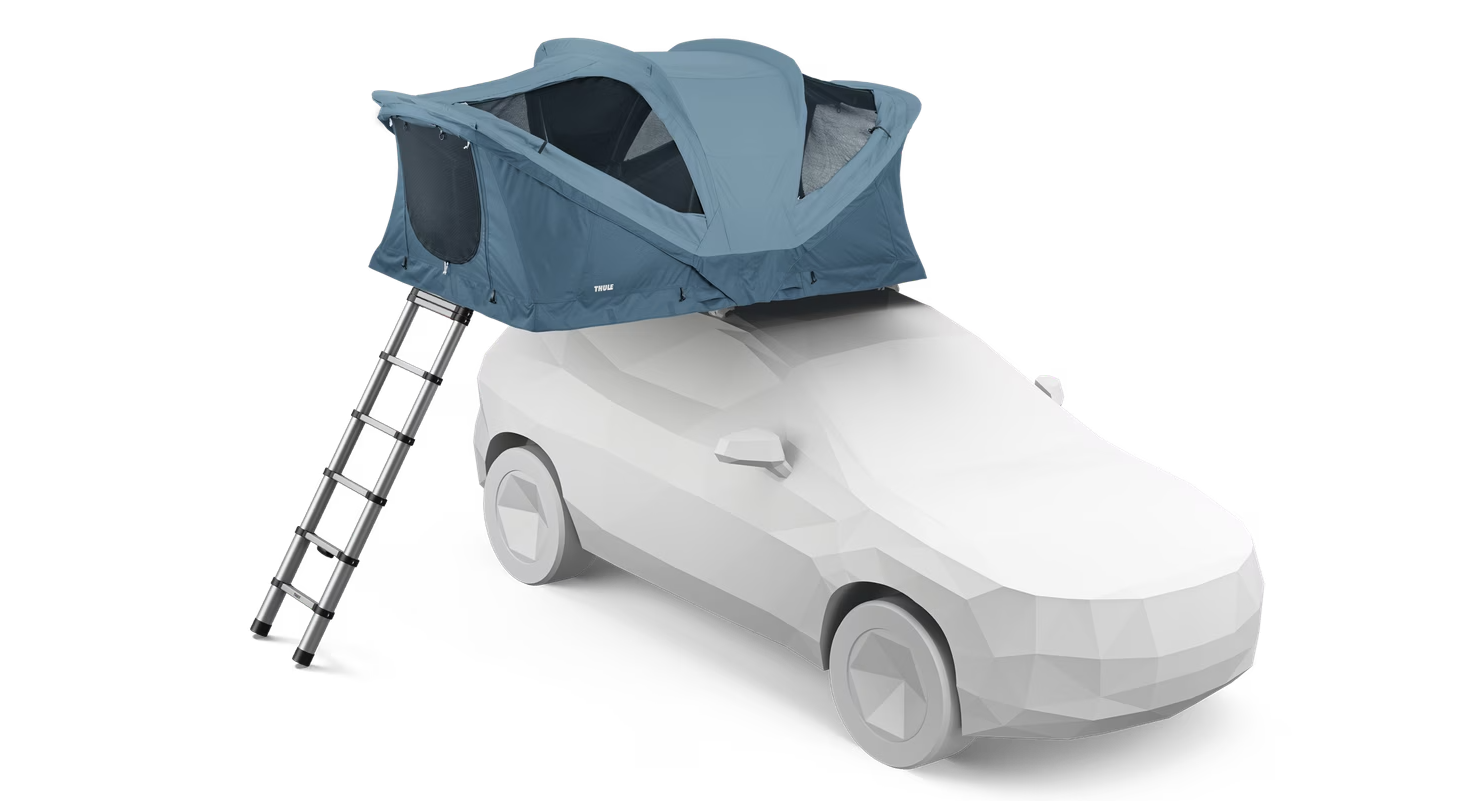 Thule’s Approach 2 S soft-shell rooftop tent is more affordable, but less convenient than a hardshell rooftop tent. (Photo: Courtesy Thule)
Soft-shell Rooftop Tent Pros and Cons
Thule’s Approach 2 S soft-shell rooftop tent is more affordable, but less convenient than a hardshell rooftop tent. (Photo: Courtesy Thule)
Soft-shell Rooftop Tent Pros and Cons
+ Less expensive
+ Compact design allows them to fit better on smaller cars and trucks
+ Often lighter than hardshells
– Set up and take down is often more involved
– The cover doesn’t handle weather as well.
– You lose rooftop carrying capacity
Instead of a hard poly shell, soft-shell rooftop tents are tucked inside a waterproof, ripstop nylon travel cover that zips off when it’s time to set up camp. Setup is a little more involved than a hardshell—the “wings” of the tent fold out and pop up, then you add poles to the various roof peaks and you’re good to go. I had a Front Runner soft-shell tent on my 4Runner for years and thoroughly enjoyed it. The biggest benefit of the soft-shell is its compact footprint, which fits well on smaller vehicles. They’re also often 30 to 50 pounds lighter than a hardshell of comparable size. To compare the two Thule options again: the Approach 2S is just 43″x48″x11″ when closed, while the Widesky is 83″x55″x8″. The soft-shell weighs 110 pounds; the hardshell comes in at 147.
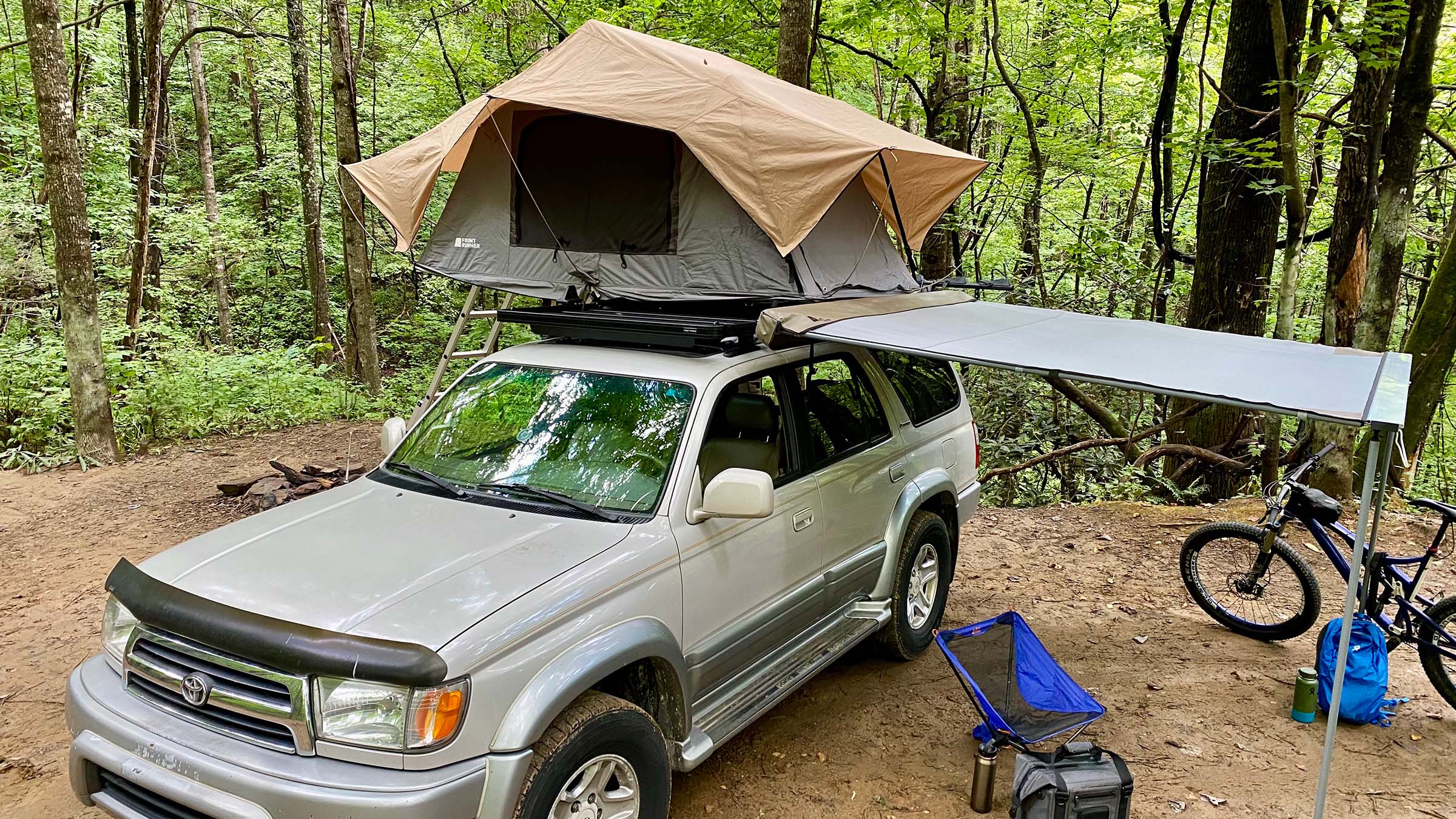 The author’s Front Runner soft-shell rooftop tent on his Toyota 4Runner. (Photo: Graham Averill)
If soft-shell rooftop tents are cheaper, lighter, and fit well on more vehicles, are they the better choice? Maybe. But those ripstop travel covers don’t handle weather and aging as well as hardshell counterparts. I found myself scrubbing mildew off my soft-shell cover more often than I’d like. The travel cover you unzip also has to be stored somewhere, which is one more logistical step when you’re setting up camp. And packing soft-shell tents away is often more involved—you have to tuck all of that fabric back into itself from all sides, a job that frequently takes two people. I also haven’t found a soft-shell yet that can handle crossbars on top of the shell, so you lose rooftop cargo capacity.
Hardshell vs. Soft-Shell Rooftop Tents: The Bottom LineSo which rooftop tent style is best for you? To some degree it depends on your situation, but here’s my hard-earned opinion: hardshell rooftop tents are just better. I’ve had both, and the ease of use combined with the ability to still load a paddleboard or surfboard on top seals the deal. Spend a little more and you’ll get a much more streamlined, low-maintenance experience. And if budget is the limiting factor, there’s nothing wrong with pitching a tent on the ground like we’ve all done for decades—you can just leave your mountain bike on your Subaru so everyone in the Trader Joe’s parking lot knows you’re cool.
| # | Наименование новости | Тональность | Информативность | Дата публикации |
|---|---|---|---|---|
| 1 | Overland OGs Share Their Secrets to Thriving Off-Road | 0 | 11.9 | 19-06-2026 |
| 2 | The Best Coolers on Sale This Summer—at Slashed Prices | 0 | 9.45 | 14-08-2026 |
| 3 | This Tire Repair Kit Helps Fix an Overlander’s Worst Nightmare | 0 | 6.6 | 12-08-2026 |
| 4 | The 17 Best August Deals from REI, Backcountry, and Patagonia | 0 | 11.4 | 18-08-2026 |
| 5 | Schimmel im Auto entfernen: So macht man es richtig | 0 | 6.4 | 24-07-2026 |
| 6 | 45-lb rooftop duffel tent rides in the car, camps on the roof & beyond | 0 | 8.6 | 27-07-2026 |
| 7 | Kratzer vermeiden: Ab in die Waschbox! So wird das Auto schön sauber | 0 | 10.32 | 13-08-2026 |
| 8 | 'Car-wash-in-a-box' promises sparkling results in just 20 minutes | 5 | 5 | 06-07-2026 |
| 9 | Loud music, drinking til dawn - not Ibiza, but UK campsites! Experts reveal what to do if you've pitched up next to a nightmare on your summer holiday | 0 | 7.62 | 01-08-2026 |