Просмотр новости
Найдите то, что Вас интересует
 Спутники
 РН
РН SpaceX
 Роскосмос
 NASA
NASA
СпутникиРНSpaceXРоскосмосNASAThe iconic Cyclops of The Odyssey might look like a massive, one-eyed person, but it might have more in common with creatures other than humans.
The seeing world is dominated with eyes that come in sets of two or more. But single-eyed oddities have long had a place in the animal kingdom — and our imagination.
Perhaps the most famed of these creatures is the Cyclops Polyphemus. He appears in The Odyssey, an ancient Greek tale by Homer. It got turned into a live-action movie earlier this year. As Odysseus and his men reached the island of Sicily on their epic journey home, they found a formidable foe. This giant, one-eyed creature had a taste for sailors. As chronicled in the tale, the Cyclops held the men captive, then ate them two-by-two — until he was outsmarted.
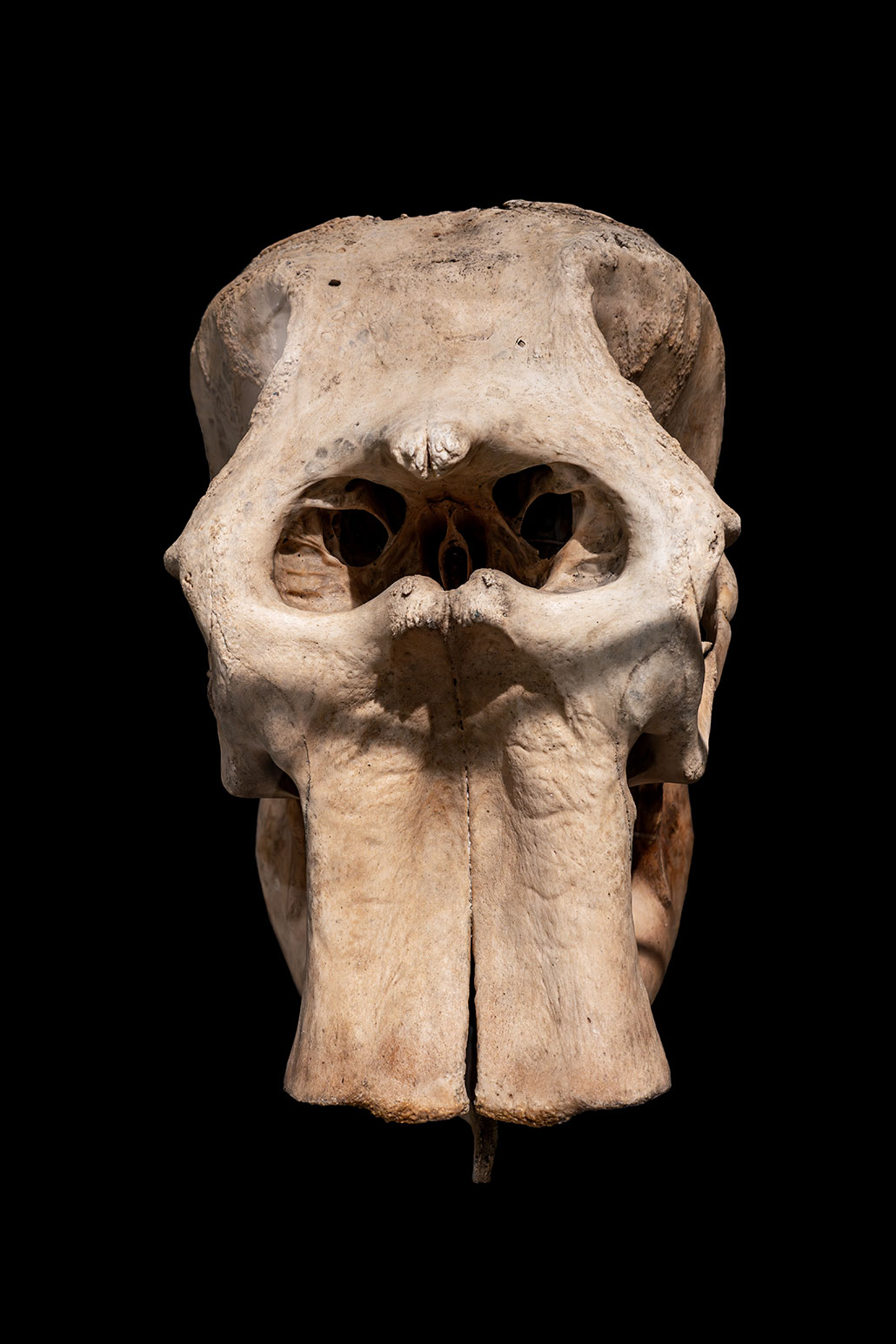 Some researchers suspect unearthed prehistoric elephant skulls inspired the cyclops myth.TON PONCHAI/SHUTTERSTOCK
In a modern version of the story, Percy Jackson ends up in a similar misadventure. Polyphemus takes captive Percy’s satyr buddy Grover. But Percy prevails because he has a cyclops on his side, his brother Tyson.
While the stuff of mythology, Cyclopes may have their roots in biology. Homer and the ancient Greeks, for instance, may have misinterpreted fossils — especially those of prehistoric elephant ancestors.
In the time of Homer, “nobody in Greece had ever seen a living elephant,” says Adrienne Mayor. She’s a historian of ancient science at Stanford University in California. Ancient peoples thought the immense bones of massive mammals belonged to giants, heroes and mythical creatures.
Those elephant ancestors had a big opening in the center of the skull for the trunk. That could have led ancient Greeks to think the creature had one big eye. “The eye sockets,” she notes, “are really not very noticeable.”
While this possible inspiration for the Greek Cyclops may not have actually had one eye, several creatures have evolved over time to have a single eye.
One-eyed wondersTo find a real one-eyed creature, just visit an ocean. Tiny crustaceans called copepods are about a millimeter (0.04 inch) long. They make up a big share of the base of the food chain in oceans and many bodies of water. A single, bright red eye peers from between two antennae on the heads of some species.
Copepod eyes “wouldn’t have high resolution like [our eyes] would,” says Megan Porter. She’s an evolutionary biologist. She studies visual systems at the University of Hawaiʻi at Mānoa. A copepod’s fairly simple eyes contain three cuplike structures that sense light. They point in different directions, which probably gives copepods a broad field of vision. That vision is good enough, Porter says, to guide copepods that live in the ocean to navigate from shallow waters at night to deeper waters during the day. That helps them to evade predators.
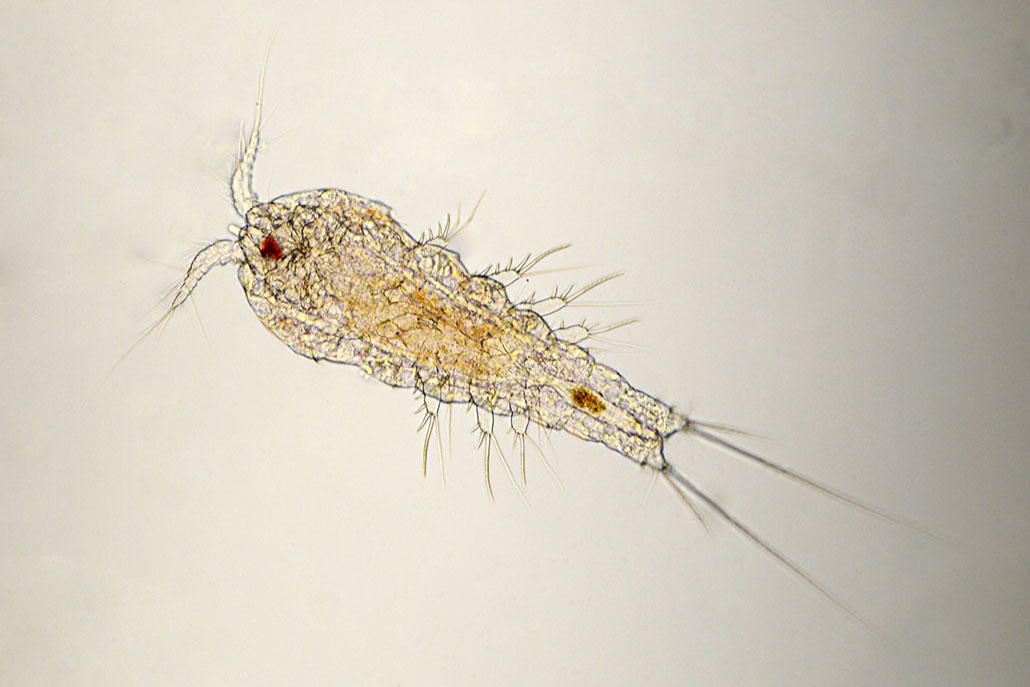 This freshwater copepod shares its genus name, Cyclops, with the mythical one-eyed Greek monster.NNEHRING/E+/GETTY IMAGES
But copepods aren’t the only creatures to have had only one eye. Around 560 million years ago, an ancestor of all vertebrates — including us — also had a single “median eye” on the top of its head. This eye could detect light but couldn’t resolve detailed images.
For this water-dwelling critter, going to one eye was evolutionary innovation. Its ancestor had a pair of eyes on the sides of the head plus another median eye, says George Kafetzis. He’s an evolutionary neuroscientist at the University of Sussex in England. The eyes on either side of the head probably handled navigation. The median eye followed the daily rhythms of the sun.
Kafetzis and his colleagues think this creature then lost the original lateral eyes, retaining only the median one. This might have happened when this creature abandoned its free-swimming lifestyle for a sedentary burrowing one, Kafetzis says. “When you’re partially burrowed,” he says, “the steering eyes don’t have much purpose to serve anymore.”
His team described the evolution of this lone-eyed vertebrate in the February Current Biology.
Submit your question here, and we might answer it an upcoming issue of Science News Explores
Over a few million years, lifestyles changed again. Vertebrates evolved. Three eyes again became better than one.
Two became the kinds of eyes you’re probably using to read this story. And our “third eye”? It descended into the brain to become the pineal gland. This gland regulates our circadian rhythm based on information it receives from our seeing eyes.
For some reptiles, amphibians and fish, a version of this median eye remains exposed on the top of their head. It can still sense light directly. You could say these examples stretch the definition of the cyclops beyond a centered eye that is the only one on their face.
When one eye is deadlyWhen a human embryo is growing, it also starts out with a single eye, of sorts. But it only stays like that in rare — and deadly — cases.
As they’re growing in the womb as an embryo, the cells that eventually become eyes begin as a cluster. Later, it will split in two. But in rare cases, genetics or environmental factors can cause cyclopia. In this deadly disorder, that cluster of eye cells doesn’t split and instead develops as one large eye.
“Cyclopia is sort of the extreme end of a whole range of malformations,” says Philip Beachy. He’s a developmental molecular biologist at Stanford University.
Some important clues about how this disorder develops came from Idaho farmers in the 1950s. Some of their sheep ate a few too many corn lily plants while they were pregnant.
“During a drought, [the farmers sent their sheep] to higher pastures so that their flocks would have something to graze on. And they consumed this plant. And guess what? The lambs were born cyclopic,” Beachy says. The plant chemical that caused this was later identified and named cyclopamine (Sy-KLOH-puh-meen).
While today’s one-eyed wonders are a world apart from the monsters of Greek mythology, they still inspire us to explore — and marvel at — our world.
amphibians: A group of animals that includes frogs, salamanders and caecilians. Amphibians have backbones and can breathe through their skin. Unlike reptiles, birds and mammals, unborn or unhatched amphibians do not develop in a special protective sac called an amniotic sac.
ancestor: A predecessor. It could be a family forebear, such as a parent, grandparent or great-great-great grandparent. Or it could be a species, genus, family or other order of organisms from which some later one evolved. For instance, ancient dinosaurs are the ancestors of today's birds. (antonym: descendant)
biology: The study of living things. The scientists who study them are known as biologists.
cell: (in biology) The smallest structural and functional unit of an organism. Typically too small to see with the unaided eye, it consists of a watery fluid surrounded by a membrane or wall. Depending on their size, animals are made of anywhere from thousands to trillions of cells.
chemical: A substance formed from two or more atoms that unite (bond) in a fixed proportion and structure. For example, water is a chemical made when two hydrogen atoms bond to one oxygen atom. Its chemical formula is H2O. Chemical also can be an adjective to describe properties of materials that are the result of various reactions between different compounds.
circadian rhythm: Biological functions such as body temperature and sleeping/waking times that operate on a roughly 24-hour cycle.
colleague: Someone who works with another; a co-worker or team member.
copepod: A type of small crustacean found in salt and fresh water. Some species of them are plankton, floating with the currents. Others spend time on the sea floor. These animals aren’t limited to oceans; copepods also are found in freshwater, from ponds to puddles. They often serve as food for larger species, and most eat phytoplankton — single-celled organisms that get their energy from the sun.
crustaceans: Hard-shelled water-dwelling animals including lobsters, crabs and shrimp.
current: A fluid — such as of water or air — that moves in a recognizable direction. (in electricity) The flow of electricity or the amount of charge moving through some material over a particular period of time.
cyclops: An informal term for something with one eye. When capitalized, it's any of several one-eyed giants in Greek (and later Roman) mythology. Here, the plural is Cyclopes. Those in Homer’s tales were cannibals.
develop: To emerge or to make come into being, either naturally or through human intervention, such as by manufacturing. (in biology) To grow as an organism from conception through adulthood, often undergoing changes in chemistry, size, mental maturity or sometimes even shape.
developmental: (in biology) An adjective that refers to the changes an organism undergoes from conception through adulthood. Those changes often involve chemistry, size and sometimes even shape.
disorder: (in medicine) A condition where the body does not work appropriately, leading to what might be viewed as an illness. This term can sometimes be used interchangeably with disease.
drought: An extended period of abnormally low rainfall; a shortage of water resulting from this.
embryo: The early stages of a developing organism, or animal with a backbone, consisting of only one or a few cells. As an adjective, the term would be embryonic — and could be used to refer to the early stages or life of a system or technology.
evolution: (v. to evolve; adj. evolutionary) A process by which species undergo changes over time, usually through genetic variation and natural selection. These changes usually result in a new type of organism better suited for its environment than the earlier type. The newer type is not necessarily more “advanced,” just better adapted to the particular conditions in which it developed. Or the term can refer to changes that occur as some natural progression within the non-living world (such as computer chips evolving to smaller devices which operate at an ever faster speed).
evolutionary biologist: Someone who studies the adaptive processes that have led to the diversity of life on Earth. These scientists can study many different subjects, including the microbiology and genetics of living organisms, how species change to adapt, and the fossil record (to assess how various ancient species are related to each other and to modern-day relatives).
factor: Something that plays a role in a particular condition or event; a contributor.
fossil: Any preserved remains or traces of ancient life. There are many different types of fossils: The bones and other body parts of dinosaurs are called “body fossils.” Things like footprints are called “trace fossils.” Even specimens of dinosaur poop are fossils. The process of forming fossils is called fossilization.
genetic: Having to do with chromosomes, DNA and the genes contained within DNA. The field of science dealing with these biological instructions is known as genetics. People who work in this field are geneticists.
gland: A cell, a group of cells or an organ that produces and discharges a substance (or “secretion”) for use elsewhere in the body or in a body cavity, or for elimination from the body.
innovation: (v. to innovate; adj. innovative) An adaptation or improvement to an existing idea, process or product that is new, clever, more effective or more practical.
lateral: An adjective for something that occurs on or to the side of something.
mammal: An animal distinguished by possessing hair or fur, the secretion of milk by females for the feeding of their young, and (typically) the bearing of live young. They also are warm-blooded (or endothermic).
navigate: To find one’s way through a landscape using visual cues, sensory information (like scents), magnetic information (like an internal compass) or other techniques.
neuroscientist: Someone who studies the structure or function of the brain and other parts of the nervous system.
peer: (noun) Someone who is an equal, based on age, education, status, training or some other features. (verb) To look into something, searching for details.
pineal gland: The source of melatonin, the hormone which helps regulate the onset of sleep. This gland is located deep in the center of the brain, right behind the thalamus. It takes its name from its shape, which somewhat resembles a pinecone.
predator: (adjective: predatory) A creature that preys on other animals for most or all of its food.
prehistoric: An adjective for something that happened tens of thousands to millions of years ago, periods before people began deliberately recording events.
range: The full extent or distribution of something. For instance, a plant or animal’s range is the area over which it naturally exists. (in math or for measurements) The extent to which values can vary (such as the highest to lowest temperatures). Also, the distance within which something can be reached or perceived.
regulate: (n. regulation) To control with actions. Governments write rules and regulations — laws — that are enforced by police and the courts.
reptile: Vertebrate animals belonging to a group known as Reptilia. Most reptiles have skin that is covered with scales or horny plates. Snakes, turtles, lizards and alligators are all reptiles. Once considered their own separate group, birds now belong to this order. With the exception of modern birds, most modern reptiles are cold-blooded (or ectothermic).
resolution: (in optics) A term having to do with the degree of clarity or detail with which some object can be seen. (v. resolve)
sedentary: Not physically active; an adjective for activities done largely while sitting.
skull: The skeleton of a person’s or animal’s head.
species: A group of similar organisms capable of producing offspring that can survive and reproduce.
system: A network of parts that together work to achieve some function. For instance, the blood, vessels and heart are primary components of the human body's circulatory system. Similarly, trains, platforms, tracks, roadway signals and overpasses are among the potential components of a nation's railway system. System can even be applied to the processes or ideas that are part of some method or ordered set of procedures for getting a task done.
vertebrate: The group of animals with a brain, two eyes, and a stiff nerve cord or backbone running down the back. This group includes amphibians, reptiles, birds, mammals and most fish.
Lily Burton was the Spring 2026 science writing intern at Science News. She holds a bachelor’s degree in Molecular and Cell Biology and Anthropology from UC Berkeley. She also has a Ph.D. in Biochemistry and Molecular Biophysics from the University of Chicago where she researched circadian rhythms in photosynthetic bacteria and the role they play in metabolism. She was a 2024 AAAS Mass Media Fellow where she reported on local science at WUNC – North Carolina Public Radio.
| # | Наименование новости | Тональность | Информативность | Дата публикации |
|---|---|---|---|---|
| 1 | Греческий историк рассказал, существовал ли Одиссей в реальности | 0 | 10.4 | 29-08-2026 |
| 2 | Sussex research shows humans descended from one-eyed ‘Cyclops’ | 0 | 14.59 | 03-03-2026 |
| 3 | Человеческие глаза могли произойти от одноглазого морского существа, жившего 600 млн лет назад | 0 | 11.07 | 01-08-2026 |
| 4 | Ученые связали происхождение человеческих глаз с древним «циклопом» | 0 | 12.74 | 27-07-2026 |
| 5 | How classic myths make for big-screen movie magic | 0 | 11.26 | 26-07-2026 |
| 6 | The Ending of Christopher Nolan’s The Odyssey Changes the Meaning of the Whole Story | 0 | 6.94 | 18-07-2026 |
| 7 | The Most Overlooked Performance in <em>The Odyssey</em> Is Also the One That Towers Over All the Rest | 0 | 7.03 | 25-07-2026 |
| 8 | 20 creatures from the deep ocean that look like nothing you've seen above water | 0 | 7 | 06-07-2026 |
| 9 | Расследование вели.......................................................................... Самым зашифрованным, многослойным и таинственным сюжетом у Гомера ... | 7 | 8 | 30-06-2026 |