Просмотр новости
Найдите то, что Вас интересует
 Спутники
 РН
РН SpaceX
 Роскосмос
 NASA
NASA
СпутникиРНSpaceXРоскосмосNASAMore and more young people are turning to AI chatbots for mental health help. There can be risks, and it’s important to know what they are, experts say.
When you’re feeling sad, angry or stressed, it might be tempting to ask a chatbot for help. In fact, a new survey of 12- to 21-year-olds showed that nearly 1 in 5 of them had turned to AI for mental health support. That’s up from 1 in 8 just a couple years ago.
It’s perhaps not surprising that many teens and young adults are seeking advice. In 2023, a whopping 40 percent of high school students said they felt so sad or hopeless that they couldn’t engage in activities that are normal for them. In 2024, 15 percent of 12- to 17-year-olds had a major depressive episode — many without treatment.
Clearly, there is a big need among young people for mental and emotional support. But as lifelike as they might sound in conversations, chatbots aren’t real people with empathy. And free, general-use chatbots such as ChatGPT, Meta AI and Character.AI weren’t built to support mental health. They don’t earn licenses to offer therapy — or follow rules for treating patients — the way humans do.
So, what should teens know before using AI tools for mental health advice? Science News Explores asked the experts.
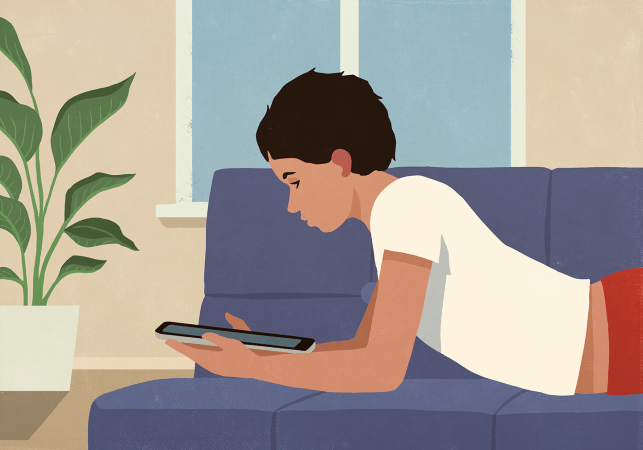 “There absolutely are positive use cases for using even general-purpose [chatbots] to learn more about mental health,” says psychologist Vaile Wright. These tools can help you search for information on mental health conditions and find resources. (Just be sure to double-check a chatbot’s answers.)Malte Mueller/fStop/Getty ImagesShould AI ever be used for mental health help?
A chatbot could help you learn more about mental health issues, says Vaile Wright. A psychologist in Chicago, Ill., she works with the American Psychological Association.
You could use AI to search for information about mental health conditions and resources online, Wright suggests. (Just be sure to double-check its findings. Chatbots sometimes make stuff up.) An AI might even be able to offer “some basic advice if you’re struggling in the moment and don’t know where else to turn,” Wright says.
Treating a chatbot like a therapist, though, is not wise. “It’s really when you’re having these multi-turn, very extended types of conversations where you’re using the chatbot to fill some sort of emotional gap in your life,” Wright says, that you enter risky territory.
Why doesn’t a chatbot make a good therapist?A real therapist’s goal is to help their patient. Chatbots are different. “They’re purposely engineered to keep people on the platform for as long as possible,” Wright says. “The way they do that is by being exceedingly validating and just telling people exactly what they want to hear.” That might feel good. But it’s not what a therapist would do. And it’s not likely to give you useful advice.
“A therapist is going to validate somebody’s feelings,” Wright says. “But it’s also our role to point out where … someone’s acting, thinking or feeling in ways that’s not maybe helpful to them.”
Plus, a chatbot doesn’t have the same types of information a therapist does, says Darja Djordjevic. She’s a psychiatrist at Stanford University in California. “AI was built to have this encyclopedic knowledge,” she says. “But it doesn’t understand the context of people’s lives.” That well-rounded knowledge of a person is key to aiding their mental health.
What are the risks of treating chatbots like therapists?“They do not handle any mental health crises or emergencies well,” says Djordjevic. She has studied how AI systems would respond to users with a variety of mental health conditions, such as self-harm, anxiety and eating disorders.
“The models really don’t do a good job of recognizing … situations that would warrant human intervention,” Djordjevic says. “Unfortunately, we have some very tragic, more extreme cases [showing this] that involve young people.” Take Adam Raine, 16, of California. He died by suicide last year after discussing his suicidal thoughts with ChatGPT.
Djordjevic notes how crucial human connection is. “We have very little research right now on what the long-term effects of using AI for mental health would be,” she says. “What we do have a lot of research on is how much social connection and human contact are important for health and flourishing. So we know what’s good for us.” Leaning on AI might get in the way of forming crucial connections with real people.
There also are privacy risks to using AI, adds Wright. “Everything [you] put in these apps is not private. All the chats are maintained.” If a chatbot were hacked, someone else might be able to read your sensitive conversations with a bot.
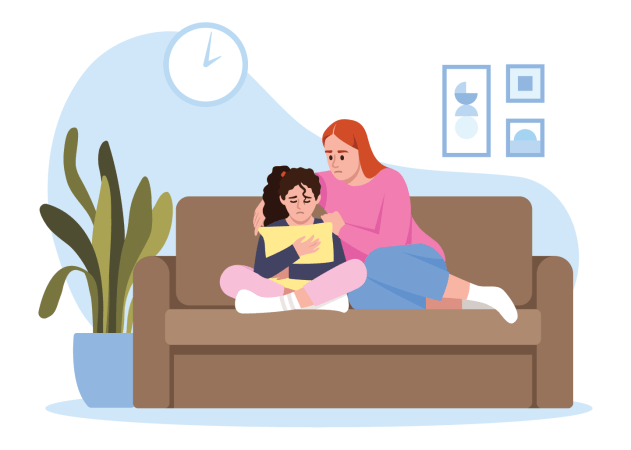 A chatbot might be able to help you brainstorm ideas for how to ask a trusted adult for mental or emotional support. Frants Tsyvinskyi/iStock/Getty Images PlusAny advice for seeking mental health help from people, not chatbots?
“It doesn’t have to be an either-or,” Wright says. “You could use the chatbot to say, ‘I’m nervous about approaching my dad about my concerns. How could I do it?’… Using the chatbot as a tool to connect with human relationships in real life, I think, is probably one of the most impactful things that this technology can do.”
Djordjevic notes that most schools have a counselor students can talk to. The National Alliance for Mental Illness also has lots of resources on its site, she adds. This includes a free, confidential helpline for teens.
Sometimes, it might seem easier or less embarrassing to ask a computer about mental-health issues than a real person. In the new survey, almost two-thirds of young people who used chatbots for mental health didn’t tell anyone they were doing it.
But for anyone nervous about seeking human help: Fear not, Djordjevic says. “A lot more adults and people around you have struggled at some point or struggle with mental health issues than you think.”
Suicide was the third leading cause of death among U.S. teens ages 15-19 in 2024. If you or someone you know is suffering from suicidal thoughts, please seek help. In the United States, you can reach the Suicide Crisis Lifeline 24/7 by calling or texting 988 or chat at 988lifeline.org. Please do not suffer in silence.
anxiety: A nervous reaction to events causing excessive uneasiness and apprehension. People with anxiety may even develop panic attacks.
app: Short for application, or a computer program designed for a specific task.
chatbot: A type of computer program known as a bot (web robot) that has been created to interact with people in a way that seems to model normal human conversation. The idea is that if they seem human-like enough, people should be more willing to "chat" with these computer programs or let them take on tasks previously handled only by people. Some chatbots can craft customized text, such as a letter or report. Others might ask or share information (by phone or online) on a company’s behalf. One drawback: They are susceptible to hallucinating — as in making up their answers — or telling people what the chatbot’s artificial-intelligence model thinks they want (even if this is not objectively healthy or true).
context: The setting or circumstances that help explain an event, some statement or some conclusion.
disorder: (in medicine) A condition where the body does not work appropriately, leading to what might be viewed as an illness. This term can sometimes be used interchangeably with disease.
eating disorder: An illness of the mind involving dangerously unhealthy patterns of eating and weight loss or gain.
mental health: A term for someone’s emotional, psychological and social well-being. It refers to how people behave on their own and how they interact with others. It includes how people make choices, handle stress and manage fear or anxiety. Poor mental health can be triggered by disease or might reflect a short-term response to life’s challenges. It can occur in people of any age, from babies to the elderly.
psychiatrist: A medical doctor who spends many years learning to study and treat diseases of the human mind. Treatments may consist of talking therapies, prescription drugs or both. This medical field is known as psychiatry.
psychological: (adj.) Related to how the human mind works, especially in relation to guiding actions and behavior.
psychologist: A scientist or mental-health professional who studies the mind, especially in relation to actions and behaviors. Some work with people. Others may conduct experiments with animals (usually rodents) to test how their minds respond to different stimuli and conditions.
risk: The chance or mathematical likelihood that some bad thing might happen. For instance, exposure to radiation poses a risk of cancer. Or the hazard — or peril — itself. (For instance: Among cancer risks that the people faced were radiation and drinking water tainted with arsenic.)
self-harm: Intentionally injuring one’s body. Examples may include cutting, scratching or burning oneself. This unhealthy behavior is typically a way this individual attempts to cope with emotional pain. It’s usually not intended as a suicide attempt. Also known as self-injury.
social: (adj.) Relating to gatherings of people; a term for animals (or people) that prefer to exist in groups. (noun) A gathering of people, for instance those who belong to a club or other organization, for the purpose of enjoying each other’s company.
survey: To view, examine, measure or evaluate something, often land or broad aspects of a landscape. (with people) To ask questions that glean data on the opinions, practices (such as dining or sleeping habits), knowledge or skills of a broad range of people. Researchers select the number and types of people questioned in hopes that the answers these individuals give will be representative of others who are their age, belong to the same ethnic group or live in the same region. (n.) The list of questions that will be offered to glean those data.
system: A network of parts that together work to achieve some function. For instance, the blood, vessels and heart are primary components of the human body's circulatory system. Similarly, trains, platforms, tracks, roadway signals and overpasses are among the potential components of a nation's railway system. System can even be applied to the processes or ideas that are part of some method or ordered set of procedures for getting a task done.
technology: The application of scientific knowledge for practical purposes, or the devices, processes and systems that result from those efforts.
therapy: (adj. therapeutic) Treatment intended to relieve or heal a disorder.
tool: An object that a person or other animal makes or obtains and then uses to carry out some purpose such as reaching food, defending itself or grooming.
Aimee Cunningham is the biomedical writer at Science News. She has a master’s degree in science journalism from New York University.
Maria Temming is the Assistant Managing Editor at Science News Explores. She has bachelor's degrees in physics and English, and a master's in science writing.
| # | Наименование новости | Тональность | Информативность | Дата публикации |
|---|---|---|---|---|
| 1 | Opinion: Teens are turning to chatbots for mental health help. We need rules to keep them safe | 0 | 7 | 02-07-2026 |
| 2 | Teens are turning to AI chatbots for emotional support — here's how to keep kids safe | 0 | 5.29 | 16-08-2026 |
| 3 | Teens are turning to AI chatbots for emotional support – here’s how to keep kids safe | 0 | 11.36 | 15-08-2026 |
| 4 | Teens are turning to AI chatbots for emotional support – here’s how to keep kids safe | 0 | 11.36 | 15-08-2026 |
| 5 | Teens are turning to AI chatbots for emotional support – here’s how to keep kids safe | 0 | 11.36 | 15-08-2026 |
| 6 | Teens are turning to AI chatbots for emotional support – here’s how to keep kids safe | 0 | 11.36 | 15-08-2026 |
| 7 | Teens are turning to AI chatbots for emotional support – here’s how to keep kids safe | 0 | 6.78 | 13-08-2026 |
| 8 | The Therapist in Your Pocket | 0 | 9.19 | 28-07-2026 |
| 9 | ChatGPT as a therapist? New study reveals serious ethical risks | 0 | 9.71 | 02-03-2026 |
| 10 | Should people marry AI agents? | 0 | 6.86 | 11-08-2026 |