Просмотр новости
Найдите то, что Вас интересует
 Спутники
 РН
РН SpaceX
 Роскосмос
 NASA
NASA
СпутникиРНSpaceXРоскосмосNASAThe climate pattern could bring “shockingly high” temps this winter, plus extreme weather. Some scientists are looking into an engineering “fix.”
Climate scientists are warning us to buckle up for a bumpy ride. An El Niño has begun. By year’s end, this periodic climate event might become the strongest El Niño on record.
An El Niño Southern Oscillation, or ENSO, is a recurring two- to seven-year ocean-climate pattern. On June 11, the U.S. National Oceanic and Atmospheric Administration confirmed Earth has officially entered the El Niño phase of this cycle.
El Niño events emerge in the Eastern Pacific. Eventually, the changes in climate they spawn will affect weather globally. And the stronger an El Niño, the more costly it can be to human health, farming, buildings and our wallets.
Forecasters currently predict a 63 percent chance that, by winter, the new El Niño will prove very strong — as in a “super El Niño.”
Here are four things to know as this climate pattern takes hold.
What’s an El Niño?An ENSO’s several-years-long cycle has three phases.
The first, known as El Niño, involves months of warmer than normal sea-surface temperatures in the eastern equatorial Pacific. Back in the 1600s, fishers in Peru noticed this warming tended to show up around Christmas. So they dubbed it “El Niño,” which is Spanish for “little boy.” It’s also the name given to “the Christ child.”
A second phase — La Niña (or little girl) — swings to cooler than normal temps in those eastern Pacific waters near the equator.
The last is a neutral, in-between phase. It brings average temperatures back to the Pacific’s equatorial sea surface.
The “Southern Oscillation” part of ENSO’s name refers to another seesawing pattern. Here the swings are between areas of high and low atmospheric pressure over the eastern versus western Pacific Ocean. That up-and-down pressure pattern triggers global-scale changes in winds, air temps and precipitation.
Scientists track ENSO air-pressure changes at two main stations. One is in the West Pacific at Darwin, Australia. The other is in the East Pacific at Tahiti (part of French Polynesia).
During neutral periods and La Niña phases, the high-pressure zone is in the east. That sends prevailing winds westward across the Pacific around the equator. These winds push the warming surface waters of the Pacific to the west. This keeps them away from the coast of the Americas.
In so doing, it allows cold, nutrient-rich water to well up from the deep ocean. That keeps the eastern equatorial Pacific waters cold.
But every few years, conditions flip. Now high pressure prevails over the western Pacific, and lower pressure over the eastern Pacific.
This weakens or even reverses the direction of the prevailing winds. It also allows warm surface waters to stay in place. This suppresses the upwelling of cold water. Now sea-surface temps warm rapidly in the eastern Pacific. This also serves as a telltale sign an El Niño is back.
No two El Niño events are exactly alike, says Tom Di Liberto. He’s a climate scientist and meteorologist now working for the nonprofit news group Climate Central. It’s based in Washington, D.C.
But each El Niño transfers huge amounts of heat from tropical Pacific waters into the air. That bonus heat can temporarily — and dramatically — boost air temperatures around the globe.
Submit your question here, and we might answer it an upcoming issue of Science News Explores
An El Niño officially starts when sea-surface temperatures in the eastern equatorial Pacific Ocean steadily remain at least 0.5 degree Celsius (0.9 degree Fahrenheit) above average for several months. The warmer the waters, the stronger an El Niño’s likely global impacts.
Waters warmer than 2 degrees C (3.6 degrees F) above average signal the emergence of a very strong — or “super” — El Niño.
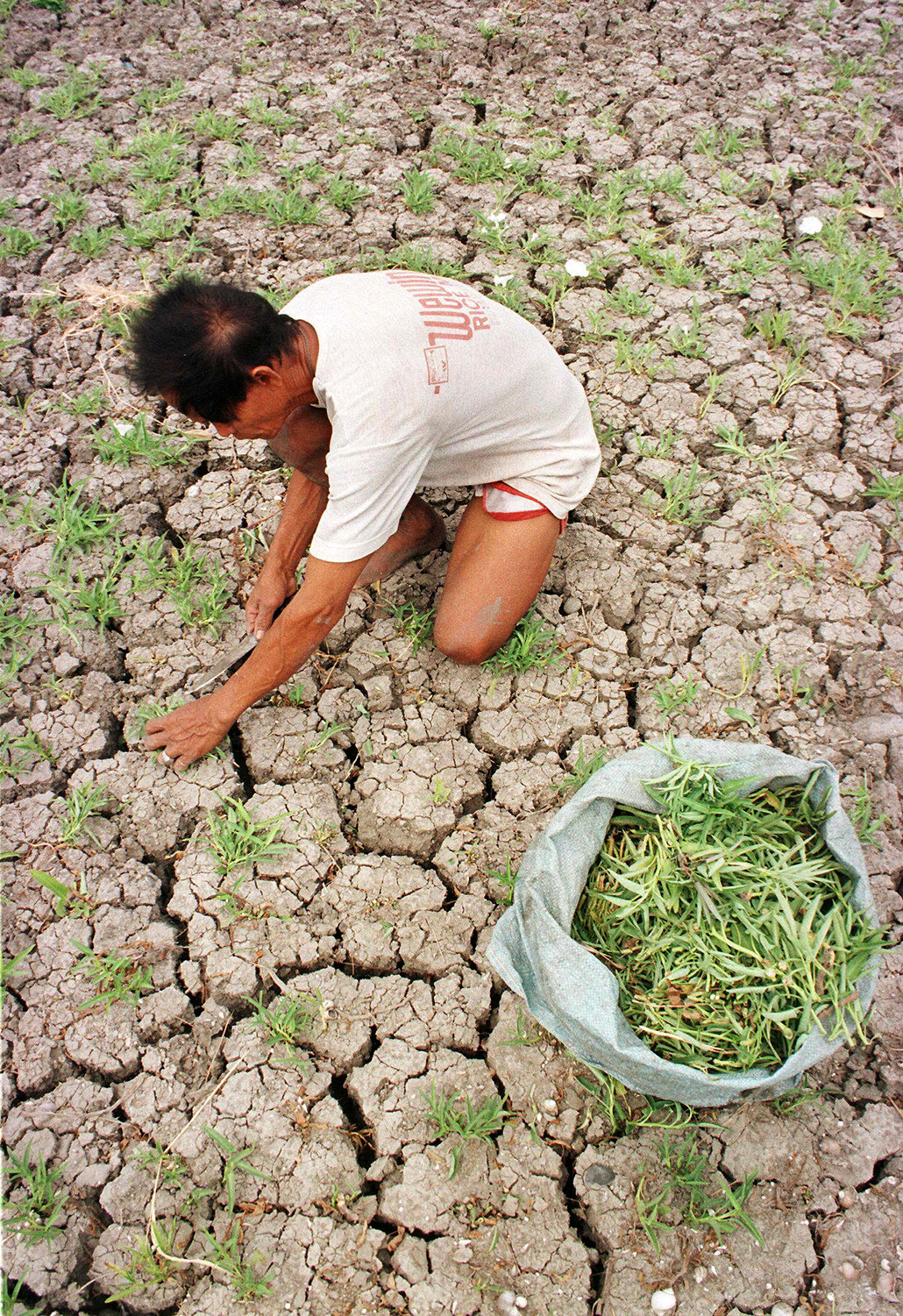 This Philippine farmer was trying to salvage any surviving water-pond plants during the super El Niño in April 1998. He hoped to feed local people and livestock. Seven Philippine corn and rice growing provinces were declared a state of calamity after their crops were totally destroyed by this El Niño’s long, severe drought.Romeo Gacad/AFP/Getty Images Plus
Since April, temps over the eastern equatorial Pacific Ocean have remained well above average. Dozens of forecasters around the world concluded an El Niño was on its way. By June, as the ocean warmed even more, their forecasts began to warn that this could prove a really powerful event.
Recently, climate change has made detecting an El Niño’s onset and strength more difficult. Why? Global temperatures have been warming steadily over the last decade, which can mask an emerging El Niño. So in May, NOAA’s Climate Prediction Center adopted a new tool for its El Niño forecasts. This now adjusts for that climate change–related warming.
Using this new tool, NOAA predicts that this winter, sea-surface temps in the eastern tropical Pacific are 63 percent likely to be more than 2 degrees Celsius higher than average. That’s what suggests a super El Niño is developing.
In fact, computer models are now forecasting “shockingly high” global temperatures for November and December, Di Liberto says.
Such heat can have deadly consequences. A rise in heat-related illnesses is one. Another is upticks in diseases (such as cholera, typhoid and malaria) carried by mosquitoes and other pests that like it hot.
El Niños also alter the track of the Pacific jet stream. The result: Some areas will become drier than normal. Others will get wetter.
For the United States, one of the most significant impacts will likely be more numerous and intense Pacific cyclones. At the same time, changing wind patterns can make it harder for Atlantic hurricanes to form.
Fortunately, the life of any one El Niño is relatively short: Events typically form in the summer, strengthen into the winter, then die out the next spring.
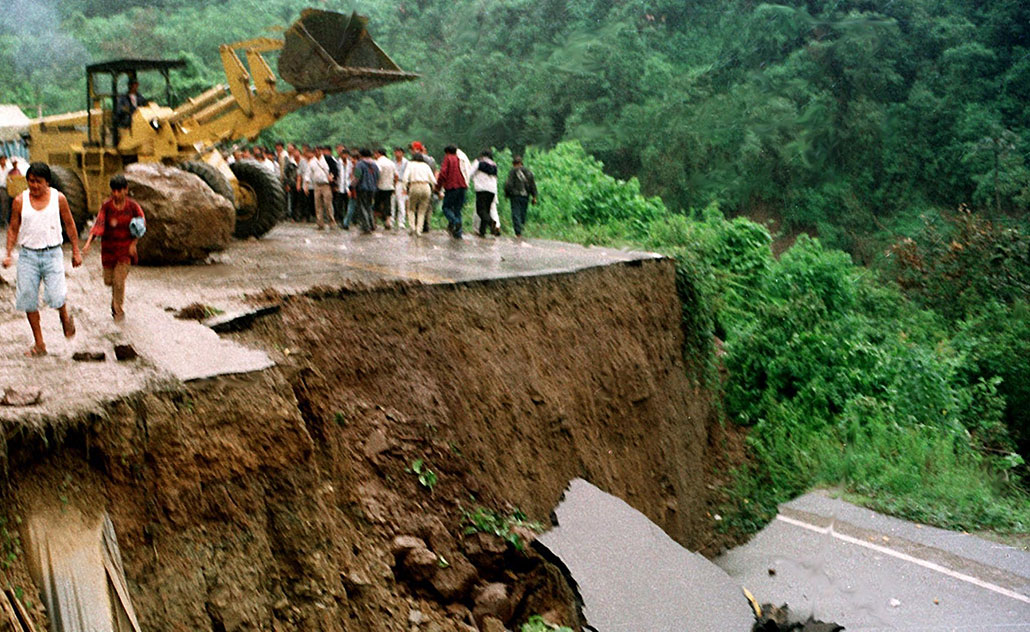 People in Locotal, Bolivia, check out a major road after torrential rains washed out a large section of it on January 9, 1998. Meteorologists attributed the flooding rains and mudslides here to a powerful El Niño, which had been triggering extreme weather events around the globe.STR/AFP/Getty Images PlusHow will this year compare to past major El Niños?
The most recent strong El Niños happened in 2015–16, 1997–98 and 1982–83.
The 1997–98 event was the strongest on record. It temporarily raised average global temps by 1.5 degrees Celsius (2.7 degrees Fahrenheit) and triggered devastating weather events.
These included torrential rains and floods in Peru and East Africa. Those, in turn, triggered an outbreak of Rift Valley Fever in Africa. Droughts in Southeast Asia kicked off deadly wildfires. California saw powerful storms that brought major flooding and landslides. Soaring ocean temperatures led to the bleaching of about one-sixth of the world’s coral reefs.
Such strong El Niños are costly, too. The 1982–83 one cost the world an estimated $4.1 billion. The 1997–98 event was estimated to cost about $5.7 trillion.
How bad this year’s event will be is still unclear. But it’s occurring on top of strong global warming from human activities. And even if this year’s turns out to be only moderately strong, Di Liberto says, its impacts could still be very big. “It would not take a very strong El Niño to see records broken this year.”
Here a BBC meteorologist offers a snapshot of why weather forecasters are worried about the developing El Niño and how its impacts could play out across the globe.Is there a way to downgrade this El Niño?People might be able to weaken future El Niños by injecting small smoke-size particles into the atmosphere. That’s the finding of an analysis in the July 10 Science Advances.
To work, these aerosols would have to be targeted over a particular patch of the Pacific Ocean. This should increase and brighten clouds there, a new computer model finds. And that would reflect more of the sun’s warming light back into space, cooling the climate.
The idea for this was sparked by the 2019–20 Australian wildfires, says Jessica Wan. She’s a climate scientist at the University of Chicago in Illinois. Those fires spewed huge billows of particles into the air. Plumes of them wafted over the southeastern subtropical Pacific Ocean. This brightened clouds there — and helped trigger a multiyear La Niña.
This natural “experiment” hinted at how altering clouds in the proper region can change large climate patterns, says Wan. Her team’s computer model has now calculated what would happen if people injected a huge quantity of aerosols into the atmosphere (as the wildfires had). This should weaken an El Niño. But how much weaker it got would depend on when the injection took place, the model finds. The strategy seemed to work best when done early in an El Niño.
This idea “is really interesting and very new,” says Daniele Visioni. He’s a climate scientist at Cornell University in Ithaca, N.Y. who did not take part in this new study. To him, “the fact that it looks like this could work is a really good indication that it is something worth thinking about.”
But it’s not a strategy that could work for this year’s El Niño. There are too many big questions to answer first, Wan says. For one thing, the technology to inject particles is years from being ready. Plus, there needs to be more study about the possible negative consequences of injecting aerosol particles.
Atlantic: One of the world’s five oceans, it is second in size only to the Pacific. It separates Europe and Africa to the east from North and South America to the west.
atmospheric pressure: The pressure exerted by the weight of the atmosphere.
average: (in science) A term for the arithmetic mean, which is the sum of a group of numbers that is then divided by the size of the group.
cholera: A bacterial disease that infects the small intestine, causing severe diarrhea, vomiting and dehydration. It is spread by germs from feces that contaminate water or food.
climate: The weather conditions that typically exist in one area, in general, or over a long period.
climate change: Long-term, significant change in the climate of Earth. It can happen naturally or in response to human activities, including the burning of fossil fuels and clearing of forests.
computer model: A program that runs on a computer that creates a model, or simulation, of a real-world feature, phenomenon or event.
coral: Marine animals that often produce a hard and stony exoskeleton and tend to live on reefs (the exoskeletons of dead ancestor corals).
cyclone: A strong, rotating vortex, usually made of wind. Notable examples include a tornado or hurricane.
disrupt: (n. disruption) To break apart something; interrupt the normal operation of something; or to throw the normal organization (or order) of something into disorder.
drought: An extended period of abnormally low rainfall; a shortage of water resulting from this.
El Niño: Extended periods when the surface water around the equator in the eastern and central Pacific warms. Scientists declare the arrival of an El Niño when that water warms by at least 0.4 degree Celsius (0.72 degree Fahrenheit) above average for five or more months in a row. El Niños can bring heavy rainfall and flooding to the West Coast of South America. Meanwhile, Australia and Southeast Asia may face a drought and high risk of wildfires. In North America, scientists have linked the arrival of El Niños to unusual weather events — including ice storms, droughts and mudslides.
ENSO: (short for El Niño-Southern Oscillation) A natural cycle of changing temperatures in the ocean and atmosphere, near the equator in the Pacific Ocean. During ENSO events, atmospheric pressure also changes in affected areas. (see also El Niño)
equator: An imaginary line around Earth that divides Earth into the Northern and Southern Hemispheres.
equatorial: (adj.) Having to do with Earth's equator or its general vicinity.
global warming: The gradual increase in the overall temperature of Earth’s atmosphere due to the greenhouse effect. This effect is caused by increased levels of carbon dioxide, chlorofluorocarbons and other gases in the air, many of them released by human activity.
hurricane: A tropical cyclone that occurs in the Atlantic Ocean and has winds of 119 kilometers (74 miles) per hour or greater. When such a storm occurs in the Pacific Ocean, people refer to it as a typhoon.
jet stream: A fast-flowing, high-altitude air current. On Earth, the major jet streams flow from west to east in the mid-latitude regions of the Northern and Southern Hemispheres.
La Niña: Extended periods when the surface water around the equator in the eastern Pacific cools for long stretches of time. Scientists will announce the arrival of a La Niña (Lah-NEEN-yah) when the average temperature there drops by at least 0.4° C (0.72° degree F). Impacts on global weather during a La Niña tend to be the reverse of those triggered by an El Niño: Now, Central and South America may face severe droughts while Australia floods.
malaria: A disease caused by a parasite that invades the red blood cells. The parasite is transmitted by mosquitoes, largely in tropical and subtropical regions.
mean: One of several measures of the “average size” of a data set. Most commonly used is the arithmetic mean, obtained by adding the data and dividing by the number of data points.
meteorologist: Someone who studies weather and climate events.
National Oceanic and Atmospheric Administration: (or NOAA) A science agency of the U.S. Department of Commerce. Initially established in 1807 under another name (The Survey of the Coast), this agency focuses on understanding and preserving ocean resources, including fisheries, protecting marine mammals (from seals to whales), studying the seafloor and probing the upper atmosphere.
outbreak: The sudden emergence of disease in a population of people or animals. The term may also be applied to the sudden emergence of devastating natural phenomena, such as earthquakes or tornadoes.
Pacific: The largest of the world’s five oceans. It separates Asia and Australia to the west from North and South America to the east. The term can also refer to island nations that sit within the Pacific Ocean.
precipitation: (in chemistry) The creation of a solid from a solution. This can occur if there is too much of a chemical to dissolve completely into a solution. It also can be a sign that some chemical reaction is taking place. (in meteorology) A term for water falling from the sky. It can be in any form, from rain and sleet to snow or hail.
reef: A ridge of rock, coral or sand. It rises up from the seafloor and may come to just above or just under the water’s surface.
rift: (v.) to break or split apart, such as a friendship. (in geology) The separation of a span of Earth’s surface along a geologic fault as a result of plate tectonics. (n.) The term for such a break or split.
Rift Valley Fever: A viral disease, it takes its name from where it was first identified, in the Rift Valley of East Africa. Mosquitoes spread the virus to people and animals. Infected people typically get no more than mild symptoms (such as fever, weakness, back pain or dizziness) and can get better without treatment in a few days. Livestock often suffer more. Not only can they get sick, but also die. Pregnant animals may lose their fetus. Outbreaks of this disease often show up after heavy rains, which boosts the reproduction of the mosquitoes that transmit this virus.
sea: An ocean (or region that is part of an ocean). Unlike lakes and streams, seawater — or ocean water — is salty.
spawn: To quickly cause something to come into being. (in biology) To release or fertilize eggs in an aquatic environment.
trillion: A number representing a million million — or 1,000,000,000,000 — of something.
tropical cyclone: A strong, rotating storm. These usually form over tropical areas around the equator where the water is warm. Tropical cyclones have strong winds of more than 119 kilometers (74 miles) per hour and usually have heavy rain. Large ones in the Atlantic are known as hurricanes. Those in the Pacific are termed typhoons.
upwelling: (in oceanography) A rise to the warm surface of cold — usually nutrient-rich — waters from the dark depths of the ocean. It usually takes place along the western coastlines of continents in the subtropics. It develops when prevailing winds push the surface water away from the shore. This pulls deeper water up to take its place. (in geology) The process by which material rises from Earth’s middle layer into its outer layer, where it will become part of the tectonic plates.
weather: Conditions in the atmosphere at a localized place and a particular time. It is usually described in terms of particular features, such as air pressure, humidity, moisture, any precipitation (rain, snow or ice), temperature and wind speed. Weather constitutes the actual conditions that occur at any time and place. It’s different from climate, which is a description of the conditions that tend to occur in some general region during a particular month or season.
Journal: J.S. Wan et al. Targeted marine cloud brightening weakens subsequent El Niño. Science Advances. Vol. 12, July 10, 2026. doi: 10.1126/sciadv.adx3012.
Journal: G.A. Meehl et al. 2019-2020 Australian bushfire smoke, multi-year La Niña, and implications for the Interdecadal Pacific Oscillation (IPO). npj Climate and Atmospheric Science. Vol. 8, August 30, 2025. doi: 10.1038/s41612-025-01204-8.
Journal: C.W. Callahan and J.S. Mankin. Persistent effect of El Niño on global economic growth. Science. Vol. 380, May 18, 2023. doi: 10.1126/science.adf2983.
Journal: J.M. Haywood et al. Climate intervention using marine cloud brightening (MCB) compared with stratospheric aerosol injection (SAI) in the UKESM1 climate model. Atmospheric Chemistry and Physics. Vol. 23, December 14, 2023. doi: 10.5194/acp-23-15305-2023.
Carolyn Gramling is the earth & climate writer at Science News. She has bachelor’s degrees in geology and European history and a Ph.D. in marine geochemistry from MIT and the Woods Hole Oceanographic Institution.