Просмотр новости
Найдите то, что Вас интересует
 Спутники
 РН
РН SpaceX
 Роскосмос
 NASA
NASA
СпутникиРНSpaceXРоскосмосNASAAfter surviving a HEMS accident, Krista Haugen turned personal tragedy into a career dedicated to advancing patient safety, supporting survivors, and strengthening organizational resilience.
The post Beyond Survival: How flight nurse Krista Haugen turned trauma into a lifesaving mission appeared first on Vertical Mag.
Published on: September 21, 2026
Estimated reading time 15 minutes, 12 seconds.
On the evening of Friday, Oct. 28, 2005, an Airlift Northwest Agusta A109 Power landed on the rooftop helipad at Providence St. Peter Hospital in Olympia, Washington, for a patient transport to Harborview Medical Center in Seattle.
Flight nurse Krista Haugen was on the crew, along with the pilot and another flight nurse. After the team loaded the patient, the aircraft lifted off shortly before 11:30 p.m.
“The first indication I had that something was wrong was the engine noise — it started to decrescendo,” Haugen recalled. “Then there was a ‘rotor low, rotor low’ voice.”
Seated aft-facing, back-to-back with the pilot, Haugen felt the aircraft tip nose-down. The tail rotor struck the helipad’s concrete barrier as the aircraft descended.
“Everything just exploded into shrapnel, and it was extremely violent,” Haugen said. “We were being whipped around, and it seemed like we were falling for a long time.”
At that moment, Haugen experienced what so many others have during traumatic events: time seemed to slow down.
“I had all these simultaneous thoughts,” she said. “I thought about the service we’d been through from our crash a month earlier. I wondered what I could do to lessen the impact, but there was really nothing we could do — it happened so quickly. I had a little chat with God and went from thinking, ‘You’re OK, you’re OK’ to ‘You might not come out of this’ as the fall kept happening. The strange thing is, I couldn’t remember how far we had to fall in the moment. It just felt like a very long time.”
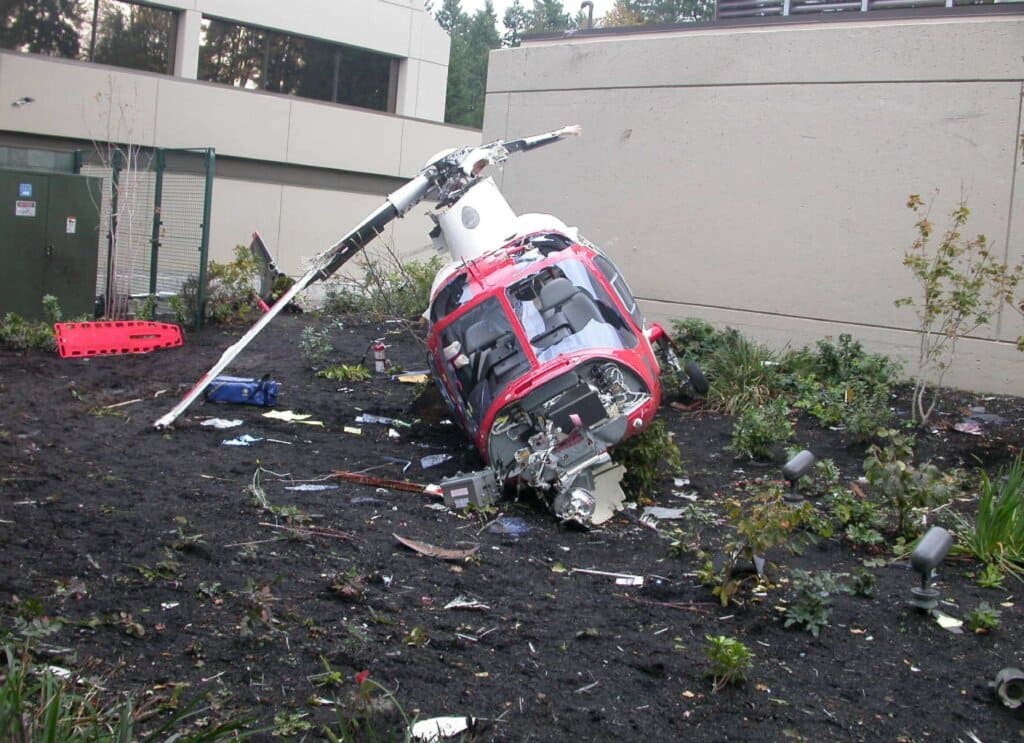 Photo Courtesy of Krista Haugen
In the end, the aircraft fell about 65 to 70 feet (20 to 21 meters), accounting for its trajectory. After the tail rotor separated, the helicopter struck a nearby building, spun 180 degrees, and came to rest on its side in a soft dirt courtyard — fortunately without a post-crash fire.
While everyone survived, including the patient, survival was only the beginning for Haugen.
It begins at survival
A little more than 20 years later, Haugen is now the director of clinical, quality, and patient safety at Airlift Northwest. She is also a survivor of post-traumatic stress injury (PTSI) — a journey that led her to a new mission: helping survivors of traumatic aeromedical accidents access mental health resources and community.
“I really want to destigmatize that conversation around mental health,” she explained. “Because there are a lot of really tough guys and gals out there who maybe feel shame in asking for help. And to me, it takes real strength and courage to ask for help, to admit when you’re struggling.”
The night of the crash, Haugen first sensed that something wasn’t right. She remembers standing beside the broken helicopter and feeling nothing — no anger, sadness, fear, gratitude, or joy. Nothing. This worried her because she’s a self-described deeply feeling person. She wrote it off as a defense mechanism — her brain protecting her in the moment — assuming she would feel it all once the adrenaline wore off.
“Everybody responds to these types of traumas differently,” she explained. “Some have an acute stress reaction right away, and some have delayed stress reactions. It wasn’t until three months later that I started experiencing those delayed symptoms of traumatic stress.”
 Photo Courtesy of Krista Haugen
Haugen returned to work a couple of weeks after the accident and, by her own assessment, functioned normally — until she didn’t.
“I started having nightmares, sleep disturbances, loss of appetite, inability to focus, and significant anxiety,” she said. “These were all so foreign to me, and it was scary. That fear compounded it, taking the joy out of flying and left me in a constant state of feeling unsettled.”
Haugen was experiencing the hallmark signs of PTSI. She continued flying for about a year after the accident before realizing she needed to step away completely.
During her time away, she began seeing mental health professionals and started demystifying her symptoms, learning they were the result of her sympathetic nervous system remaining in overdrive. Understanding the physiology of traumatic stress helped her begin to face what she was experiencing.
Haugen took a position as a traveling nurse, spending time at Tripler Medical Center in Hawaii and at smaller community hospitals while continuing PTSI therapy. When she found a therapist who introduced her to eye movement desensitization and reprocessing (EMDR), she turned a corner. The therapy helped her process the trauma in a way that allowed her to live her life normally again.
Being away from flying left her feeling as though she had lost her sense of purpose. Four years had passed since she last flew with Airlift, and as she began to feel like herself again, she also began to develop a new sense of purpose.
“After EMDR, I realized PTSI is no longer a life sentence, and I wanted to help share that realization with our industry,” Haugen said, adding that it was post-traumatic growth that allowed her to bring those lessons back to the industry.
Prioritizing mental health
Haugen’s path to increasing awareness began early in her recovery. About a year after her own accident, she heard about a HEMS crash in her hometown of Kalispell, Montana. She reached out on a hunch. If she was struggling, there was a good chance the survivors of that accident were experiencing something similar. Three weeks later, one of the flight nurses called Haugen. She was struggling.
The two nurses began comparing notes and supporting each other. Then, another accident occurred in Kansas a year later. The Kalispell nurse reached out to the flight nurse in Kansas, and they formed a similar connection.
The three women eventually connected with Jonathan Godfrey, the sole survivor of a 2005 crash in the Potomac River. The four spoke at the Air Medical Transport Conference (AMTC) in 2009, sharing their stories of the accidents and what they experienced afterward.
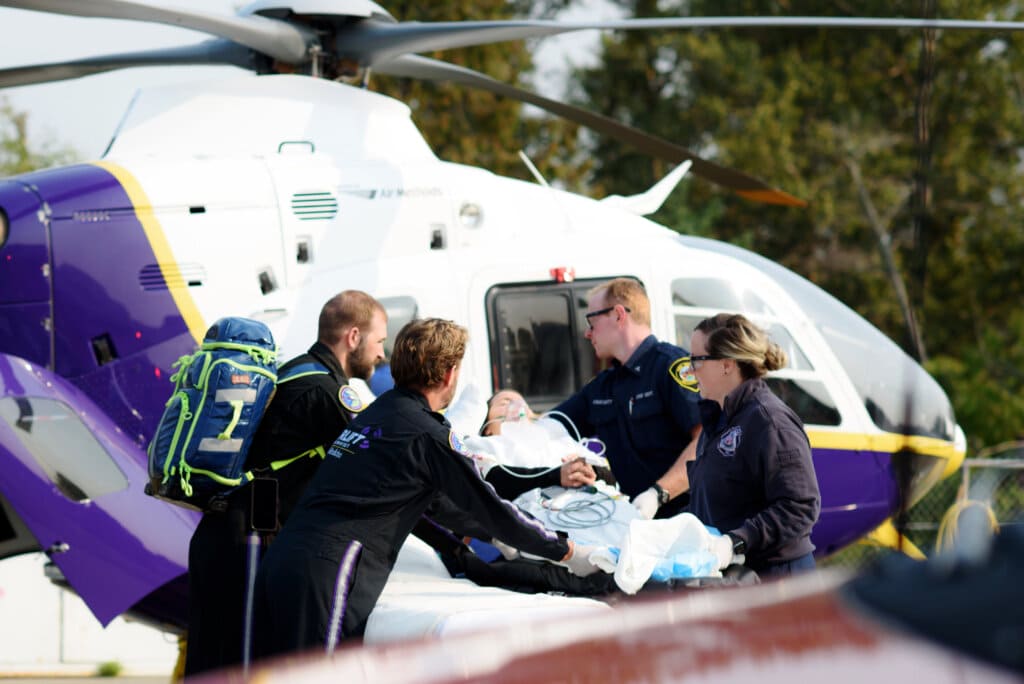 Airlift Northwest Photo
The response to their presentation was immediate. They were approached by more survivors and advocates, and it wasn’t long before a clear pattern emerged.
“Regardless of what the trauma survivors witness, it became apparent we’re all having some of the same experiences,” Haugen said. “It also became clear that if I didn’t want to share my experience because someone else’s crash was worse, then those lessons would be lost. We needed a way for us all to share and support each other.”
Out of those conversations grew the Survivors Network for the Air Medical Community, an informal organization Haugen manages that provides connections and resources for stress management, PTSD, addiction, loss, grief, suicide, and more, along with support for implementing mental health policies. The network includes both a website and a Facebook page.
“My experience in this industry is people will wait and wait and wait, and when they finally seek help, they needed it yesterday,” she explained. “There is a reason there is a high suicide rate in first responder and related professions. I want to destigmatize therapy, make people aware of their options, and encourage them to talk to someone and admit when things are bothering them. Putting on a poker face and toughing it out is not sustainable.”
While “air medical” is in the name, Haugen emphasizes that the community also supports ground medical transportation teams and other partners.
In addition to providing a community and resources for survivors, the network also aims to improve safety by helping medical organizations develop mental health policies that better support their teams.
Haugen has also spent more than a decade sharing her story to help improve safety in air ambulance operations. Whether speaking at safety conferences, connecting with survivors, or bringing her perspective into the highest levels of organizational leadership, she approaches patient safety not as an abstract compliance function, but as the direct result of what happens to human beings when systems fail and organizations look away.
“We know that humans err,” she said. “So, we should be designing our systems to provide redundancies and a safety net when they do.”
Her crash is a clear example. National Transportation Safety Board (NTSB) investigators ultimately determined the accident occurred because the pilot had unknowingly lifted off with one engine at idle — a condition the aircraft’s design physically permitted and one its alerts failed to prevent in time.
Blaming the pilot, she argues, misses the point and allows the mistake to be repeated.
At the time, Airlift was transitioning from the Agusta A109 Mark II to the Agusta A109 Power. The more than 7,900-hour Vietnam-era pilot testified to the NTSB that operation of the limit override switch had never been demonstrated during his training. The switch was also awkwardly positioned, making it difficult to correct the condition, and he described inconsistencies in his training.
“The probable cause is the proximate cause,” she said. “There’s always a series of contributing factors that create the conditions people are operating within. If you don’t look upstream and address those weaknesses, you’re going to leave this latent set of conditions in place, and that’s going to eventually bite the next fallible human.”
After her recovery and return to nursing in Hawaii and at community hospitals on the mainland, Haugen moved into patient safety roles at Med-Trans and then Global Medical Response (GMR). She returned to Airlift Northwest last fall as director of clinical, quality, and patient safety.
Airlift changed while she was away. It has a different helicopter services provider and now flies Airbus H135s. While she’s no longer actively flying as a flight nurse, she’s still looking out for staff and patients.
In addition to leading the survivors’ community, Haugen is working with Airlift Northwest to develop high-reliability systems and just culture frameworks while fostering an environment where people feel safe reporting mistakes before they become disasters.
“There are people who do the work of the organization, and then there are people who work on the organization,” she explained. “I’m working on the organization, identifying places where there’s a lack of redundancy or other risks that require mitigation to create a high-reliability organization. In the end, patient safety — along with the wellbeing of our crews — goes hand in hand with overall organizational safety, and that’s my mission now.”
| # | Наименование новости | Тональность | Информативность | Дата публикации |
|---|---|---|---|---|
| 1 | Beyond survival: From HEMS crash survivor to patient safety advocate | 0 | 6.55 | 29-09-2026 |
| 2 | How air medical operators are building the next generation of talent | 0 | 6.75 | 23-09-2026 |
| 3 | Beyond the mission: The human connection | 0 | 10.41 | 21-09-2026 |
| 4 | Drone as First Responder: The uncrewed advantage | 0 | 9.03 | 10-08-2026 |
| 5 | How telemedicine Is transforming HEMS and pre-hospital care | 0 | 12.96 | 30-09-2026 |
| 6 | Blades of Valor Road Tour: Where the mission happens | 0 | 6.37 | 18-08-2026 |
| 7 | Pilots Who Ask Why: When Systems Fail | 0 | 9.96 | 28-08-2026 |
| 8 | Mission over maintenance: Choosing the right helicopter for the job | 0 | 5.75 | 19-08-2026 |
| 9 | PAC International: Rebuilt for mission | 0 | 8.44 | 26-08-2026 |
| 10 | How the Flying Bulls keep history aloft | 0 | 8.03 | 20-08-2026 |