Просмотр новости
Найдите то, что Вас интересует
 Спутники
 РН
РН SpaceX
 Роскосмос
 NASA
NASA
СпутникиРНSpaceXРоскосмосNASAAbout eight-in-ten U.S. adults say they are currently taking at least one supplement for their health, according to a new Pew Research Center survey.
 (Lisa5201 via Getty Images)
About eight-in-ten U.S. adults say they are currently taking at least one supplement for their health, according to a new Pew Research Center survey. And most people who do this say supplements are at least somewhat important to their health.
About this researchThis Pew Research Center analysis explores the types of supplements Americans are taking and how important they feel supplements are to their health.
Why did we do this?Pew Research Center does research to help the public, media and decision-makers understand important topics. This research builds on our work studying Americans’ views of medicine and health topics.
Learn more about Pew Research Center and our other research on science and society.
How did we do this?We surveyed 3,554 U.S. adults from July 6 to 12, 2026. Everyone who took part in this survey is a member of the Center’s American Trends Panel. The survey represents the views of the full U.S. adult population.
Before we asked people about supplements, we told them: “In this survey, ‘supplements’ refers to products like vitamins, minerals, herbals, protein powders, melatonin or probiotics that you may take for health reasons. It does not include prescription drugs or over-the-counter drugs like Tylenol.”
Here are the survey questions used for this analysis, the detailed responses and the survey methodology.
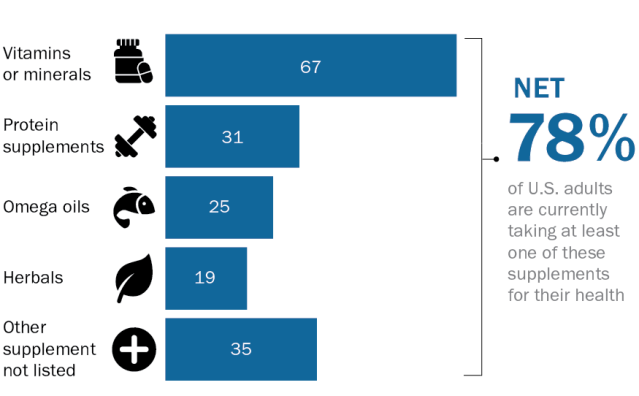
Vitamins and minerals (such as iron, calcium or multivitamins) are by far the most common supplement. Two-thirds of Americans say they are currently taking vitamin or mineral supplements for their health.
78% of U.S. adults are currently taking supplements for their health
% of U.S. adults who say they are currently taking each of the following types of supplements for their health
Note: NET figure is those who said they are currently taking at least one of the types of supplements we asked about. Refer to topline for full question wording.
Source: Survey of U.S. adults conducted July 6-12, 2026.
PEW RESEARCH CENTER
78% of U.S. adults are currently taking supplements for their health
% of U.S. adults who say they are currently taking each of the following types of supplements for their health
| % | |
|---|---|
| Vitamins or minerals | 67 |
| Protein supplements | 31 |
| Omega oils | 25 |
| Herbals | 19 |
| Other supplements not listed | 35 |
| NET currently taking at least one of these supplements for their health | 78 |
Note: NET figure is those who said they are currently taking at least one of the types of supplements we asked about. Refer to topline for full question wording.
Source: Survey of U.S. adults conducted July 6-12, 2026.
PEW RESEARCH CENTER
No more than one-third take each of the other specific types of supplements we asked about:
In addition, 35% say they are taking supplements other than the four types we asked about (such as melatonin or probiotics).
Supplements are a booming industry, with an estimated global value of $209.5 billion in 2025. And they’re a common topic of discussion for social media health and wellness influencers, whom Americans are increasingly turning to for information.
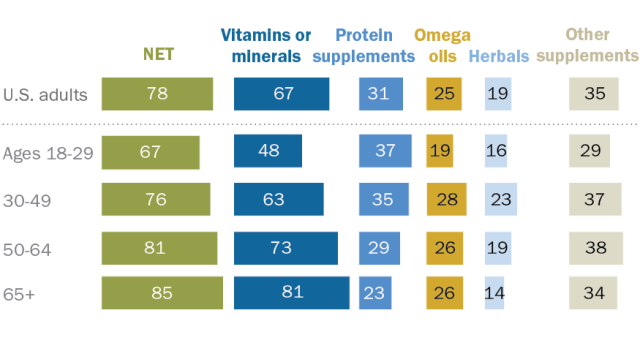
Older adults are more likely to take supplementsOlder adults are more likely than younger adults to be taking supplements. Among those ages 65 and older, 85% say they do this, compared with 67% of adults under 30.
Older adults are more likely to take supplements overall, but younger adults are more likely to take protein supplements
% who say they are currently taking each of the following types of supplements for their health
Note: NET figure is those who said they are currently taking at least one of the types of supplements we asked about. Refer to topline for full question wording.
Source: Survey of U.S. adults conducted July 6-12, 2026.
PEW RESEARCH CENTER
Older adults are more likely to take supplements overall, but younger adults are more likely to take protein supplements
% who say they are currently taking each of the following types of supplements for their health
| NET | Vitamins or minerals | Protein supplements | Omega oils | Herbals | Other supplements | |
|---|---|---|---|---|---|---|
| U.S. adults | 78 | 67 | 31 | 25 | 19 | 35 |
| Ages 18-29 | 67 | 48 | 37 | 19 | 16 | 29 |
| 30-49 | 76 | 63 | 35 | 28 | 23 | 37 |
| 50-64 | 81 | 73 | 29 | 26 | 19 | 38 |
| 65+ | 85 | 81 | 23 | 26 | 14 | 34 |
Note: NET figure is those who said they are currently taking at least one of the types of supplements we asked about. Refer to topline for full question wording.
Source: Survey of U.S. adults conducted July 6-12, 2026.
PEW RESEARCH CENTER
This gap is largely due to age differences among those who take vitamins or minerals. Most adults 65 and older (81%) take vitamins or minerals, compared with 48% of adults under 30. Older people may need more of some vitamins and minerals, like calcium and vitamin D, than younger folks do.
One type of supplement that younger adults are more likely to take? Protein supplements. Roughly a third or more of adults ages 18 to 29 (37%) and 30 to 49 (35%) say they are taking protein supplements. A smaller share of adults 65 and older (23%) say the same.
With the rise of “protein maxxing” on social media and updated federal dietary guidelines that emphasize protein, protein marketing and additives are seemingly everywhere.
There are smaller differences by age for omega oils, herbals and other supplements.
Other demographic differencesWomen are slightly more likely than men to say they are currently taking supplements (82% vs. 74%). This difference is driven by women being more likely than men to take vitamins or minerals, herbals, and other supplements. Women are also more likely than men to spend money on supplements, and they spend more on healthcare in general.
In addition, Asian adults are particularly likely to say they are taking omega oils. Four-in-ten Asian adults say they are taking these kinds of supplements, compared with about a quarter of Hispanic, Black and White adults.
Read the table below for more on these detailed breaks.
How essential do Americans think supplements are to their health?Whether supplements are beneficial or not has long been debated. Many medical professionals advise caution.
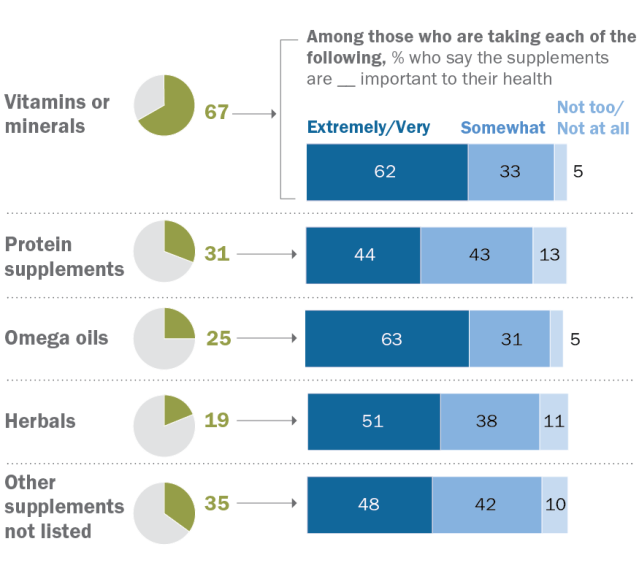
Many of those who take supplements see them as important to their health
% of U.S. adults who say they are currently taking each of the following types of supplements for their health
Note: Respondents who did not answer are not shown.
Source: Survey of U.S. adults conducted July 6-12, 2026.
PEW RESEARCH CENTER
Many of those who take supplements see them as important to their health
% of U.S. adults who say they are currently taking each of the following types of supplements for their health
| Vitamins or minerals | Protein supplements | Omega oils | Herbals | Other supplements not listed | |
|---|---|---|---|---|---|
| % | 67 | 31 | 25 | 19 | 35 |
| Among those who are taking each of the above, % who say the supplements are __ important to their health | |||||
| Extremely/Very | 62 | 44 | 63 | 51 | 48 |
| Somewhat | 33 | 43 | 31 | 38 | 42 |
| Not too/Not at all | 5 | 13 | 5 | 11 | 10 |
Note: Respondents who did not answer are not shown.
Source: Survey of U.S. adults conducted July 6-12, 2026.
PEW RESEARCH CENTER
In our survey, Americans who take supplements largely see them as at least somewhat important for their health.
They’re especially likely to say this about vitamins or minerals. Two-thirds of Americans take vitamins or minerals, and a majority of those who do (62%) say they are extremely or very important to their health. Another 33% who take these supplements say they are somewhat important to their health.
Similarly, 63% of those who take omega oils find them extremely or very important to their health. (Adults are much less likely to say they’re currently taking omega oil supplements than vitamin and minerals, though.)
Fewer of those who take herbals (51%) or protein supplements (44%) say these things are extremely or very important for their health.
Detailed tableSupplement takers by demographic groups
% who say they are currently taking each of the following types of supplements for their health
| NET currently taking any supplements | Vitamins or minerals | Protein supplements | Omega oils | Herbals | Other supplements not listed | |
|---|---|---|---|---|---|---|
| U.S. adults | 78 | 67 | 31 | 25 | 19 | 35 |
| Men | 74 | 61 | 30 | 24 | 16 | 30 |
| Women | 82 | 72 | 33 | 27 | 21 | 40 |
| White | 79 | 70 | 32 | 23 | 16 | 37 |
| Hispanic | 73 | 58 | 32 | 27 | 22 | 32 |
| Black | 77 | 65 | 30 | 23 | 24 | 32 |
| Asian* | 82 | 70 | 29 | 40 | 19 | 34 |
| Postgrad | 82 | 75 | 36 | 29 | 20 | 41 |
| College grad | 81 | 70 | 37 | 27 | 18 | 38 |
| Some college | 78 | 67 | 33 | 25 | 21 | 38 |
| HS or less | 74 | 61 | 24 | 23 | 17 | 29 |
| Upper income | 85 | 75 | 40 | 27 | 18 | 42 |
| Middle income | 78 | 67 | 31 | 25 | 18 | 37 |
| Lower income | 74 | 61 | 28 | 24 | 21 | 30 |
* Estimates for Asian adults are representative of English speakers only.
Note: NET figure is those who said they are currently taking at least one of the types of supplements we asked about. Read the topline for full question wording. White, Black and Asian adults include those who report being only one race and are not Hispanic. Hispanic adults are of any race. Family income tiers are based on adjusted 2024 earnings.
Source: Survey of U.S. adults conducted July 6-12, 2026.
PEW RESEARCH CENTER
Note: Here are the survey questions used for this analysis, the detailed responses and the survey methodology.

Emma Kikuchi is a research analyst focusing on science and society research at Pew Research Center.

Brian Kennedy is a senior researcher focusing on science and society research at Pew Research Center.
| # | Наименование новости | Тональность | Информативность | Дата публикации |
|---|---|---|---|---|
| 1 | Weekly: 9.5.26 | 0 | 13.23 | 04-09-2026 |
| 2 | Methodology | 0 | 15.44 | 01-09-2026 |
| 3 | About half of Americans say they spend too much time on their smartphone | 0 | 13.7 | 01-09-2026 |
| 4 | How Americans think about corporate and political influence on the news | 0 | 8.67 | 15-09-2026 |
| 5 | How Americans think about censorship of news in the U.S. | 0 | 5.99 | 15-09-2026 |
| 6 | Weekly: 10.3.26 | 0 | 14.69 | 02-10-2026 |
| 7 | Heartbreaking number of single Americans don’t believe they’ll ever find ‘the one’ | 0 | 9.79 | 23-09-2026 |
| 8 | Weekly: 9.19.26 | 0 | 9.78 | 18-09-2026 |
| 9 | The higher your body fat percentage, the less accurate your smartwatch is at measuring calories burned | 0 | 13.98 | 26-09-2026 |
| 10 | Dietary Guidelines confusing consumers? | 0 | 7.46 | 11-05-2026 |