Просмотр новости
Найдите то, что Вас интересует
 Спутники
 РН
РН SpaceX
 Роскосмос
 NASA
NASA
СпутникиРНSpaceXРоскосмосNASATexas, UCSF, Siemens, and a London startup are staking patent claims on brain-to-text decoding. Older patents already cover pieces of the path.
Continue reading this post on Patently-O.
by Dennis Crouch
Back in May 2023 I wrote a short post about the University of Texas study that used a GPT-style language model to reconstruct the gist of stories from fMRI scans (An API for the Human Mind, May 6, 2023). What I did not know at the time was that the UT System had already filed a provisional application on the method a full year earlier, fourteen months before the Nature Neuroscience paper. The resulting non-provisional application published as US 2025/0068841 A1, titled “Decoding Language from Non-Invasive Brain Recordings,” naming Alexander Huth and Jerry Tang as inventors. It allowed on the first action in June 2026, without a single rejection. Texas paid the issue fee on September 18, so a patent should issue later this fall. No continuation in the record yet, but I expect they’ll file one.
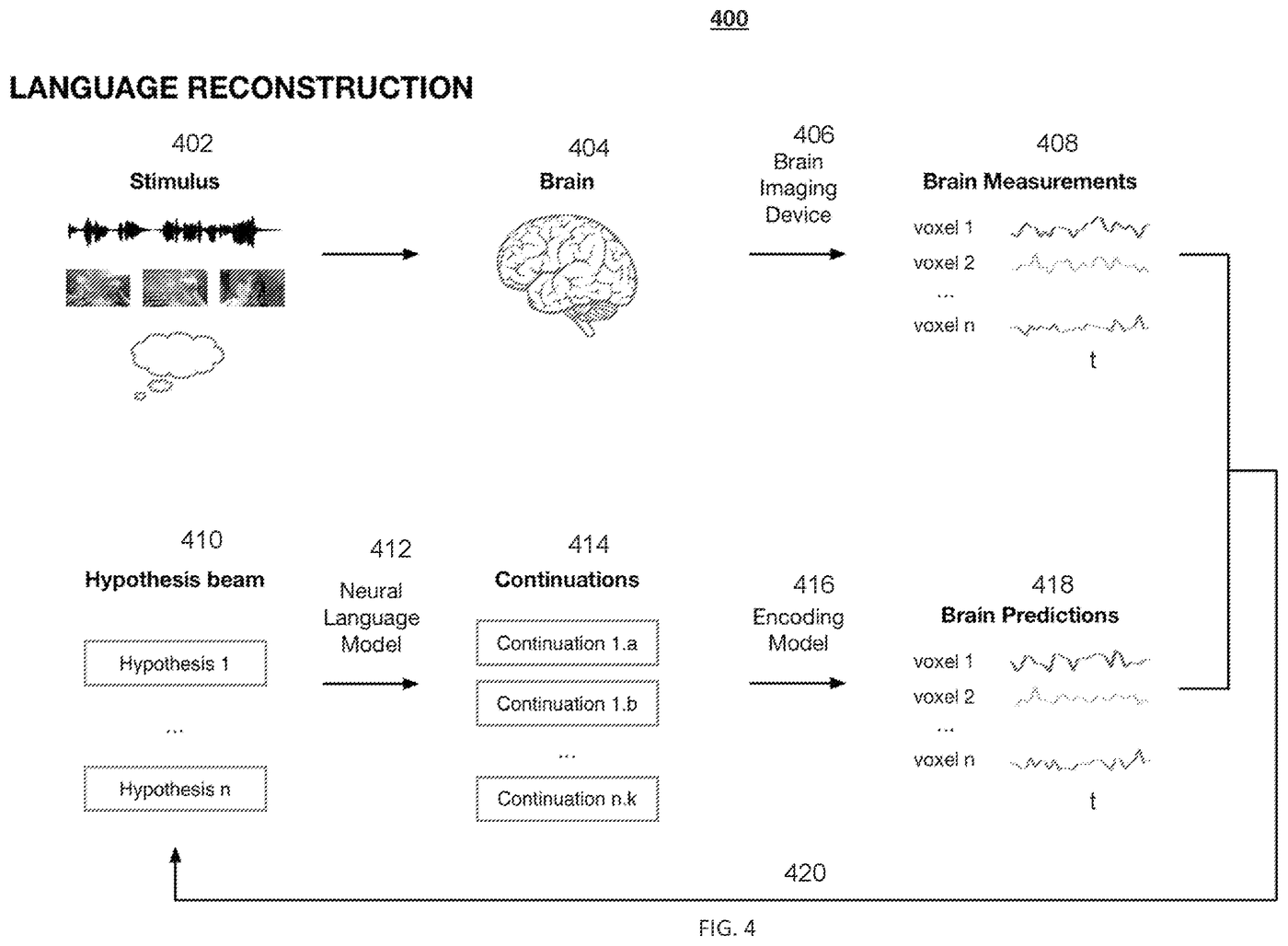
The basic idea here is that different words and ideas produce different patterns of neural activity across the brain, and fMRI can measure those patterns (via bloodflow) while a person listens to a story. Huth and Tang first trained an “encoding model” on many hours of scans. Decoding then runs in the opposite direction. A GPT-style language model proposes candidate word sequences; the encoding model predicts the brain activity each candidate should produce; and the system keeps the candidates whose predictions best match the actual scan. Repeat that word by word and the output is a running paraphrase of what the subject heard or imagined. Ultimately, this results in the decoded output capturing the gist of the thought rather than exact wording.
Huth and Tang’s specification includes a section titled “Privacy Implications” explaining that their approach does not read unrestricted thoughts. But, there are an increasing number of researchers and companies staking out pieces of the path from brain signal to semantic representation to language model to text. In potentially revolutionary fields like this, there are often early precursors whose patent rights expire before commercialization. An example is Huth’s own doctoral advisor (Jack Gallant) whose patent recently expired for failure to pay a maintenance fee.
The published claim 1 is not simply “mind reading.” The claim recites a computer-implemented beam search:
Claim 14 separately covers building the encoding model itself, mapping neural-language-model word embeddings into voxel space. The dependent claims add fMRI (claim 2) and fNIRS (claim 3), and claim 5 covers a subject who “receives the stimulus by thinking, reading, or listening.”
As you might expect in the patent system, the claims go well beyond what they demonstrated in the academic paper. Tang et al., 26 Nature Neuroscience 858 (2023), trained on three subjects, each scanned for 16 hours while listening to stories, and worked only with fMRI. The claims cover fNIRS and a “different sensor.” The specification’s own privacy section reports that decoders trained on other people’s brains performed “barely above chance” and concludes that “subject cooperation remains necessary for decoder training.”
Gallant’s lab (mentioned above) filed a provisional in March 2009 that eventually issued as U.S. Patent No. 9,451,883, “Apparatus and Method for Decoding Sensory and Cognitive Information from Brain Activity.” Huth is not a named inventor, although his 2012 Neuron paper on semantic maps is cited as a reference. Claim 1 of that patent uses a similar encoding-model architecture: acquire training brain data; convert it into encoding-model parameters over “linearizing feature spaces”; build a “decoding database” of candidate items; generate a predicted brain activity signal for each item; compute the probability that a new scan corresponds to each prediction; select the best item; and reconstruct the stimulus.
Siemens has another similar patent that I was able to find. U.S. Patent No. 10,856,815, “Generating Natural Language Representations of Mental Content from Functional Brain Images,” associated with the “universal decoder” project discussed in Pereira et al., 9 Nat. Commun. 963 (2018). The government holds a confirmatory license through the Air Force, which funded the research. Claim 1 recites capturing fMRI data while a subject is exposed to training text that has been assigned semantic vectors; decomposing the images into a weighted set of “basis images”; mapping those weights to the dimensions of the semantic vector; decoding a semantic vector for a new scan; and “generating a text output based on the decoded semantic vector.” In 2008 Mitchell and Just were able to predict fMRI activation for concrete nouns from a text corpus (Mitchell et al., 320 Science 1191 (2008)), but I didn’t find a patent filing on point.
I also did some digging and found a 1967 Air Force research publication in which volunteers were trained to switch their brain alpha rhythms on and off (using eye movements) and then used that switch to send Morse code through an EEG. E.M. Dewan, Occipital Alpha Rhythm Eye Position and Lens Accommodation, 214 Nature 975 (1967). I’m not sure why they waited so long, but the Air Force roughly patented the concept in 2003 (U.S. Patent No. 6,529,773). The ‘773 patent claims a “mentally controlled optical communication system” in which the user’s altered alpha waves spell out Morse code and switch on a light transmitter. The specification incorporates the 1967 Nature paper by reference and quotes Martin Caidin’s 1968 novel The God Machine on Dewan’s “alpha adepts.”
Eligibility and the mental process irony. Section 101 excludes “mental processes,” meaning claims that could be performed in the human mind. Although these are claims about reading thoughts, none of them can be performed in the human mind.
The privacy question. Patent claims say what a decoder does with a brain signal. They say nothing about whose signal it is or who may use the output, and legislators have started to fill that gap. Colorado and California amended their consumer privacy statutes in 2024 to treat “neural data” as sensitive information. In September 2025, Senators Schumer, Cantwell, and Markey introduced the MIND Act, S. 2925, which would direct the FTC to study the governance of “information obtained by measuring the activity of an individual’s central or peripheral nervous system through the use of neurotechnology” and report to Congress within a year. It would also bar federal agencies from buying or operating neurotechnology inconsistent with forthcoming OMB guidance. But the MIND Act is not becoming law this session.
| # | Наименование новости | Тональность | Информативность | Дата публикации |
|---|---|---|---|---|
| 1 | FY2026 Patent Data Update: Grants, Publications, and Cross-Border Inventors | 0 | 25.46 | 02-10-2026 |
| 2 | This Is Not a Feature Vector: Zentian v. Apple | 0 | 13.68 | 29-09-2026 |
| 3 | Tie Goes to the Applicant: The USPTO’s SMED Flowchart | 0 | 8.87 | 29-09-2026 |
| 4 | AI Co. Reaches Deal To End Copyright Case Against Microsoft | 0 | 8.69 | 02-10-2026 |
| 5 | Cerebionics wants to turn human intent into commands for machines | 0 | 7.13 | 24-09-2026 |
| 6 | 8 Recommendations to Shape the Future of our Brain Commons | 0 | 7.47 | 30-07-2026 |
| 7 | Wireless Patent Suits Offer Lessons For Data Center Industry | 0 | 6.02 | 24-09-2026 |
| 8 | PTAB Invalidates Challenged Claims In Breast Pump Patent | 0 | 6.32 | 25-09-2026 |
| 9 | How brain stimulation could impact how we develop new skills | 0 | 5.47 | 28-09-2026 |