Просмотр новости
Найдите то, что Вас интересует
 Спутники
 РН
РН SpaceX
 Роскосмос
 NASA
NASA
СпутникиРНSpaceXРоскосмосNASABackground In this paper, we focus on deriving an efficient method for solving ordinary differential equations (ODEs) of sixth order, and then, we modify the proposed method for solving fractional differential equations (FDEs). Methods The methodology of this paper used the approach of derivation of implicit numerical method. However, the purpose of this study is to derive a direct implicit block and multi-step strategy for solving sixth-order ODEs. Results The main novelty of this work lies in the investigation of constructing a novel method for solving FDEs. This paper presents a general block two-point approach, known as GIBM2P, for solving sixth-order initial-value problems (IVPs) using Hermite-interpolating polynomials. Consequently, the FDE problem has been transformed into ODE using the α-fractional-derivative transform, and then, the sixth-order IVP is solved using the proposed GIBM2P method. Conclusions In this paper, we offered a method for solving sixth-order FDEs. The proposed method has been shown to be an accurate and efficient method; also, one can obtain the approximate efficient solutions of FDEs problems. The numerical implementations are used to show the high accuracy and efficacy of the proposed GIBM2P approach. However, the GIBM2P method is effective in terms of accuracy, processing time, and the number of function calls.

Mechee MS and Mahmood Salih M. Construction an Implicit Block Multi-Steps Approach for Solving Sixth-Order Fractional Differential Equations [version 2; peer review: 1 approved, 2 approved with reservations]. F1000Research 2026, 14:1444 (https://doi.org/10.12688/f1000research.172397.2)
Research Article
Revised
[version 2; peer review: 1 approved, 2 approved with reservations]
https://orcid.org/0000-0002-6522-1811
1, Mohammed Mahmood Salihhttps://orcid.org/0000-0002-7812-6119
2https://orcid.org/0000-0002-6522-1811
1, Mohammed Mahmood Salihhttps://orcid.org/0000-0002-7812-6119
21 TRDC, university of Kufa, Najaf, Najaf-Iraq, 00964, Iraq
2 Faculty of Information Technology Ninevah, Ninevah University, Mosel, 00964, Iraq
Mohammed S. Mechee
Roles: Formal Analysis, Methodology, Software, Supervision, Validation
Mohammed Mahmood Salih
Roles: Conceptualization, Data Curation, Formal Analysis, Funding Acquisition, Resources, Software, Writing – Original Draft Preparation, Writing – Review & Editing
OPEN PEER REVIEW
REVIEWER STATUS
In this paper, we focus on deriving an efficient method for solving ordinary differential equations (ODEs) of sixth order, and then, we modify the proposed method for solving fractional differential equations (FDEs).
MethodsThe methodology of this paper used the approach of derivation of implicit numerical method. However, the purpose of this study is to derive a direct implicit block and multi-step strategy for solving sixth-order ODEs.
ResultsThe main novelty of this work lies in the investigation of constructing a novel method for solving FDEs. This paper presents a general block two-point approach, known as GIBM2P, for solving sixth-order initial-value problems (IVPs) using Hermite-interpolating polynomials. Consequently, the FDE problem has been transformed into ODE using the α-fractional-derivative transform, and then, the sixth-order IVP is solved using the proposed GIBM2P method.
ConclusionsIn this paper, we offered a method for solving sixth-order FDEs. The proposed method has been shown to be an accurate and efficient method; also, one can obtain the approximate efficient solutions of FDEs problems. The numerical implementations are used to show the high accuracy and efficacy of the proposed GIBM2P approach. However, the GIBM2P method is effective in terms of accuracy, processing time, and the number of function calls.
Implicit Method; Block Method; Multi-Step Method; ODEs; IVPs; Sixth-Order; FDEs.
Corresponding author: Mohammed S. Mechee Competing interests: No competing interests were disclosed.
Grant information: The author(s) declared that no grants were involved in supporting this work.
Copyright: © 2026 Mechee MS and Mahmood Salih M. This is an open access article distributed under the terms of the Creative Commons Attribution License, which permits unrestricted use, distribution, and reproduction in any medium, provided the original work is properly cited. How to cite: Mechee MS and Mahmood Salih M. Construction an Implicit Block Multi-Steps Approach for Solving Sixth-Order Fractional Differential Equations [version 2; peer review: 1 approved, 2 approved with reservations]. F1000Research 2026, 14:1444 (https://doi.org/10.12688/f1000research.172397.2) First published: 24 Dec 2025, 14:1444 (https://doi.org/10.12688/f1000research.172397.1) Latest published: 08 Jun 2026, 14:1444 (https://doi.org/10.12688/f1000research.172397.2)
The novelty of the paper is the construction of a specific two-point block method (GIBM2P) for sixth-order IVPs that fills a gap in current numerical literature, while the methodology of this paper is the use of Hermite-interpolating polynomials, which provides a robust foundation for the implicit multi-step strategy. Lastly, the clarity of the paper's implementation is that the algorithm for converting FDEs to ODEs is clearly outlined in three logical steps.
As a result, the new version of the paper has been completed by incorporating the minor corrections suggested by the reviewer based on the available comments.
See the authors' detailed response to the review by Yahya Qaid Hasan
See the authors' detailed response to the review by Peter Olatunji
Differential equations (DEs) are very important in many applications of mathematical models in the applied sciences and engineering, particularly in the physics, electrical engineering, economics, chemistry, and biology.1 However, the mathematical models in the area of applied science, and engineering of actual issues are constructed using DEs techniques. Unfortunately, determining the exact solutions of some kinds of DEs might be somewhat challenging, in spite of numerous efficient common modern or classical analytical and numerical techniques are currently available to the researchers of engineers and scientists. In general, the computation of the analytical solutions of general DEs is sometimes difficult or complicated. Various researchers derived some numerical linear multistep methods for solving IVPs for different orders of ODEs. For the literature reviews (LRs) of this study, we have introduced some studies of numerical methods for solving some classes of ODEs. Firstly, for a review several researchers developed some methods for solving boundary value problems (BVPs) of sixth order ODEs to increase the effectiveness and the accuracy of these approaches2–7 while Ref. 8 presented a comparison study and a survey of the researches for the generalized RK integrators for solving IVPs of various orders ODEs. Secondly, in likewise, some numerical algorithms of implicit block multistep methods for solving IVPs of ODEs for various orders have been improved by several authors in Refs. 9–15. Meanwhile, for example, the researchers Refs. 16–18 derived block backward methods for solving first-order stiff ODEs, as well as Refs. 19–21 derived one-step, implicit block, block predictor, and 4-step corrector methods for solving a general second-order ODEs. However, the implicit block method and a new strategy of the implicit hybrid block method for solving third-order ODEs are introduced by Refs. 22, 23. In the same manner,24introduced a new special 15-step block method for solving general fourth-order ODEs. In contrast, the general implicit-block method for solving fifth-order ODEs has been derived by Ref. 25 but Turki et al. are constructed a general implicit-block method for solving seventh-order ODEs.26 Moreover, for variable-step block methods, the authors in Refs. 27, 28 have derived a variable-step variable-order block fully implicit method and direct variable-step block multistep method for solving general third-order ODEs. Finally, an explicit multistep block method for solving neutral delay differential equations (DDEs) has been derived by Ref. 29 while Ref. 30 developed three-point diagonally implicit block methods for solving ordinary and fuzzy DEs.
Nowadays, the FDEs and their applications have a significate role in the fields of science and engineering. As a consequence, the researches in finding new approaches for FDEs are increasing.31 As a result, numerous researchers have proposed new definitions for fractional derivatives. For instance, the α-fractional-derivative or integral of real functions was defined in a novel way by Mechee et al., which is used in this article.32 Also, Khalil et al. and Z. Zheng et al.33,34offered more new definitions of the fractional derivative. This article utilizes the fundamental functions of a Hermite-interpolating polynomial to propose a general implicit block two-point multistep approach, called GIBM2P, for solving the IVPs of sixth-order ODEs. Furthermore, this new technique has been used for solving sixth-order FDEs by converting FDE to ODE using α-fractional derivative.
Several concepts and definitions have been introduced in this section.
The general formula for the sixth-order ODE’s initial value problem can be expressed as follows7:
Ψ(ζ,u(ζ),u′(ζ),u′′(ζ),u′′′(ζ),u(4)(ζ),u(5)(ζ),u(6)(ζ))=0,a≤ζ≤b
with the initial-conditions (ICs),
u(j)(a)=ζj,j=0,1,2,…,5.
while the initial-values problem of the special quasi-linear ODEs of sixth-order can be given as follows:
u(6)(ζ)=ϕ(ζ,u(ζ),u′(ζ),u′′(ζ),u′′′(ζ),u(4)(ζ),u(5)(ζ)),a≤ζ≤b
with the ICs in Equation (2).
General Class of Sixth-Order FDEs
Below is the definition of the general class of sixth-order FDEs.
ϕ(ζ,u(ζ),u(j)(ζ),u(jα)(ζ))=0,j=1,2,…,6;0<α<1,a≤ζ≤b,
u(jα)(a)=ζj,j=0,1,2,…,5.
Special Cass of Quasi-Linear FDEs of Sixth-Order
The following formula illustrates the class of sixth-order FDEs:
u(6α)(ζ)=f(ζ,u(ζ),u(j)(ζ),u(jα)(ζ)),a≤ζ≤b;0<α<1;j=1,2,…,5.
with the ICs in Equation (5).
In this subsection, we introduced the α-fractional derivative of a function
α-Fractional-derivative15
Mechee et al.32 introduced a novel α-fractional-derivative definition for the real function ϕ(ζ):[a,∞)→R by following:
Tα(ϕ(ζ))=ϕ(α)(ζ)=limϵ→0ϕ(ζ+ϵζ1−α)−ϕ(ζ−ϵζ1−α)2ϵ,
for α∈(0,1).
From the α-fractional derivative in Definition 2.3, we get the following property of α-fractional derivative of the function ϕ(ζ).
15Consider ϕ(ζ):[a,b)→R be a real function.
Then, the α-fractional-derivative of the function ϕ(ζ) defined in the Equation (7) has the following property:
Tα(ϕ(ζ))=ζ1−αdϕ(ζ)dζ.
We introduce the analysis of GIBM2P method which approximate the solution of IVP using Hermite polynomials in this section.
The form of a Hermite polynomial is defined as follows:
P2(ξ)=∑i=0m∑k=0mi−1ϕi(k)Lik(ξ).
Consider h=b−am and ξi=a+ih and fi=f(ξi,yi,yi′,yi′′), for i=0,1,…,m where m = number of partitions in domain interval which is equal to the number of Lagrange’s polynomials and mi−1 is the degree of Lagrange polynomial. In this case, Lik(ξ) is the generalized Lagrange polynomial for m = 0,1,2, …, mi , with a step-size equal to 2h, and ym+1 and ym+2 are the approximation generates the approximated solutions at two-points ξm+1 and ξm+2 resp. In the block interval [ξm,ξm+2], we have, ξm is the starting-point while ξm+2 is the end-point. However, the initial value for all next iterations should be the approximated solution by ym+2 at the end-point ξm+2
P2(ξ)=f0L00(ξ)+f1L10(ξ)+f2L20(ξ)+g0L01(ξ)+g1L11(ξ)+g2L21(ξ),
3.1.1 Lagrange polynomials
Lagrange polynomials are defined as follows in this article:
L00(λ)=(λ−λn)(1−χ1)((λn+2−λ)(λn+1−λ)(λn−λn+2)(λn−λn+1))2,
L10(λ)=(λ−λn+1)(1−χ2)((λ−λn)(λn+2−λ)(λn+1−λn)(λn+1−λn+2))2,
L20(λ)=(λ−λn+1)(1−χ3)((λ−λn)(λn+1−λ)(λn+2−λn)(λn+2−λn+1))2,
L01(λ)=(λ−λn)(λn+1−λλn−λn+1)2(λn+2−λλn−λn+2)2,
L11(λ)=(λ−λn+1)((λ−λn)(λn+2−λ)(λn+1−λn)(λn+1−λn+2))2,
L21(λ)=(λ−λn+2)((λn−λ)(λn+1−λ)(λn+2−λn)(λn+2−λn+1))2,
χ1=2λn−λn+2+2λn−λn+1,χ2=2λn+1−λn+2+2λn+1−λn,χ3=2λn+2−λn+1+2λn+2−λn+1,
The expressions for Lagrange polynomials in the independent variable s are as follows, assuming that s=λ−λn+2h and,
L00(λ)=14(β1β2)2+3β3,
L01(λ)=h4β3(β1β2))2,
where β1=λ,β2=λ+1,β3=λ+2,β4=1−3λ .
3.1.2 Construction of the numerical GIBM2P approach
The approximated solution un(ζ) of Equation (3) at the initial point ζn can be obtained by multiple-integrating Equation (3) up to five times with respect to the independent variable ξ along the range [ζn;ζn+1], then, compute these integrations to obtain the formulas in Equation (22).
un+1(6−j)=∑k=6−j5h6−j−k(6−j−k)!vn(k)+∫tntn+1ψ(λ,u(λ)dλ,j=1,2,…,6
By assuming that tn+2=t−hs , the coordinate t is changed to s.
The following six formulas were created by integrating the Equation (22)
un+1(j)=∆6−j+∑k=13ajkfn+k+ajk+3gn+k,forj=5,4,3,2,1,0
A=(aij)=(101240815112401342161428176720410547672013h240−h6−h8059168081051116808367201481367206720161144167216902419201945612419205774752001720017475200371206949455120961432419201144017241920179190080011039519008)
∆j=∑k=6−j5h6−j−k(6−j−k)!vn(k),forj=1,2,…,6.
In this subsection, the analysis of the proposed method for solving FDEs of sixth-order is introduced and studied. In Equation (7), Mechee et al. presented a new definition of the α-fractional-derivative for the real function f(τ):[a,∞)→R. From the α-fractional- derivative in Definition 2.3, we get the property of α-fractional-derivative of the function ϕ(ζ) in Equation (8). Consequently, by deriving the two sides of Equations (8) five times to get the sixth α-fractional-derivative of the function f(τ) . Thus, the α-fractional-derivative of sixth-order for the real function f(τ) in the domain Iα , denoted by T6α , has the following definition:
T6α(f(ζ))=ζ1−6α(ζ5f(6)(ζ)+15(1−α)ζ4f(5)(ζ)+5(1−α)(13−7α)ζ3f(4)(ζ)+(1−α)(15(5−7α)+2(1−2α)(7−11α))ζ2f(3)(ζ)+2(1−α)(1−2α)(7−11α)(2−5α)ζf′′(ζ)+(1−α)(1−2α)(1−3α)(1−4α)(1−5α)f′(ζ)),
which is simplified to the following
T6α(f(ζ))=ζ1−6α(ζ5f(6)(ζ)+15(1−α)ζ4f(5)(ζ)+(1−α)(5(13−7α)ζ3f(4)(ζ)+(15(5−7α)+2(1−2α)(7−11α))ζ2f(3)(ζ)+2(1−2α)(7−11α)(2−5α)ζf′′(ζ)+(1−2α)(1−3α)(1−4α)(1−5α)f′(ζ))).
To prove Equation (24), by using α -fractional-derivative five times for two sides of Equation (8) to obtain the formula in Equation (24)
In this subsection, using the α-fractional derivative property from Equation (24), the FDE in Equation (6) with ICs in Equation (5) has been transformed into an ODE in Equation (3) with ICs in Equation (2) and then, using GIBM2P approach to obtain the numerical solution of the IVP.
4.2.1 The proposed method’s algorithm
The solution of FDE in Equation (6) with the ICs in Equation (5) has been introduced the proposed method using the following algorithm:
4.2.1.1 The Proposed Algorithm for Solving Sixth-Order FDEs
Step I: Convert the FDE in Equation (6) with ICs in Equation (5) into an ODE in Equation (3) with ICs in Equation (2).
Step II: Utilizing an appropriate analytical technique, or the proposed GIBM2P approach, solve the ODE in Equation (3) with the ICs in Equation (2).
Step III: The analytical or numerical solution for the IVP in step II is consequently exactly the same solution of given FDE problem in Equation (6) with the ICs in Equation (5).
The performance of the numerical GIBM2P approaches was evaluated in this section since we transformed the FDE in Equation (6) to a sixth-order ODE and then solved it using proposed strategy specified in Equation (23) compared with Taylor method. The comparison of numerical solutions of proposed GIBM2P method against Taylor method is shown in Figure 1. The following is how the notations were used:
• GIBM2P: A two-point general implicit block approach is proposed.
Linear FDE31
η(6α)(ζ)=η(ζ)+η′(ζ)−3η′′(ζ)−11η′′′(ζ);0<α<1;0<ζ≤1.
With the ICs: η(κα)(0)=(−1)κ for κ=0,1,2,3,4,5.
Using the formula in Equation (24), we get the following ODE
T6α(f(ζ))=ζ−399(ζ5f(6)(ζ)+159ζ4f(5)(ζ)30581ζ3f(4)(ζ)−1135729ζ2f(3)(ζ)−77006561ζf′′(ζ)+7486559049f′(ζ)).
T6α(f(ζ))=2ζ23f(6)(ζ)+ζ−399(159ζ4f(5)(ζ)30581ζ3f(4)(ζ)−1135729ζ2f(3)(ζ)−77006561ζf′′(ζ)+7486559049f′(ζ)),
With the ICs: η(k)(0)=(−1)κ for κ=0,1,2,3,4,5.
Non-Linear FDE31
η(6α)(ζ)=η(ζ)η′(ζ)−3η(5)(ζ)−11η′′′(ζ);0<α<1;0<ζ≤1.
With the ICs: η(κα)(0)=(−1)κ for κ=0,1,2,3,4,5.
Using the formula in Equation (24), we get the following ODE
ζ5η(6)(ζ)+15(1−α)ζ4η(5)(ζ)+5(1−α)(13−7α)ζ3η(4)(ζ)+(1−α)((15(5−7α)+2(1−2α)(7−11α)))ζ2η(3)(ζ)+2(1−α)(1−2α)(7−11α)(2−5α)ζη′′(ζ)+(1−α)(1−2α)(1−3α)(1−4α)(1−5α)η′(ζ)=ζ6α−1(η(ζ)η′(ζ)−3η(5)(ζ)−11η′′′(ζ))
with the ICs: η(k)(0)=(−1)κ for κ=0,1,2,3,4,5.
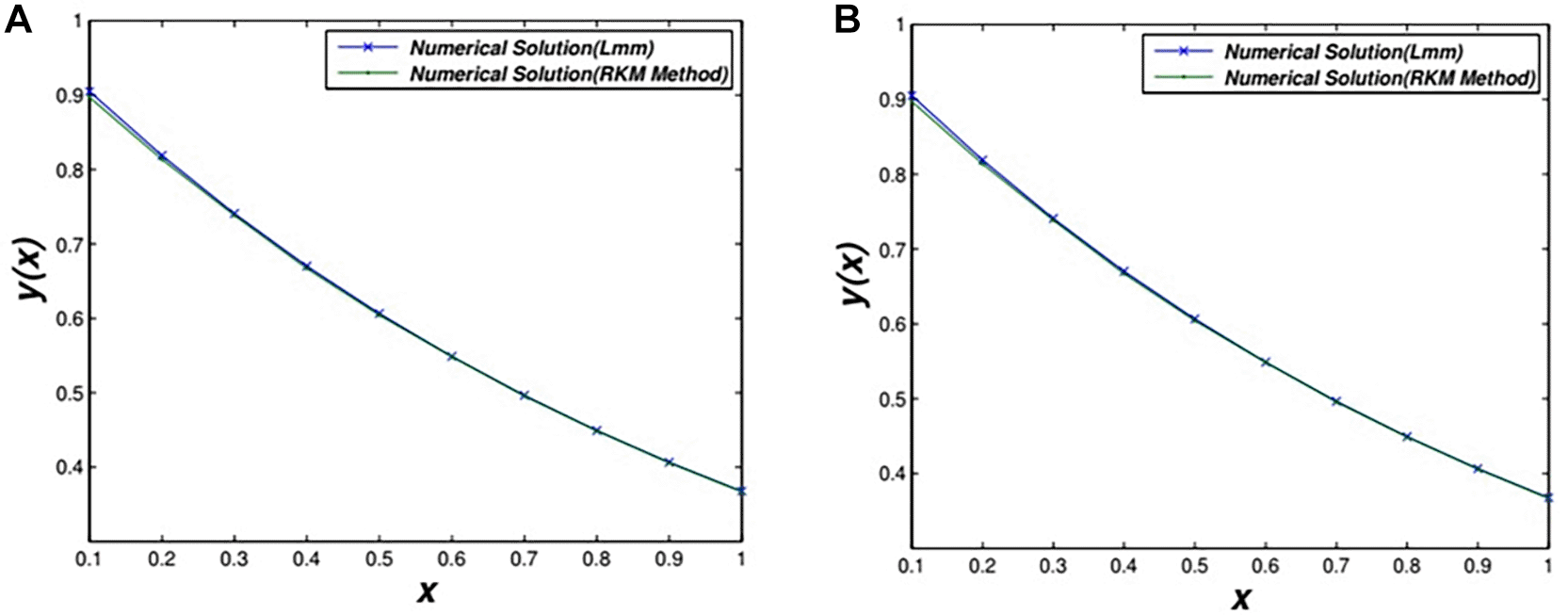
The two objectives of this article are to convert the FDE to an ODE and to derive a direct-implicit block numerical method for solving a class of ODE. The current paper developed and analyzed the method of converting a sixth-order quasi-linear FDE to an ODE and then solving this ordinary differential equation using a novel direct implicit block technique with two points, which is named GIBM2P. Accordingly, we can conclude that the proposed method GIBM2P is powerful and efficient. From the discussion of the results of this paper of the two examples of implementation, we may conclude that the proposed approach performs efficiently and accurately.
No data associated with this article.
Our researcher extends his Sincere thanks to the editor and members of the preparatory committee of the journal.
The author(s) declared that no grants were involved in supporting this work.
© 2026 Mechee MS and Mahmood Salih M. This is an open access article distributed under the terms of the Creative Commons Attribution License, which permits unrestricted use, distribution, and reproduction in any medium, provided the original work is properly cited.
Current Reviewer Status: ?
Key to Reviewer Statuses VIEW HIDE
ApprovedThe paper is scientifically sound in its current form and only minor, if any, improvements are suggested
Approved with reservations A number of small changes, sometimes more significant revisions are required to address specific details and improve the papers academic merit.
Not approvedFundamental flaws in the paper seriously undermine the findings and conclusions
Version 2
VERSION 2
PUBLISHED 08 Jun 2026
Revised
Reviewer Report 02 Jul 2026
souhila sabit, Universite Ibn Khaldoun Tiaret, Tiaret, Tiaret Province, Algeria
Approved with Reservations
VIEWS 0
Is the work clearly and accurately presented and does it cite the current literature?
Yes
Is the study design appropriate and is the work technically sound?
Partly
Are sufficient details of methods and analysis provided to allow replication by others?
Partly
If applicable, is the statistical analysis and its interpretation appropriate?
Partly
Are all the source data underlying the results available to ensure full reproducibility?
No
Are the conclusions drawn adequately supported by the results?
Partly
Competing Interests: No competing interests were disclosed.
Reviewer Expertise: Numerical methods
CloseVersion 1
VERSION 1
PUBLISHED 24 Dec 2025
Reviewer Report 02 Mar 2026
Peter Olatunji, Adekunle Ajasin University, Akungba, Ondo, Nigeria
Approved
VIEWS 0
Is the work clearly and accurately presented and does it cite the current literature?
Yes
Is the study design appropriate and is the work technically sound?
Yes
Are sufficient details of methods and analysis provided to allow replication by others?
Yes
If applicable, is the statistical analysis and its interpretation appropriate?
Not applicable
Are all the source data underlying the results available to ensure full reproducibility?
No source data required
Are the conclusions drawn adequately supported by the results?
Yes
Competing Interests: No competing interests were disclosed.
Reviewer Expertise: Numerical Analysis, Scientific Computing, Mathematical Biology and Data Science
CloseReviewer Report 05 Feb 2026
Yahya Qaid Hasan, Thamar University, Dhamar, Yemen
Approved with Reservations
VIEWS 0
Is the work clearly and accurately presented and does it cite the current literature?
Partly
Is the study design appropriate and is the work technically sound?
Yes
Are sufficient details of methods and analysis provided to allow replication by others?
Yes
If applicable, is the statistical analysis and its interpretation appropriate?
Partly
Are all the source data underlying the results available to ensure full reproducibility?
Yes
Are the conclusions drawn adequately supported by the results?
Yes
Competing Interests: No competing interests were disclosed.
Reviewer Expertise: Adomian decomposition method , Differential Equations,
CloseOpen Peer Review
Alongside their report, reviewers assign a status to the article:
| Invited Reviewers | |||
|---|---|---|---|
| 1 | 2 | 3 | |
| Version 2 (revision) 08 Jun 26 | read | ||
| Version 1 24 Dec 25 | read | read | |
Sign up for content alerts
Alongside their report, reviewers assign a status to the article:
Approved - the paper is scientifically sound in its current form and only minor, if any, improvements are suggested
Approved with reservations - A number of small changes, sometimes more significant revisions are required to address specific details and improve the papers academic merit.
Not approved - fundamental flaws in the paper seriously undermine the findings and conclusions