Просмотр новости
Найдите то, что Вас интересует
 Спутники
 РН
РН SpaceX
 Роскосмос
 NASA
NASA
СпутникиРНSpaceXРоскосмосNASAAstronomers have gotten a closer look at the nearby super-Earth GJ 3378b. It could be habitable, if it has an atmosphere.
The post Nearby super-Earth GJ 3378b may be a good candidate for life first appeared on EarthSky.
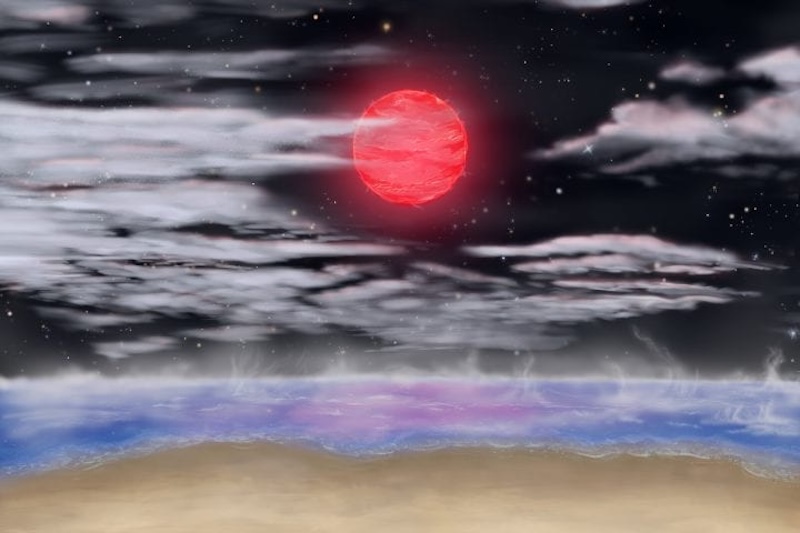 View larger. | Artist’s concept of the nearby super-Earth planet GJ 3378b. It’s about twice the size of Earth and receives a similar amount of light from its star as Earth does. Could it be habitable? Image via Nikolai Berman/ UC Irvine.
Astronomers have discovered a new Earth-like planet that might be a good candidate for habitability. The exoplanet, GJ 3378b, is about twice the size of Earth and 25 light-years away. The team of researchers, led by the University of California, Irvine, said on June 30, 2026, that the planet is in the habitable zone of its red dwarf star. That means it could have liquid water on its surface, if it has an atmosphere. So this planet could be habitable. But we don’t have enough data to know that yet.
The size of the planet makes it a super-Earth. Those are rocky planets that are larger than Earth but smaller than Neptune.
The team used the Habitable-zone Planet Finder instrument on the Hobby-Eberly Telescope at the McDonald Observatory in Texas to observe the planet’s host star. Astronomers first identified GJ 3378b as a candidate planet in 2024. And now, it is a confirmed planet.
The new observations also refined the planet’s orbit from 25 days to 21. That’s a lot less than Earth’s at 365 days, but the planet also orbits much closer to its red dwarf star, which is smaller and cooler than our sun.
The researchers published the peer-reviewed details of the new discovery in The Astrophysical Journal on June 30, 2026.
In the habitable zoneGJ 3378b is in the habitable zone of its star, a good location for potential habitability. That’s the region where temperatures could allow liquid water to exist on a planet’s surface, though whether it actually does also depends on its own atmosphere and composition. The planet does receive a suitable amount of radiation from its star, as lead author Paul Robertson at UC Irvine stated:
This super-Earth gets about 90% of the radiation from its host star as Earth gets from its sun, so it’s right in the sweet spot.
This one’s exciting. It’s one of our closest cosmic neighbors. 25 light-years sounds like a long way, but the Milky Way is about 100,000 light-years across, so in that respect it’s our next-door neighbor.
He added:
Our mantra is ‘follow the water.’ It’s the one thing every known living thing on Earth needs, so that’s the first thing we look for when trying to find environments that could sustain life.
 Paul Robertson at UC Irvine led the new study about GJ 3378b and its potential habitability. Image via UC Irvine.
Does GJ 3378b have an atmosphere?
Paul Robertson at UC Irvine led the new study about GJ 3378b and its potential habitability. Image via UC Irvine.
Does GJ 3378b have an atmosphere?
What we know so far about GJ 3378b sounds promising in terms of habitability. But there’s still one big question: does the planet have an atmosphere? We don’t know yet. It’s in the habitable zone, but it’s also at the edge of what scientists call the cosmic shoreline. If a planet is outside of that boundary, closer to the star, then radiation from the star could strip away the planet’s atmosphere. This is common with planets close to red dwarf stars.
But GJ 3378b is right at the edge of this boundary. And we don’t know yet if it still has an atmosphere or if it had one and lost it. Ideally, the planet would have a thin, evolved atmosphere like Earth’s — nitrogen-based, not the thick, hydrogen-dominated “primordial” atmosphere a planet is born with. A more Earth-like atmosphere could maintain liquid water, as Robertson explained:
Searching for signs of life on GJ 3378bIf you scale the Earth down to the size of an apple, its atmosphere would be about as thick as the skin of the apple. That’s just enough to maintain the kinds of surface pressures where you can have liquid water. It’s enough that there’ll be breathable air, and it provides maybe a little bit of protection from the harsh radiation environment of space.
Right now, we don’t know if GJ 3378b is even habitable, let alone has life of any kind. But scientists want to take a closer look. NASA’s planned Habitable Worlds Observatory, for example, scheduled to launch sometime in the 2040s, would be able to take direct images of the planet. That, or perhaps other telescopic observations before then, will help determine whether GJ 3378b could actually support life. And then scientists could search for biosignatures, chemical or other signs of life in the planet’s atmosphere.
Gogod James, a UC Irvine student, said:
If a planet in the habitable zone has a proper atmosphere, we can justify further research looking for biosignatures, liquid water or other signs of life that require both an atmosphere and the right amount of heating from the host star.
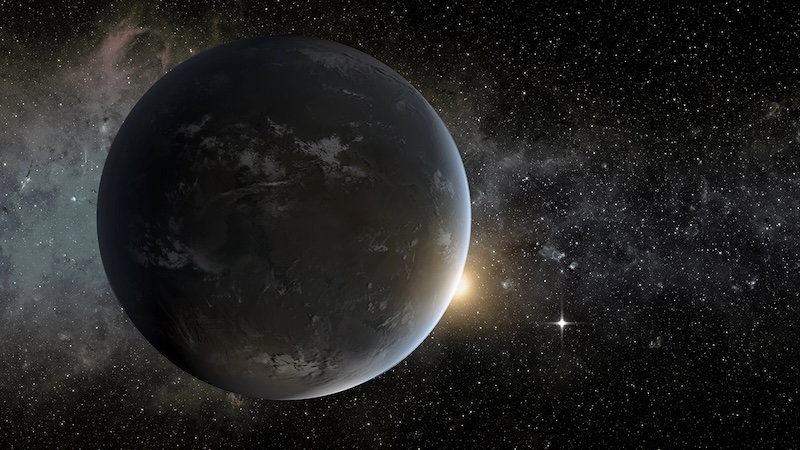 View larger. | This is another artist’s concept of a super-Earth exoplanet. Image via NASA.
The search for biosignatures continues
View larger. | This is another artist’s concept of a super-Earth exoplanet. Image via NASA.
The search for biosignatures continues
As Michael Endl, an astronomer at UT Austin, noted:
The ultimate goal is biosignatures. We really want to know, ‘Are we alone in the universe?’ We are still in the reconnaissance phase of our solar neighborhood, trying to find the planets around the nearest stars because those will be the easiest ones to detect a biosignature on. This planet brings us one step closer to knowing all of our neighbors and, ultimately, which might be hospitable for life.
For Robertson, the prospect of searching for life on GJ 3378b is something to savor:
I think that’s just too much fun.
Bottom line: Astronomers have gotten a closer look at the nearby super-Earth GJ 3378b. It could be habitable, if it has an atmosphere.
Read more: Nearby super-Earth is super-hot and airless
Read more: Powerful magnetic fields on super-Earths could boost chances of life
Paul Scott Anderson has had a passion for space exploration that began when he was a child when he watched Carl Sagan’s Cosmos. He studied English, writing, art and computer/publication design in high school and college. He later started his blog The Meridiani Journal in 2005, which was later renamed Planetaria. He also later started the blog Fermi Paradoxica, about the search for life elsewhere in the universe. While interested in all aspects of space exploration, his primary passion is planetary science and SETI. In 2011, he started writing about space on a freelance basis with Universe Today. He has also written for SpaceFlight Insider and AmericaSpace and has also been published in The Mars Quarterly. He also did some supplementary writing for the iOS app Exoplanet. He has been writing for EarthSky since 2018, and also assists with proofing and social media.
| # | Наименование новости | Тональность | Информативность | Дата публикации |
|---|---|---|---|---|
| 1 | Ученые допустили инопланетную жизнь на «супер-Земле» | 2 | 7 | 04-07-2026 |
| 2 | Близкая к нам экзопланета, считавшаяся непригодной для жизни, оказалась гораздо перспективнее | 2 | 7 | 07-07-2026 |
| 3 | Учені виявили схожу на Землю планету недалеко від Сонця | 0 | 11.43 | 20-08-2026 |
| 4 | Обнаружена потенциально обитаемая планета, всего в 25-ти световых годах от ... | 5 | 7 | 12-07-2026 |
| 5 | Astronomers make landmark discovery on next-door ‘super-Earth’ | 5 | 7 | 17-07-2026 |
| 6 | Nearby Super-Earth Has No Atmosphere and a Dark, Moon-like Surface | 0 | 11.47 | 07-05-2026 |
| 7 | Astronomers Find an Atmosphere on a Nearby Earthlike Planet | 7 | 8 | 16-07-2026 |
| 8 | Астрономы нашли планету, на которой может быть жизнь — и ... | 5 | 7 | 12-07-2026 |
| 9 | Serait-ce la candidate la plus prometteuse à la vie extraterrestre découverte à ce jour ? | 5 | 7 | 20-07-2026 |
| 10 | Webb space telescope reveals a scorching “super-Earth” that looks like Mercury | 0 | 13.36 | 06-05-2026 |