Просмотр новости
Найдите то, что Вас интересует
 Спутники
 РН
РН SpaceX
 Роскосмос
 NASA
NASA
СпутникиРНSpaceXРоскосмосNASAJapanese and Chinese space agencies completed 2 asteroid flybys in early July. Read more about the asteroids and see the closeup images here!
The post 2 asteroid flybys yield new closeup images first appeared on EarthSky.
 The Japanese space agency (JAXA) just shared an image from the Hayabusa2 mission to asteroid Torifune. On July 5, 2026, the space probe flew within 6 miles (10 km) of the asteroid and sent back the image above. The asteroid appears to be what astronomers call a contact binary, or 2 asteroids stuck together. The Chinese space agency also made a flyby of a different asteroid, 2016 HO3 Kamo’oalewa. See the pic below. These 2 asteroid flybys came within 3 days of each other. Image via JAXA/ University of Tokyo/ Chiba Institute of Technology/ Tokyo University of Science/ National Institute of Advanced Industrial Science and Technology/ Paris Observatory/ Canary Islands Institute for Astrophysics.
2 asteroid flybys yield new closeup images
The Japanese space agency (JAXA) just shared an image from the Hayabusa2 mission to asteroid Torifune. On July 5, 2026, the space probe flew within 6 miles (10 km) of the asteroid and sent back the image above. The asteroid appears to be what astronomers call a contact binary, or 2 asteroids stuck together. The Chinese space agency also made a flyby of a different asteroid, 2016 HO3 Kamo’oalewa. See the pic below. These 2 asteroid flybys came within 3 days of each other. Image via JAXA/ University of Tokyo/ Chiba Institute of Technology/ Tokyo University of Science/ National Institute of Advanced Industrial Science and Technology/ Paris Observatory/ Canary Islands Institute for Astrophysics.
2 asteroid flybys yield new closeup images
Space agencies from both China and Japan have just shared images from flybys of two different asteroids in our solar system. On July 2, 2026, China’s Tianwen-2 probe flew past asteroid Kamo’oalewa from a distance of just 12.5 miles (20 km). Then on July 5, 2026, Japan’s Hayabusa2 flew past asteroid Torifune from a mere 6 miles (10 km) distant.
Both space agencies caught images of the asteroids. Kamo’oalewa might be a chunk of the moon ejected in a giant impact. And Torifune revealed itself to be two rubble piles joined together, or what astronomers call a contact binary.
Flyby of asteroid Kamo’oalewaOn July 6, 2026, the China National Space Administration said:
The Tianwen-2 probe has arrived at its target asteroid and begun scientific exploration.
Tianwen-2’s target is the asteroid Kamo’oalewa, which is a near-Earth asteroid. The asteroid has a strange orbit that keeps it in unison with Earth. This resonant orbit makes it a quasi-satellite of Earth. A 2024 study showed Kamo’oalewa might have once been a part of the moon that blasted away during an impact that formed the lunar crater Giordano Bruno.
China’s mission to the asteroid began back on May 29, 2025, with the launch of Tianwen-2. After a journey of what the space agency called about 400 days and 621 million miles (1 billion kilometers), Tianwen-2 will now:
… conduct more detailed scientific explorations to obtain information on the asteroid’s shape, material composition and internal structure, providing support for preparations for sampling.
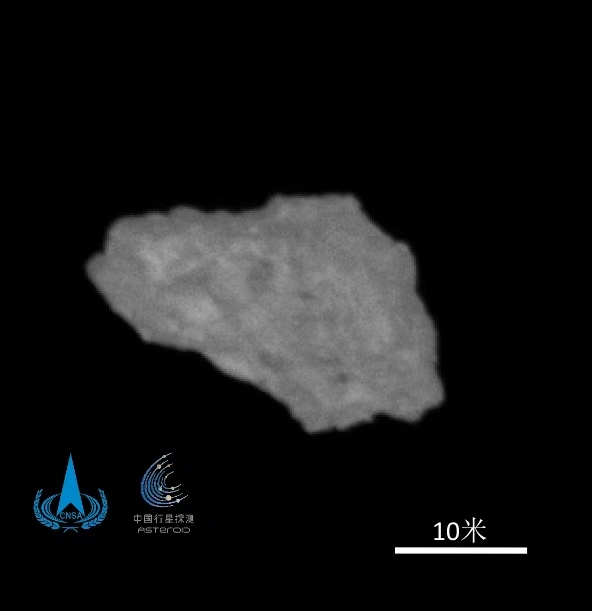 The China National Space Administration said on July 6, 2026, that it had recently captured this image of the asteroid Kamo’oalewa. Tianwen-2 took this image on July 2, 2026. Image via China National Space Administration.
Flyby of asteroid Torifune
The China National Space Administration said on July 6, 2026, that it had recently captured this image of the asteroid Kamo’oalewa. Tianwen-2 took this image on July 2, 2026. Image via China National Space Administration.
Flyby of asteroid Torifune
Hayabusa2’s journey to Torifune has taken much longer. The mission launched to space in December 2014. At that time, its target was the asteroid Ryugu. In 2020, Hayabusa2 rendezvoused with Ryugu and took samples that it sent back to Earth. Analysis of the samples show they are rich in primitive organic material.
After Ryugu, the Japan Aerospace Exploration Agency (JAXA) sent the Hayabusa2 probe on an extended mission to Torifune. The probe arrived at 18:30 Japan Standard Time on July 5, 2026. Hayabusa2 made several observations during its flyby. JAXA is still acquiring this data, so expect more revelations about the asteroid to come!
But Hayabusa2’s extended mission is not over. After a couple of swings past Earth, the space probe is headed for the tiny asteroid 1998 KY26. The asteroid is just 36 feet (11 meters) in diameter. Hayabusa2 should arrive at the asteroid in 2031.
Bottom line: Japanese and Chinese space agencies both completed asteroid flybys in early July 2026. See the closeup images here.
Via China National Space Administration
Kelly Kizer Whitt - EarthSky’s nature and travel vlogger on YouTube - writes and edits some of the most fascinating stories at EarthSky.org. She's been writing about science, with a focus on astronomy, for decades. She began her career at Astronomy Magazine and made regular contributions to other outlets, including AstronomyToday and the Sierra Club. She has nine published books, including a children's picture book, Solar System Forecast, and a young adult dystopian novel, A Different Sky.
| # | Наименование новости | Тональность | Информативность | Дата публикации |
|---|---|---|---|---|
| 1 | Japan releases snowman-like asteroid image after flyby | 0 | 5 | 06-07-2026 |
| 2 | Japan space probe skims asteroid in test for planetary defense | 0 | 5 | 05-07-2026 |
| 3 | За один день человечество «познакомилось» сразу с двумя астероидами! Про ... | 0 | 7 | 06-07-2026 |
| 4 | За один день человечество «познакомилось» сразу с двумя астероидами: Торифунэ и Камоалева | 0 | 17.78 | 06-07-2026 |
| 5 | ✅Японский зонд «Хаябуса-2» пролетел рядом с астероидом Торифунэ на расстоянии ... | 5 | 7 | 07-07-2026 |
| 6 | И вновь доброе утро всем тем, кто проснулся, и добрых ... | 2 | 7 | 29-06-2026 |
| 7 | Японский зонд прислал первые кадры космического «снеговика» | 5 | 7 | 07-07-2026 |
| 8 | «Хаябуса-2» получил первые снимки астероида Торифунэ с рекордно малого расстояния ... | 5 | 7 | 07-07-2026 |
| 9 | А вот и второй астероид, который мы впервые увидели крупным ... | 0 | 7 | 10-07-2026 |
| 10 | # Японский аппарат показал «двуликий» астероид, который может изменить наше ... | 5 | 7 | 08-07-2026 |