Просмотр новости
Найдите то, что Вас интересует
 Спутники
 РН
РН SpaceX
 Роскосмос
 NASA
NASA
СпутникиРНSpaceXРоскосмосNASA
The massive chasm between AI hype and reality is finally reaching the breaking point.
that is an amazing idea and you are a genius, dave
We're living in split realities. There's what modern software is actually capable of, and then there's the gargantuan pile of "AI" hype, fraud, and bullshit our biggest tech companies (and their lazy enablers in the tech press) have shoveled down the public's throat for the better part of the last five years. There's useful automation software that makes it easier to code, draft a new resume, or study vast repositories of scientific knowledge. And then there's a parade of technofascist hucksters lying to your face about the imminent arrival of omniscient, sentient, paradigm-rattling supercomputers. There's a tremendous chasm between these two things. And everywhere you look you can see evidence that we've reached a breaking point when it comes to reconciling these two wildly-different realities. Over at Ford Motor Company, executives recently fired a bunch of engineers and rushed madly into widespread AI adoption, only to discover the software made constant quality control mistakes, resulting in them having to rehire a lot of the engineers they previously shitcanned:"Mistakenly, we thought that by just introducing artificial intelligence and ingesting the design requirements that we had, that would produce a high-quality product," he said.Wonder where they might have gotten that idea."Over prior years, we didn't pay as much attention as we should have to the experience of our most knowledgeable engineers that have been with us through many product cycles," he said.A few years ago, corporate media owners also began rushing face-first into AI adoption in newsrooms, very excited about the potential to cut corners, automate their clickbait, and replace pesky human journalists with magic software.They were so excited by the promise of not having to pay human beings a living wage or health insurance, they didn't really bother to make sure the technology worked or could be responsibly integrated into existing, broken systems.It...didn't go well. The AI outputs contained so many factual errors, instances of plagiarism, or outright falsehoods, that newsrooms found they had to pay significantly more money for human editors to come in and fix all the problems. You've seen the same problems bubble up in academia, health care, and everywhere else. It's gotten so bad that innovation-drunk MBA types are now having to come to terms with the fact that automation software is neither sentient nor magic, contrary to the claims of Elon Musk and Sam Altman. This reconciliation is creating no limit of suffering and entertainment value, simultaneously.And there's some absolutely fascinating layers to the dysfunction. One recent study on AI "efficiency" out of Stanford found that the introduction of a flood of rushed and factually-incorrect AI slop into workflows actually results in human beings having to work harder than ever:“When coworkers receive workslop, they are often required to take on the burden of decoding the content, inferring missed or false context. A cascade of effortful and complex decision-making processes may follow, including rework and uncomfortable exchanges with colleagues.”As the Harvard Business Review notes, this hyperscaled introduction of pseudo-efficiency workslop results not just in new conflict and a bunch of wasted time for people, but a sort of broader "knowledge decay" that introduces the potential for organizational downward spirals:“Errors compound and pile up. Trust in information erodes. People spend more time verifying facts or risk costly and dangerous mistakes. Eventually, people start to lose trust in the processes that they rely on to do their jobs.”That is, so we're clear, not the future we were promised. That future was a lie built by people who don't believe in empathy and have never cracked a sociology textbook. It was a mirage built by dull and greedy egomaniacs who don't actually care about other human beings – or if the products they're selling actually work.There's just endless examples of this, like this employee of a Miami-based cybersecurity firm, who noted his boss fired a bunch of employees, replaced them with AI, and immediately made everybody's lives harder:“Quality decreased significantly, time to produce a piece of content increased significantly and, most importantly, morale decreased,” said the copywriter, who spoke under a pseudonym for fear of losing his job. “Everything got a whole lot worse once they rolled out AI.” Ken said the company’s executives shifted the blame to staff when they pushed back about AI-fueled productivity decreases.You've got a lot of bosses, many of them already wildly out of touch due to class and privilege, now making bad decisions not just based on their misrepresented understanding of what modern software is capable of, but because they're using AI chatbots as a sort of delusion confirmation machine:click to read on BlueskyIn one video, which has 30,000 views on TikTok, a young woman becomes increasingly exasperated as she attempts to convince the AI that she wants a caramel ice cream, only for it to add multiple stacks of butter to her order.In another, which has 360,000 views, a person claims that her order got confused with one being made by someone else, resulting in nine orders of tea being added to her bill.Or Taco Bell, which also had to shut down their AI kiosk experiments after folks easily tricked the computer into trying to dole out 18,000 cups of water.Mirroring the experience at Ford, the Commonwealth Bank of Australia and IBM also both fired a bunch of employees only to realize that their software replacements weren't anywhere near ready for the job:"According to an ABC report in August last year, CBA admitted it “did not adequately consider all relevant business considerations” when announcing the redundancies and acknowledged “we should have been more thorough in our assessment of the roles required.”Perhaps you are detecting a theme. So you get ample myopia among management types who already hate labor, and are obsessed with the idea of saving a ton of money and firing people via AI. But they're also using AI for high-level decision-making without functional skepticism or introspection, resulting in stories like this one or this one featuring incoherent directives by bosses who are dunktanking themselves into deep webs of pseudo-innovative delusion without understanding it's even happening:“I got feedback to be more concise at work, yet am routinely sent copypasta from ChatGPT that is literally the longest shit known to man,” said Mel, who works in finance. “I can’t read it.” As a result, the work of deciphering—and sometimes fixing—a boss’s A.I. effort becomes an additional task on an employee’s plate.You'll see this again and again; bosses who weren't good managers to begin with, that double down on bad decisions because the computer autocomplete told them their gut instincts were spot on:“My view of AI was very different from my supervisor’s. I saw it as a tool that could help analyze information, find patterns, and make funny cat meme pictures,” said one worker, an IT staffer at a tech company. “He seemed to use it more as a digital priest whose primary purpose was to confirm that he was right and everyone else was mistaken.”There's a lot of other fascinating but poorly understood subtlety as it relates to the rushed adoption. This Boston University study, for example, found that managers were 18 percent less likely to catch errors generated in outputs if they were told it was crafted by an "AI employee" (with a name like Jack-7) versus an "AI tool."Strange days.Keep in mind that so far we're just talking about whether AI works as advertised and whether your boss has maintained a functional tether to objective reality. We're not even talking about the massive resources being consumed to make such errors, the environmental and climate data center impact, the precarious impact of AI on mental health in a country without consistent mental health care, the massively higher consumer costs due to GPU and chip scarcity, the abusive overseas labor exploitation needed to make a lot of the magic happen, the soaring enterprise costs of AI use due to funny math and unrealistic business models, the impact on the livelihoods of creatives and journalists, the fact that most of the folks in charge of AI's trajectory are unrepentant fascist sociopaths, or the fact that corruption has hollowed out U.S. AI, labor, environmental, consumer, and public safety regulators like a pumpkin, leaving the entire economy at risk of collapse.Our "CEO said a thing!" corporate press doesn't really want to brutally engage with these broader pesky ethical ramifications, because that's not in ownership's financial best interests. So on top of everything else, we have a badly-automated news and media apparatus that's also incapable of telling people the truth. The result is deep, interlocking delusions in a country already being devoured by artifice. The sales pitch for AI is heavily predicated on the fact that this is all a profitable and sustainable venture that evolves into computerized sentience, and there's simply no evidence that's true. These models are all absurdly expensive to run, and the mad dash toward pseudo-productivity masked the reality that execs blew gargantuan wads of cash on negligible net benefit and a lot of chronic migraines.Software automation can be helpful, but it helps if you're self-aware, not in a cult, trained to use it, inherently skeptical, and living in a society with working ethical and public interest guardrails that hasn't been devoured by artifice and corruption. We ain't that.
(Just a quick reminder that if you like and appreciate my work, please consider signing up for a paid subscription tier. It genuinely helps me keep doing what I do in a country that doesn't value (or fund) journalism. Consider it the equivalent of buying me a coffee every month. I very much appreciate your time and readership!)
The massive chasm between AI hype and reality is finally reaching the breaking point.

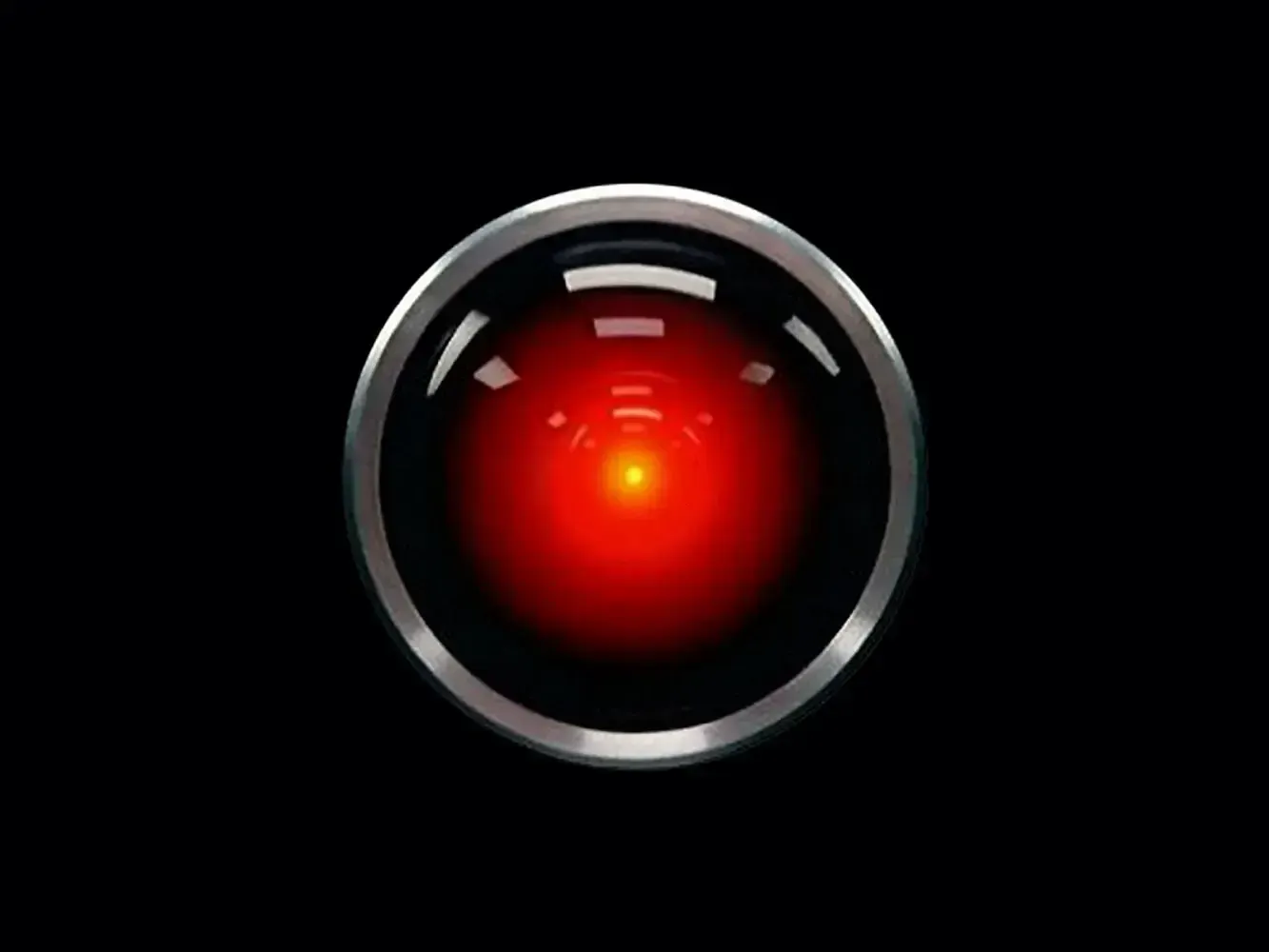 that is an amazing idea and you are a genius, dave
We're living in split realities.
There's what modern software is actually capable of, and then there's the gargantuan pile of "AI" hype, fraud, and bullshit our biggest tech companies (and their lazy enablers in the tech press) have shoveled down the public's throat for the better part of the last five years.
There's useful automation software that makes it easier to code, draft a new resume, or study vast repositories of scientific knowledge. And then there's a parade of technofascist hucksters lying to your face about the imminent arrival of omniscient, sentient, paradigm-rattling supercomputers.
There's a tremendous chasm between these two things. And everywhere you look you can see evidence that we've reached a breaking point when it comes to reconciling these two wildly-different realities.
Over at Ford Motor Company, executives recently fired a bunch of engineers and rushed madly into widespread AI adoption, only to discover the software made constant quality control mistakes, resulting in them having to rehire a lot of the engineers they previously shitcanned:
"Mistakenly, we thought that by just introducing artificial intelligence and ingesting the design requirements that we had, that would produce a high-quality product," he said.
Wonder where they might have gotten that idea.
"Over prior years, we didn't pay as much attention as we should have to the experience of our most knowledgeable engineers that have been with us through many product cycles," he said.
A few years ago, corporate media owners also began rushing face-first into AI adoption in newsrooms, very excited about the potential to cut corners, automate their clickbait, and replace pesky human journalists with magic software.
They were so excited by the promise of not having to pay human beings a living wage or health insurance, they didn't really bother to make sure the technology worked or could be responsibly integrated into existing, broken systems.
It...didn't go well.
The AI outputs contained so many factual errors, instances of plagiarism, or outright falsehoods, that newsrooms found they had to pay significantly more money for human editors to come in and fix all the problems. You've seen the same problems bubble up in academia, health care, and everywhere else.
It's gotten so bad that innovation-drunk MBA types are now having to come to terms with the fact that automation software is neither sentient nor magic, contrary to the claims of Elon Musk and Sam Altman. This reconciliation is creating no limit of suffering and entertainment value, simultaneously.
And there's some absolutely fascinating layers to the dysfunction.
One recent study on AI "efficiency" out of Stanford found that the introduction of a flood of rushed and factually-incorrect AI slop into workflows actually results in human beings having to work harder than ever:
“When coworkers receive workslop, they are often required to take on the burden of decoding the content, inferring missed or false context. A cascade of effortful and complex decision-making processes may follow, including rework and uncomfortable exchanges with colleagues.”
As the Harvard Business Review notes, this hyperscaled introduction of pseudo-efficiency workslop results not just in new conflict and a bunch of wasted time for people, but a sort of broader "knowledge decay" that introduces the potential for organizational downward spirals:
“Errors compound and pile up. Trust in information erodes. People spend more time verifying facts or risk costly and dangerous mistakes. Eventually, people start to lose trust in the processes that they rely on to do their jobs.”
That is, so we're clear, not the future we were promised. That future was a lie built by people who don't believe in empathy and have never cracked a sociology textbook. It was a mirage built by dull and greedy egomaniacs who don't actually care about other human beings – or if the products they're selling actually work.
There's just endless examples of this, like this employee of a Miami-based cybersecurity firm, who noted his boss fired a bunch of employees, replaced them with AI, and immediately made everybody's lives harder:
“Quality decreased significantly, time to produce a piece of content increased significantly and, most importantly, morale decreased,” said the copywriter, who spoke under a pseudonym for fear of losing his job. “Everything got a whole lot worse once they rolled out AI.” Ken said the company’s executives shifted the blame to staff when they pushed back about AI-fueled productivity decreases.
You've got a lot of bosses, many of them already wildly out of touch due to class and privilege, now making bad decisions not just based on their misrepresented understanding of what modern software is capable of, but because they're using AI chatbots as a sort of delusion confirmation machine:
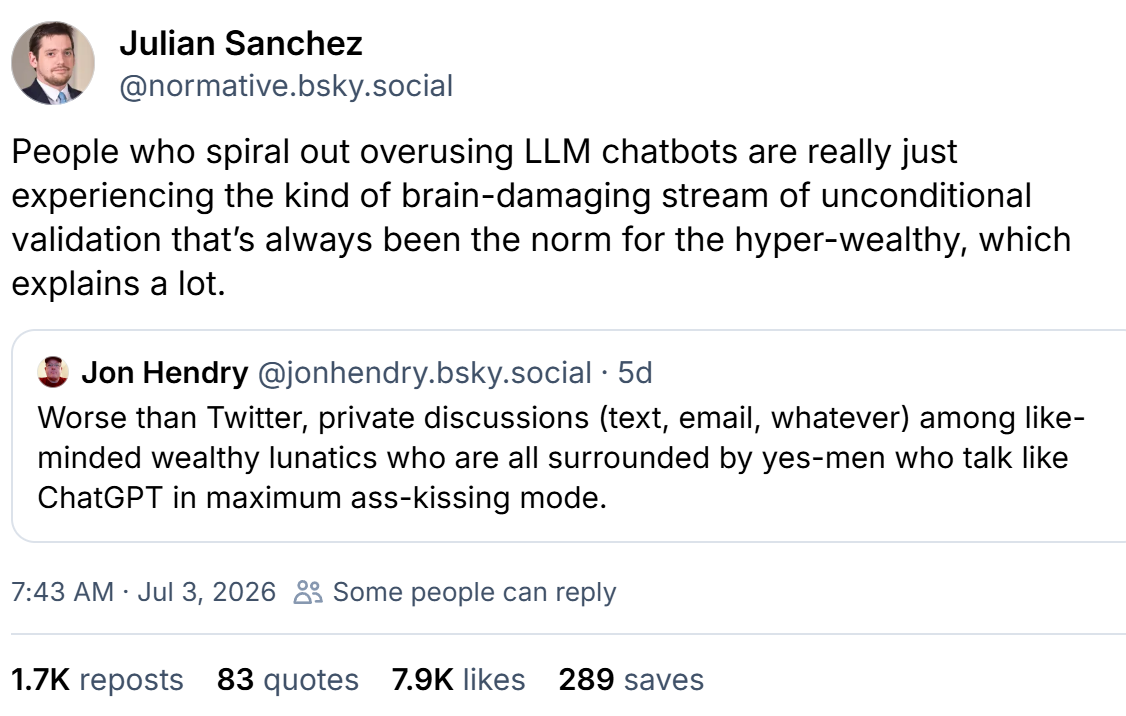 click to read on Bluesky
In one video, which has 30,000 views on TikTok, a young woman becomes increasingly exasperated as she attempts to convince the AI that she wants a caramel ice cream, only for it to add multiple stacks of butter to her order.
In another, which has 360,000 views, a person claims that her order got confused with one being made by someone else, resulting in nine orders of tea being added to her bill.
Or Taco Bell, which also had to shut down their AI kiosk experiments after folks easily tricked the computer into trying to dole out 18,000 cups of water.
Mirroring the experience at Ford, the Commonwealth Bank of Australia and IBM also both fired a bunch of employees only to realize that their software replacements weren't anywhere near ready for the job:
"According to an ABC report in August last year, CBA admitted it “did not adequately consider all relevant business considerations” when announcing the redundancies and acknowledged “we should have been more thorough in our assessment of the roles required.”
Perhaps you are detecting a theme.
So you get ample myopia among management types who already hate labor, and are obsessed with the idea of saving a ton of money and firing people via AI.
But they're also using AI for high-level decision-making without functional skepticism or introspection, resulting in stories like this one or this one featuring incoherent directives by bosses who are dunktanking themselves into deep webs of pseudo-innovative delusion without understanding it's even happening:
“I got feedback to be more concise at work, yet am routinely sent copypasta from ChatGPT that is literally the longest shit known to man,” said Mel, who works in finance. “I can’t read it.” As a result, the work of deciphering—and sometimes fixing—a boss’s A.I. effort becomes an additional task on an employee’s plate.
You'll see this again and again; bosses who weren't good managers to begin with, that double down on bad decisions because the computer autocomplete told them their gut instincts were spot on:
“My view of AI was very different from my supervisor’s. I saw it as a tool that could help analyze information, find patterns, and make funny cat meme pictures,” said one worker, an IT staffer at a tech company. “He seemed to use it more as a digital priest whose primary purpose was to confirm that he was right and everyone else was mistaken.”
There's a lot of other fascinating but poorly understood subtlety as it relates to the rushed adoption. This Boston University study, for example, found that managers were 18 percent less likely to catch errors generated in outputs if they were told it was crafted by an "AI employee" (with a name like Jack-7) versus an "AI tool."
Strange days.
Keep in mind that so far we're just talking about whether AI works as advertised and whether your boss has maintained a functional tether to objective reality.
We're not even talking about the massive resources being consumed to make such errors, the environmental and climate data center impact, the precarious impact of AI on mental health in a country without consistent mental health care, the massively higher consumer costs due to GPU and chip scarcity, the abusive overseas labor exploitation needed to make a lot of the magic happen, the soaring enterprise costs of AI use due to funny math and unrealistic business models, the impact on the livelihoods of creatives and journalists, the fact that most of the folks in charge of AI's trajectory are unrepentant fascist sociopaths, or the fact that corruption has hollowed out U.S. AI, labor, environmental, consumer, and public safety regulators like a pumpkin, leaving the entire economy at risk of collapse.
Our "CEO said a thing!" corporate press doesn't really want to brutally engage with these broader pesky ethical ramifications, because that's not in ownership's financial best interests. So on top of everything else, we have a badly-automated news and media apparatus that's also incapable of telling people the truth.
The result is deep, interlocking delusions in a country already being devoured by artifice.
The sales pitch for AI is heavily predicated on the fact that this is all a profitable and sustainable venture that evolves into computerized sentience, and there's simply no evidence that's true. These models are all absurdly expensive to run, and the mad dash toward pseudo-productivity masked the reality that execs blew gargantuan wads of cash on negligible net benefit and a lot of chronic migraines.
Software automation can be helpful, but it helps if you're self-aware, not in a cult, trained to use it, inherently skeptical, and living in a society with working ethical and public interest guardrails that hasn't been devoured by artifice and corruption.
We ain't that.
(Just a quick reminder that if you like and appreciate my work, please consider signing up for a paid subscription tier. It genuinely helps me keep doing what I do in a country that doesn't value (or fund) journalism. Consider it the equivalent of buying me a coffee every month. I very much appreciate your time and readership!)| # | Наименование новости | Тональность | Информативность | Дата публикации |
|---|---|---|---|---|
| 1 | Why every AI launch now makes the backlash worse | 0 | 17.38 | 18-09-2026 |
| 2 | AI is supercharging money scams. Here’s how to protect yourself from fraud | 0 | 12.7 | 17-09-2026 |
| 3 | State lawmakers heed Big Tech's warning on AI; Trump not following | 0 | 6.69 | 14-09-2026 |
| 4 | I run a registry that tracks 218 AI and SaaS tools. 18 are already dead or dying - here are the patterns | 0 | 8.98 | 29-07-2026 |
| 5 | 5 things to keep in mind about AI hype | 0 | 5 | 26-06-2026 |
| 6 | La inferencia de IA ya gasta más que el entrenamiento. Es un cambio de paradigma del sector (y malo para ti) | 0 | 8.06 | 12-08-2026 |
| 7 | AI inference is getting cheaper, but your agents are getting more expensive | 0 | 12.86 | 18-08-2026 |
| 8 | Daily Hacker News for 2026-07-23 | 0 | 10.96 | 24-07-2026 |
| 9 | AI tool use is becoming mandatory for more and more roles at my company, unfortunately including… | 0 | 4.23 | 06-08-2026 |
| 10 | Los ordenadores tardaron 15 años en mejorar la productividad de las empresas. La IA puede tardar más por un motivo: el sabotaje | -2 | 6 | 20-07-2026 |