Просмотр новости
Найдите то, что Вас интересует
 Спутники
 РН
РН SpaceX
 Роскосмос
 NASA
NASA
СпутникиРНSpaceXРоскосмосNASAThe situation is more complex than it may seem at first glance
Economy 27 February 2026, 1:45pm
Domestic fuel prices have been particularly favourable recently, with both gasoline and diesel prices falling. We were beginning to forget about levels around 600 forints.
However, due to the halt in Russian oil imports, the focus of attention has once again shifted to domestic fuel prices, and there are several signs that the calm, gradual price decline we have seen so far is coming to an end.
How much of a price increase could the loss of the Friendship pipeline cause?Gergely Gulyás, the Prime Minister's chief of staff, told a press briefing on Thursday that a failure to keep the Druzhba oil pipeline operational would lead to a sharp increase in petrol prices, with previous analyses referring to prices above HUF 1,000 per litre. However, with Viktor Orbán riding the pale horse of fear-mongering on his way to what could be his toughest election challange yet, it is worth scrutinising this claim, so let's look at the numbers:
Adding this extra amount to the current price of gasoline, which is 568 forints, results in a
domestic price of around HUF 653.
Although this is much lower than the previously suggested price of 1,000 forints, it would still be the highest price in the region.
It is important to note that other countries in the region, which stopped sourcing crude oil from Russia long ago, have similar or nearly identical pump prices. Therefore, the validity of scenarios predicting brutal price increases is questionable. The Hungarian state directly skims off 95% of the price difference between Western and Russian oil in the form of a special tax on the Brent-Ural spread. This tax revenue goes into the general state coffers and does not specifically reduce the burden on certain economic actors.
Sources: Mol Investor Presentation What else is driving prices?Moreover, it's not only the oil pipeline issue that could cause problems at petrol stations; the macroeconomic environment also suggests that prices will increase. Although the Hungarian forint remains strong against the US dollar and the euro,
the price of Brent crude oil has risen sharply since mid-December. This is because the oil market is increasingly factoring in geopolitical risks, particularly the potential loss of Iranian oil exports.
In addition, refinery premiums have begun to rise sharply in recent days, partly due to tighter supply following planned maintenance work on refineries in spring.
Sourrce: NesteNext, we will look at whether refuelling in Hungary is currently considered expensive.
Are Hungarian fuel prices expensive currently?The latest data is already available on the European Commission's subpage, allowing us to see whether domestic fuel prices are higher than the average in neighbouring countries. When making comparisons, it is also worth taking into account prices in neighbouring countries, since Hungarian motorists can cross the border to fill up their tanks if prices are unfavourable.
In the case of gasoline, the domestic market is only one forint more expensive than the average,
while the domestic price of diesel is two forints below the average.
The graphs below show the countries in which petrol and diesel are more expensive than in Hungary.
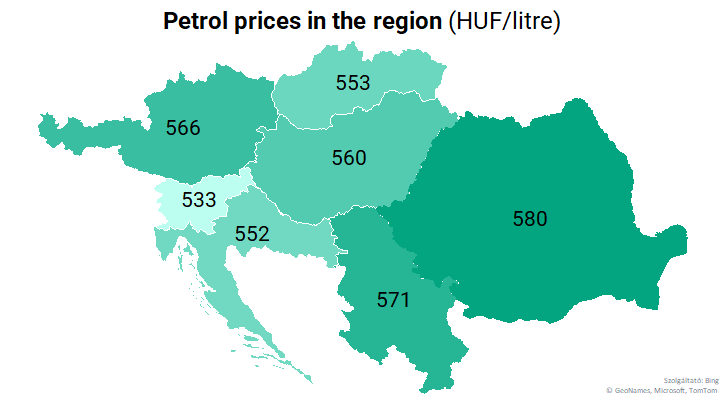
Therefore, at present, there is no need to fear either a surge in fuel prices or any drastic government measures,
given that domestic gasoline and diesel prices are currently in the regional mid-range. However, as we have seen, it is by no means certain that this will remain the case. Bearing this in mind, it is worth briefly revisiting the issues surrounding the price cap at that time.
Lessons of the 2022 fuel price freezeFrom the outset, the fuel price freeze proved difficult to maintain and highly distortive of market conditions, so the government revised the measure several times in the months before its introduction, successively excluding a growing proportion of consumers from the price freeze. The government imposed the official price of HUF 480 at the end of 2021 with temporary effect, and then repeatedly extended the measure to the last day of 2022. The following problems and difficulties were encountered in 2023 before the price cap was phased out:
THE EUROPEAN COMMISSION OPENED ANINFRINGEMENT PROCEDUREAGAINST HUNGARY OVER THE NEW DUAL FUEL PRICE REGIME,
requesting the Hungarian authorities to comply with EU law provisions with regard to the free movement of goods and services including transport services, the freedom of establishment, the free movement of citizens and workers, the principle of non-discrimination as well as rules on notifications under the Single Market Transparency Directive.IT WAS NOT WORTH IT FOR FOREIGN SUPPLIERS TO EXPORT TO HUNGARY AT THIS FIXED PRICE.
Thus, based on the previous example,
intervention in the fuel market could even lead to a security of supply risk.
Furthermore, the outlook is worsened by the fact that Mol's refinery in Százhalombatta will only be able to operate at 70% capacity for quite some time as a result of the accident last October.
Cover image (for illustration purposes only): Getty Images
| # | Наименование новости | Тональность | Информативность | Дата публикации |
|---|---|---|---|---|
| 1 | Here is the latest twist in Hungary's oil supply saga: let's see if there is a shortage! | 0 | 5 | 25-02-2026 |
| 2 | Europe’s diesel crisis deepens as prices hit record highs – Hungary feels the pressure | 0 | 8.08 | 20-09-2026 |
| 3 | The labour market situation is deteriorating in Hungary | -5 | 7 | 27-02-2026 |
| 4 | Friendship outage: Brussels responds to Viktor Orbán's letter and also sends a message to Mol | 0 | 9.22 | 27-02-2026 |
| 5 | В Венгрии наблюдается ажиотажный спрос на бензин | 0 | 0 | 06-12-2022 |
| 6 | Hungarian government uses energy companies as cash cows, but who actually pays? | 0 | 5 | 25-02-2026 |
| 7 | Hungary's Mol threatens Janaf, sets Friday deadline | 0 | 5 | 26-02-2026 |
| 8 | Орбан: Венгрия намерена не допустить запрета на поставки нефти и газа из РФ в ЕС | 0 | 0 | 23-05-2025 |
| 9 | Hungary reveals new diesel subsidy details: Who gets EUR 55 and when will payments begin? | 0 | 10.41 | 19-09-2026 |
| 10 | Цены, наличие, правила продажи, работа АЗС | 0 | 5 | 09-07-2026 |