Просмотр новости
Найдите то, что Вас интересует
 Спутники
 РН
РН SpaceX
 Роскосмос
 NASA
NASA
СпутникиРНSpaceXРоскосмосNASAAt the center of the case was label warnings about glyphosate, a weed-killing chemical that has been linked to cancer.
At the center of the case was label warnings about glyphosate, a weed-killing chemical that has been linked to cancer.
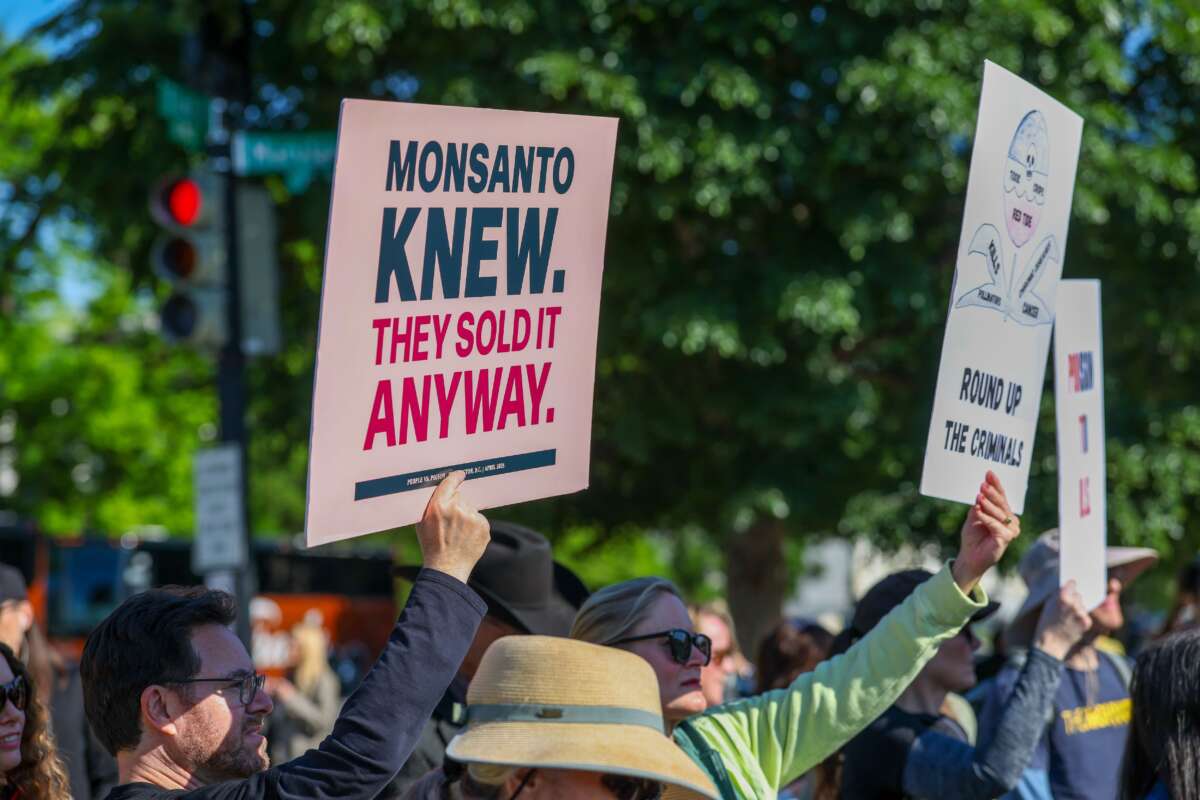 "The People vs the Poison" protesters gather at the US Supreme Court on April 27, 2026, in Washington, D.C. Tasos Katopodis / Getty Images
Honest, paywall-free news is rare. Please support our boldly independent journalism with a donation of any size.
The US Supreme Court has ruled in favor of the former Monsanto company in a closely watched case that limits people’s ability to sue pesticide companies for alleged illnesses or injuries.
The decision was made in a 7-2 split, with Justice Brett Kavanaughoffering the majority opinion and Justice Ketanji Brown-Jackson writing the dissenting opinion.
The case, Monsanto v Durnell, specifically dealt with the question of whether a federal law that gives the Environmental Protection Agency (EPA) regulatory authority over pesticides preempts state claims that a company failed to warn users of certain product risks when the EPA itself has not required such warnings.
In its ruling, the court said that the EPA regulates Roundup, one of Monsanto’s glyphosate-based herbicides, and the agency has “repeatedly concluded that glyphosate is not likely to cause cancer, [and] … has not required a cancer warning on Roundup’s label.” Regulations require manufacturers to use EPA-approved pesticide labels, the SCOTUS opinion argues, and, under the Federal Insecticide, Fungicide and Rodenticide Act (FIFRA), states cannot impose labeling requirements different from the EPA.
“Because Durnell’s state tort claim would impose a pesticide labeling requirement ‘in addition to or different from’ the label required by EPA, FIFRA expressly preempts Durnell’s claim,” Justice Kavanaugh wrote.
The Durnell case deals with glyphosate — a weedkilling chemical used in the popular Roundup brand and numerous other herbicide products sold by the former Monsanto company, which is now owned by Germany’s Bayer. The chemical has been scientifically linked to cancer in multiple studies, and was classified a probable human carcinogen by an arm of the World Health Organization in 2015.
Bayer has spent the last decade fighting more than 100,000 lawsuits filed by people who developed non-Hodgkin lymphoma they blamed on exposure to the glyphosate weedkillers, and the company has paid out billions of dollars in jury awards and settlements. All of the cases include allegations that the company failed to warn that glyphosate could cause cancer.
Bayer maintains that its products don’t cause cancer, and also asserts that under FIFRA, the EPA is the key authority for determining if its product necessitated a cancer warning. The EPA has not required such a warning and has taken the position that glyphosate is “unlikely” to be carcinogenic, so the company cannot be held liable for failing to warn, according to Bayer’s argument.
In a statement, Bayer praised the ruling as “good for science, farmers, and industries that depend on regulatory clarity for innovation.”
Health and environmental groups, however, slammed the decision.
“This Trump-blessed ruling preventing Americans’ from seeking justice for serious health problems linked to an EPA-approved pesticide means that now, more than ever, we need an EPA that protects people instead of foreign pesticide companies,” said Nathan Donley, the Center for Biological Diversity’s environmental health science director.
In the dissenting opinion, Justice Jackson, who was joined by Justice Neil Gorsuch, argued Durnell’s claim is squarely within FIFRA, and specifically the Act’s prohibition of pesticide “misbranding.”
“In accepting Monsanto’s argument and holding that Durnell’s failure-to-warn claim is preempted, the Court misunderstands FIFRA’s requirements, misinterprets the scope of FIFRA’s preemption, and ultimately leaves Durnell without a remedy for the significant harms he has suffered,” Justice Jackson wrote.
The court’s decision means the failure-to-warn claims included in several thousand lawsuits pending against Monsanto likely cannot go forward.
The ruling “should help significantly contain the Roundup litigation after nearly a decade of legal battles,” Bayer wrote in its statement. “The ruling should result in the dismissal of current warning-based claims and bar future failure-to-warn claims.”
The decision could mean thousands of such claims pending against pesticide maker Syngenta cannot proceed as well. In the Syngenta cases, plaintiffs allege they developed Parkinson’s disease due to exposure to the company’s paraquat weed killer.
Donley said “glyphosate is just the tip of the pesticide iceberg.”
“The EPA has approved hundreds of poisons the agency itself has linked to cancer, and our parents, kids and loved ones are paying for it with their health, sometimes their lives,” he said. “The need to profoundly reform our industry-captured system of pesticide regulation could not be clearer.”
Separately from the Supreme Court case, Bayer has proposed a $7.25 billion class action settlement to resolve tens of thousands of current cases and future claims that could be brought. The Supreme Court ruling could potentially impact the proposed settlement deal.
This article first appeared on The New Lede and is republished here under a Creative Commons Attribution-NonCommercial-NoDerivatives 4.0 International License.
Truthout is one of only a few platforms for justice-oriented, grassroots journalism. Today, as political censorship from the right intensifies, we have no choice but to ask for your help.
We are fundraising right now to cover our basic operating expenses. If you can support Truthout with a one-time or monthly donation, you will make a significant impact on our work. Anything you can do makes a difference — we appreciate your support.