Просмотр новости
Найдите то, что Вас интересует
 Спутники
 РН
РН SpaceX
 Роскосмос
 NASA
NASA
СпутникиРНSpaceXРоскосмосNASAHundreds of Maine companies, large and small, share billions of defense dollars each year that flow through communities across the state.
The lunch rush is on at Allard’s Market & Deli in North Berwick. Owner Tom Allard is cranking out burgers, subs and pizza slices for hungry customers, as he has for 37 years.
Andrew Patneaude is waiting for his buffalo chicken wrap. He works at Pratt & Whitney, a military and commercial jet engine maker just down the road. He’s here nearly every day.
Patneaude admits he hasn’t really considered Pratt & Whitney’s wider economic impact — beyond his attractive salary and benefits. Median pay for his job is about $40 an hour. But he recognizes his role as one of more than 2,300 employees at the Ratheon-owned plant and thousands of other Mainers who work for defense contractors.
“There’s a lot of money running through that place, and it’s important work being done,” said Patneaude, 39, of Sebago. “There’s a huge sense of pride, but I just play a small part.”
 Andrew Patneaude, a Pratt & Whitney employee, grabs lunch for himself and coworkers at Allard’s Market & Deli in North Berwick. (Brianna Soukup/Staff Photographer)
All told, there are about 300 defense contractors in Maine, including companies that provide cleaning and food services to military programs, in addition to the well-known players such as Pratt & Whitney, General Dynamics-Bath Iron Works and Portsmouth Naval Shipyard in nearby Kittery.
Allard’s Market is among hundreds of additional businesses that benefited indirectly from $4.6 billion that the U.S. Department of Defense spent in Maine in the 2024 budget year, according to the most recent data from the federal Office of Local Defense Community Cooperation.
That was 4.7% of the state’s gross domestic product (GDP), putting Maine at No. 9 in the nation by that measure. It’s an investment of outsized importance to the state’s economy, especially since Maine’s share of total U.S. defense spending was just 0.6 % and ranked No. 31 nationally. The ripple effect of that cash infusion benefits hundreds of other businesses and over 20,000 Maine workers — and experts say there’s opportunity for growth.
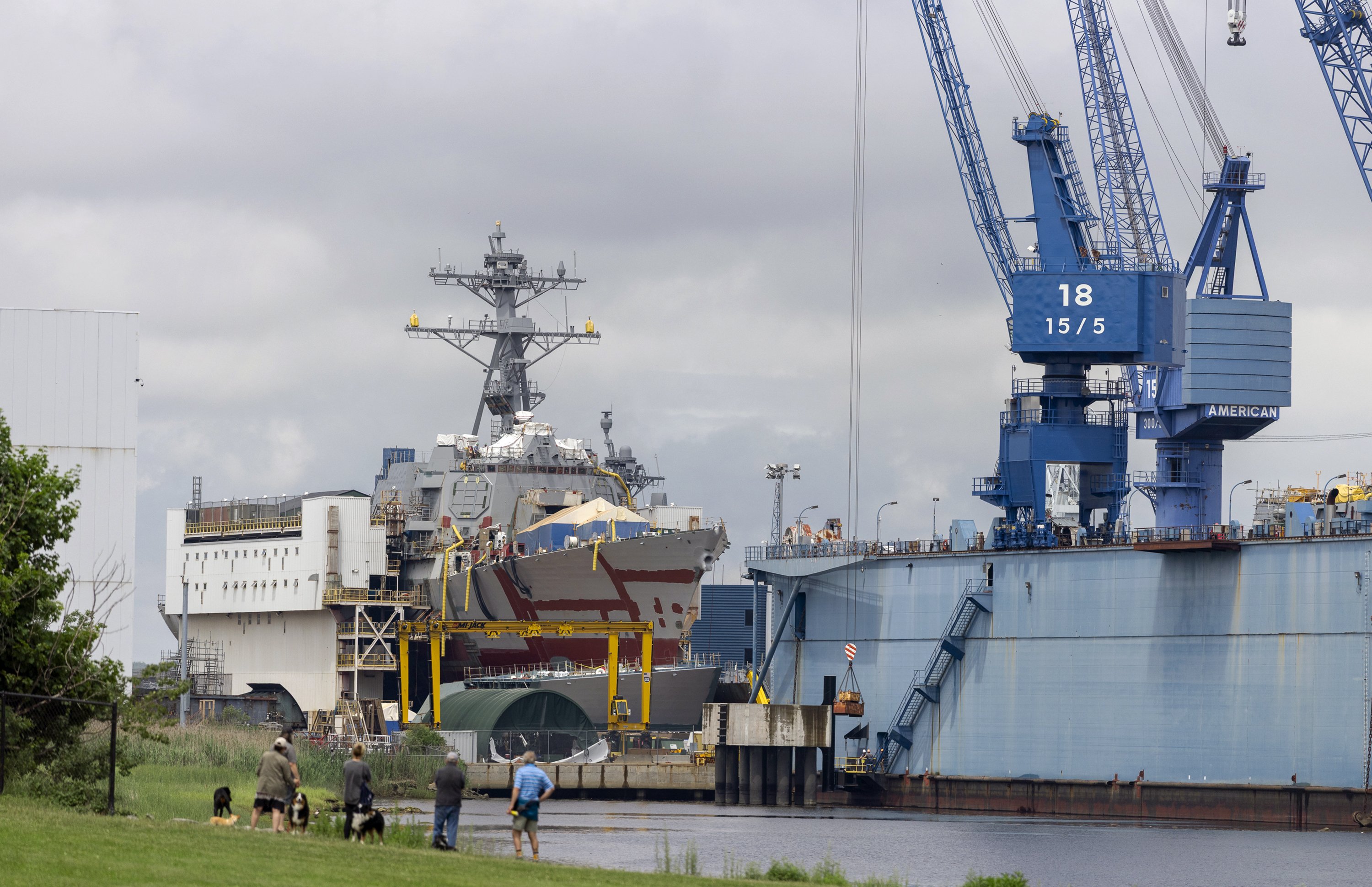 A Bath Iron Works ship seen from South End Park in Bath. (Brianna Soukup/Staff Photographer)
Other states win much larger defense contracts. Companies in top-billing Virginia (No. 1), Connecticut (No. 7) and Alabama (No. 10) had defense contracts totaling $54 billion, $19 billion and $13 billion, respectively. Maine’s defense contracts totaled $3.6 billion in the 2024 budget year, excluding military grants and payroll.
“We’re not a Connecticut, Alabama or Virginia,” said Andy Roy, executive director of the Maine Defense Industry Alliance. “But defense spending is an incredibly valuable and important part of our overall economy in Maine.”
It has been incredibly important to Allard’s Market for nearly four decades.
“Workers from Pratt & Whitney have been a big part of our business through the years,” Tom Allard said as he dropped chicken fingers into a deep-fryer. “We get a significant amount of traffic from the Navy yard, too.”
 Tom Allard and Jen Schofield make lunches behind the counter at Allard’s Market & Deli in North Berwick. (Brianna Soukup/Staff Photographer)
Pratt & Whitney and Portsmouth Naval Shipyard are two of the largest employers of people living in southern Maine and New Hampshire.
 An employee works on a jet engine at Pratt & Whitney in North Berwick. (Courtesy photo)
The shipyard, which maintains and repairs Navy submarines, had a civilian payroll of $762 million for nearly 6,800 workers in 2024, according to the Seacoast Shipyard Association. Nearly 4,600 of those workers lived in Maine and were paid $433 million.
The shipyard also is where Cianbro, based in Pittsfield, is leading a multiyear, $1.8 billion upgrade as a Navy contractor, adding two dry docks to three already operating at the facility.
Workers at the shipyard and Pratt & Whitney set the pulse of life in North Berwick. About 230 employees of each facility live in the town of 5,300, said Town Manager Dwayne Morin.
Sidewalks through town have been upgraded to accommodate Pratt & Whitney’s noontime wellness walks. The plant on Route 9 stretches over 1 million square feet, which the company says is the largest manufacturing facility under one roof in Maine. When shifts change in the afternoon, the town’s main drag becomes a parking lot. But the sense of the company’s impact stretches around the globe.
“Pratt & Whitney isn’t just important to our economy,” Morin said. “They actually keep America flying all over the world.”
 Dwayne Morin, town manger of North Berwick, looks at an economic impact report on Portsmouth Naval Shipyard. (Brianna Soukup/Staff Photographer)
Defense spending in Maine has drawn more attention lately as the widely unpopular war with Iran shades the hotly contested race between five-term U.S. Sen. Susan Collins, a Republican who heads appropriations, and Democrat Graham Platner, a Marine Corps veteran who served four combat tours in Iraq and Afghanistan.
 Residents hold signs during a protest June 27 along Broadway and Erskine Park in South Portland. (Kelley Bouchard/Staff Writer)
Maine’s congressional delegation generally jostles for credit in supporting defense contractors, but public sentiment has frayed over military spending amid a war that Congress hasn’t authorized and widespread cuts to other federal programs by the Trump administration.
Barbara Dee has always been proud of Maine’s shipbuilding heritage, from the World War II Liberty ships built where she lives in South Portland, to the modern destroyers built at Bath Iron Works. Her father, a Maine native, worked for 40 years at General Dynamics-Electric Boat in Groton, Connecticut, where they build Navy submarines.
Now, she’s organizing regular public protests in South Portland against the Trump administration, including one on June 27 that drew about 50 people. She’s particularly upset that the name of the defense department has been changed to Department of War.
“It’s so provoking,” said Dee, a retired educator. “Everything they do is so provoking. But I don’t know what we’d do without BIW. It’s such an important part of our economy.”
THE BROAD REACH OF BIW Sara Graves, a marine electrician a Bath Iron Works, is interviewed while shopping at J’adore Consignment in downtown Bath. (Brianna Soukup/Staff Photographer)
For Sara Graves, 26, working as a marine electrician at BIW is continuing a tradition of military service in her family. A Bath resident who recently moved from Auburn, she’s been pulling cable on Navy destroyers for over five years, leaving behind a job as a preschool teacher for better pay and benefits.
It’s hard work — hot in the summer and cold in the winter — but she loves it.
“Being on the boats themselves, it gives me goosebumps just thinking about it,” Graves said while shopping at J’adore Consignment in downtown Bath before her shift. “Because I know they’re going to house our Navy and they need to be safe, so we need to make sure we’re doing a good job.”
 A Bath Iron Works crane seen from Front Street in downtown Bath. (Brianna Soukup/Staff Photographer)
BIW employs over 6,800 people, who were paid a total of $508 million in 2025, according to company reports. Their average annual wage was $75,000 — well above the state average of $63,000 to $65,000 for all industries and the manufacturing average of $71,000.
They live all over Maine, including workers who commute by the vanload and some who stay nearby with friends during the week and head home on weekends.
“We’re the largest employer in Sabattus,” said David Hench, company spokesperson, noting the concentration of 161 BIW workers in the Androscoggin County town of 5,500, about 25 miles north of Bath.
In 2025, BIW spent $122 million with 246 vendors and suppliers across Maine, sharing some of the $2.1 billion in defense contracts that were awarded in fiscal 2023 to the shipyard and General Dynamics-Ordinance and Tactical Systems in Saco, formerly Saco Defense Corp.
BIW’s impact is most apparent in Bath, where the company’s industrial cranes dominate the skyline. It paid $8.7 million in property taxes last year — about 25% of the city’s tax base.
 Sara Graves, a marine electrician a Bath Iron Works, chats with sales clerk Betsy Rode, left, at J’adore Consignment in downtown Bath. (Brianna Soukup/Staff Photographer)
“Our tax base is heavily reliant on BIW,” said Betsy Rode, 75, a sales clerk at J’adore Consignment. “So many of the things we have in this community are because of them.”
The company is spending $60 million to build a six-story, 940-space parking garage, expand its surface parking and make other road improvements to help solve transportation problems near the shipyard.
It’s also collaborating with the Navy and a housing developer to build a $20 million, 84-unit apartment complex for BIW workers that’s expected to open mid-2027. And it’s working with the Navy and the YMCA to invest $13 million in local childcare resources, with 150 spaces reserved for children of shipbuilders.
SMALL BUSINESSES ADVANCE IN DEFENSEMost defense contractors in Maine are smaller companies, such as Howell Laboratories in Bridgton. Founded in 1964, it has 50 employees and makes air dehydration and water treatment systems for Navy and Coast Guard surface ships.
In 2024, Howell purchased ODAT Machine, a precision machine shop in Gorham with 25 employees that makes parts for Navy submarines. Tucked away in a business park off Route 25, the employee-owned company is a Level 1 certified defense contractor.
“That means we’ve proven we can meet those requirements, so we’re on a list of select suppliers,” said Joseph McDonnell, Howell’s president and CEO.
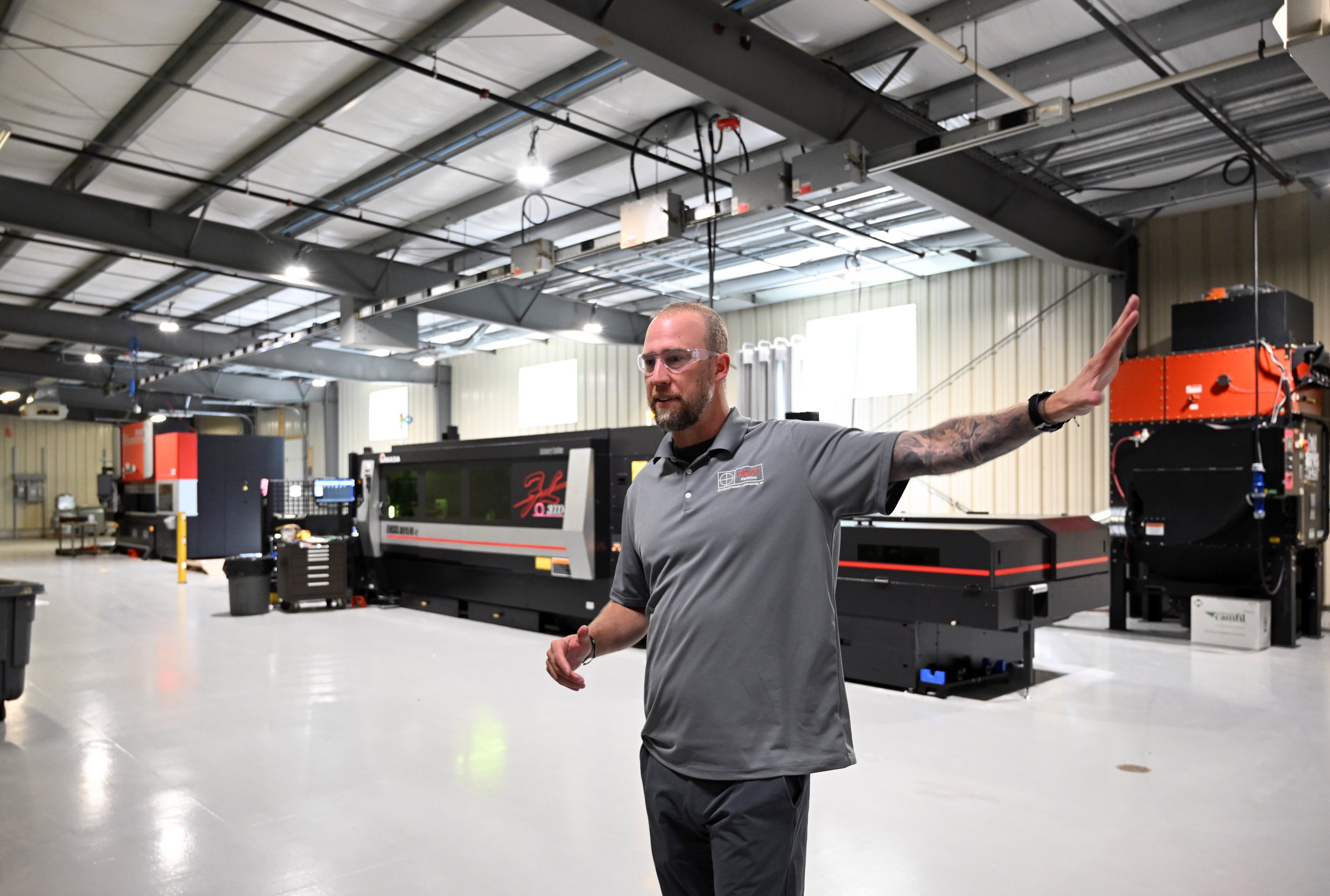 Ryan McCauley, vice president of operations, stands before a new laser sheet metal machine at ODAT Machine, a division of Howell Laboratories in Gorham. (Shawn Patrick Ouellette/Staff Photographer)
Howell has received over $8.2 million in defense contracts in the last five years. It recently spent nearly $2 million on several programmable machines to upgrade and accelerate production — paid for by the Navy. One room-size machine laser cuts sheet metal, and two smaller machines are multi-function lathes that produce precision parts.
“It was costing us a lot of money to get our sheet metal done outside, and there were long wait times,” McDonnell said. “The Navy is worried about contractors going out of business, so we were able to convince them to make this investment in us.”
Alan Roberge, head of ALR Electromechanical in Saco, was fine-tuning Howell’s new lathes last week. He specializes in setting up and maintaining computer numerical controlled machines across northern New England, including the major defense contractors.
“But there are a lot of smaller shops doing work for defense,” he said, “and they’re crucial to our economy.”
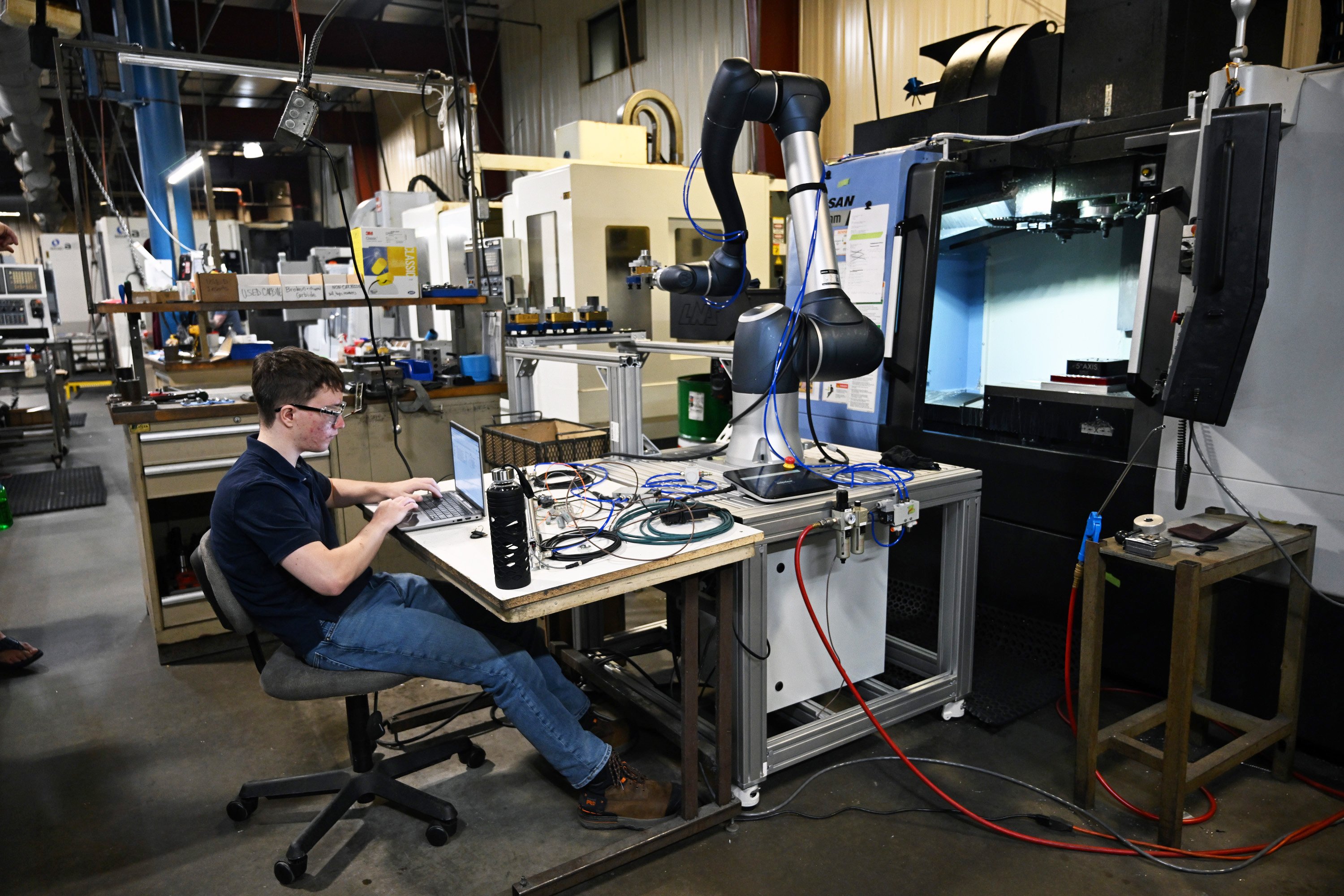 Hayden Wielki, an intern who is studying electrical engineering at the University of Southern Maine, operates a collaborative robot at ODAT Machine, a division of Howell Laboratories in Gorham. (Shawn Patrick Ouellette/Staff Photographer)
More than a dozen state, regional or federal agencies are working to sustain and grow Maine’s military-based economy.
Leading the pack lately is the Maine Defense Industry Alliance, formed in 2024 and funded by the Navy to coordinate defense spending and workforce development in the state. It includes the top defense contractors; the state’s community college and university systems; and the state departments of education, labor and economic development.
The alliance just completed its first project: the $6.5 million Center for Manufacturing Excellence at York County Community College in Sanford. The federally funded facility includes four industrial training labs for welding, machining, pipefitting and mechanics that will train workers for Maine’s defense industries and advanced manufacturing.
“A broad array of students are interested in the practical application of science, but not all of them want to pursue a four-year degree,” said David Daigler, president of the community college system and chair of the defense industry alliance. “Maine’s defense contractors offer high-paying jobs with good benefits, but you can’t just walk in off the street into those jobs. The center will prepare workers for those jobs.”
In May, Maine officials announced the creation of the Defense and Manufacturing Training Fund to disperse nearly $7.9 million from the U.S. Department of Labor to train new and current workers in defense shipbuilding and advanced manufacturing.
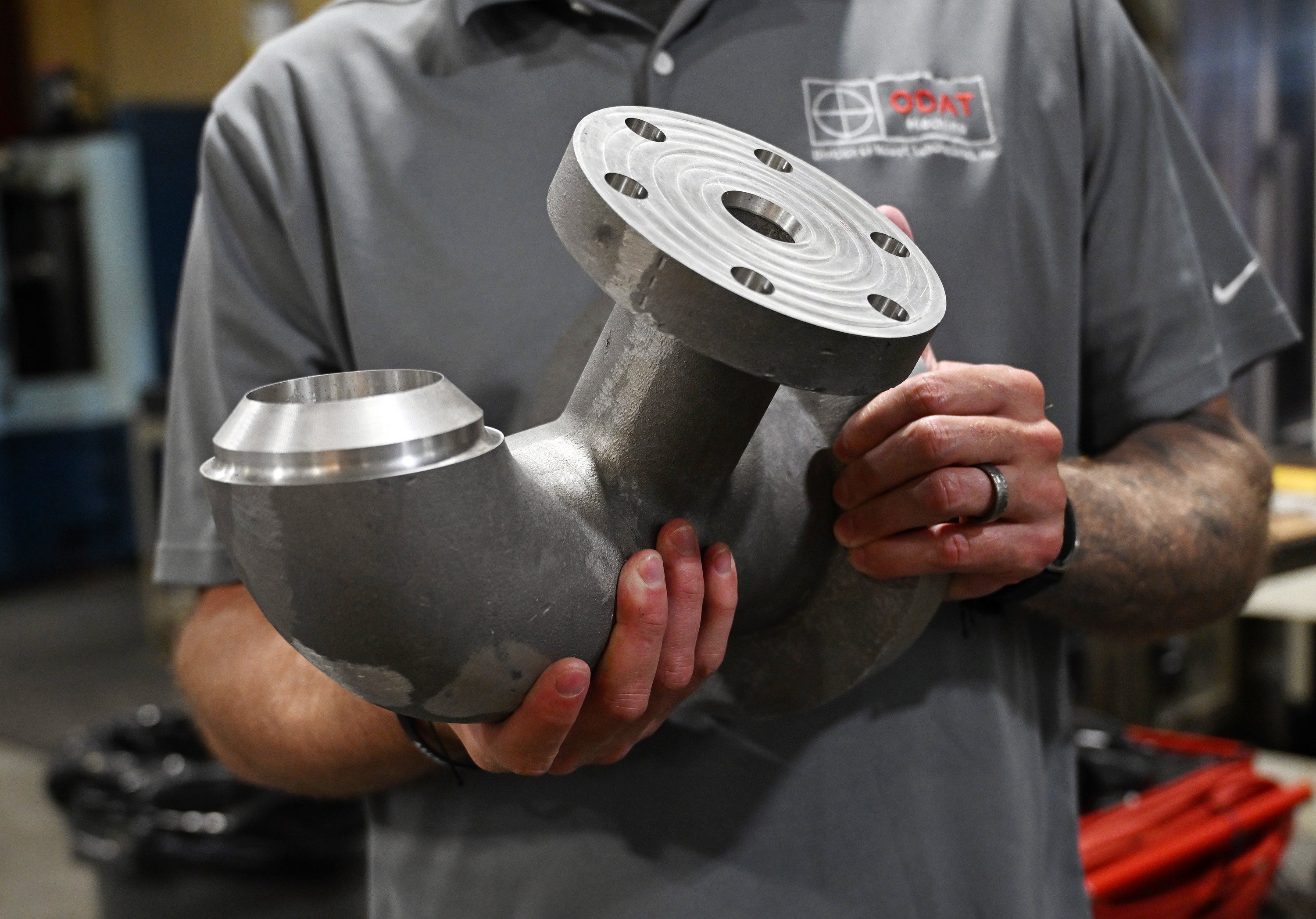 Ryan MCauley, vice president of operations, holds an elbow pipe made for a Navy submarine at ODAT Machine, a division of Howell Laboratories in Gorham. (Shawn Patrick Ouellette/Staff Photographer)
Maine’s manufacturing heritage, tightly connected communities and positive work attitude are key reasons the state has developed a strong defense industry.
That’s Jack Lesko’s impression after five years as director of engineering research at The Roux Institute of Northeastern University. Before that he was an engineering professor and researcher for 32 years at Virginia Tech, working with the Navy and companies such as Rolls Royce and Airbus on advanced manufacturing technologies and materials.
Lesko grew familiar with Maine’s industrial landscape while consulting with companies involved in UMaine’s Advanced Manufacturing Center. He’s also Roux’s representative to the Maine Defense Industry Alliance.
“There is something about Maine that is so different from other places I’ve worked,” Lesko said. “Mainers know how to roll up their sleeves and do what it takes to get it done. There’s a sense of community here that is absolutely profound. Some people here have 20 to 30 years of service with one company. That culture is not easy to find, and it’s the special sauce for company success.”
Lesko believes that Maine is ripe to expand its defense and advanced manufacturing — and that military investment can be a great driver of innovation and growth across all industries. He points to the state’s manufacturing productivity, which has shown slight but meaningful gains in recent years based on early investments in automation and workforce training, he said.
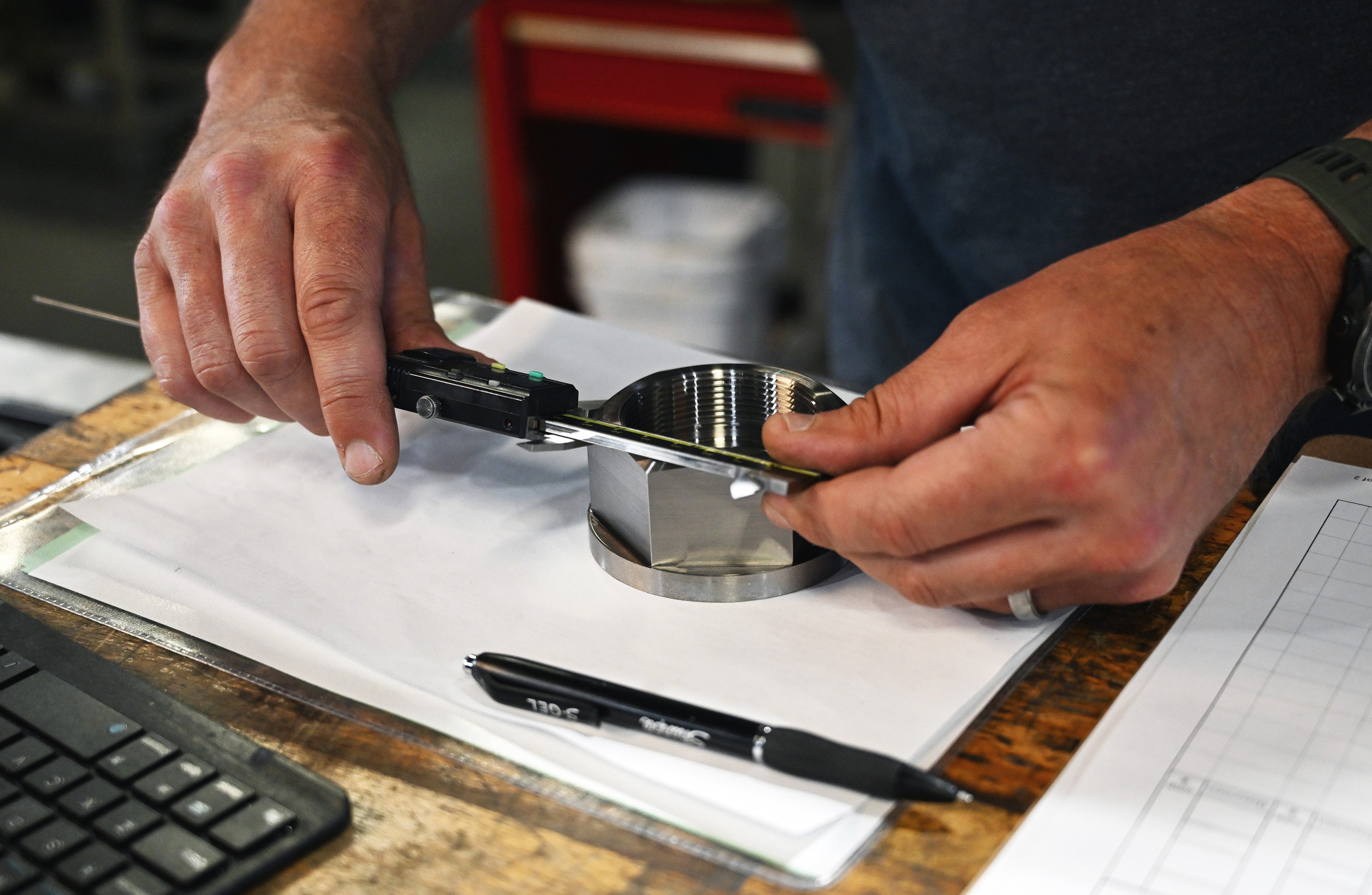 Andrew Wescott checks measurements on a nut made for a Navy submarine at ODAT Machine, a division of Howell Laboratories in Gorham. (Shawn Patrick Ouellette/Staff Photographer)
But that growth could be hindered if Maine companies don’t embrace new operational and information technology, he said.
Lesko found the technology at many firms lacked data and systems to take on new product lines or program expansions. Companies looking to expand into military contracts first must get advanced defense cybersecurity certification, he said.
A 2024 study funded by the Maine Technology Institute found most companies have been slow to adopt advanced and data-driven manufacturing. They’re automating selectively, upgrading slowly, hampered by capital constraints that limit the pace of investment, he said.
New equipment often arrives with sensors and data-collection capabilities that are not yet being meaningfully leveraged, the study found. Companies see opportunities for data-driven productivity gains but lack clear business strategies and workers trained to take advantage of them, he said.
“Honor your employees,” Lesko said. “Give them the tools they need to get the job done.”
 Andrew Patneaude, a Pratt & Whitney employee, leaves Allard’s Market & Deli in North Berwick with his lunch. (Brianna Soukup/Staff Photographer)
| # | Наименование новости | Тональность | Информативность | Дата публикации |
|---|---|---|---|---|
| 1 | 7 defense contractors in Maine you probably don’t know about | 0 | 5 | 05-07-2026 |
| 2 | How Maine leaders are crossing Pete Hegseth on shipbuilding | 0 | 34.53 | 18-06-2026 |
| 3 | Does Bath Iron Works account for about 17% of Maine’s GDP? | Fact brief | 0 | 5 | 06-07-2026 |
| 4 | Kennebunk-area towns approve $64.8M school budget | 0 | 7 | 10-06-2026 |
| 5 | Bath-area voters approve $47.7M budget | 0 | 5 | 11-06-2026 |
| 6 | Modular construction, big or small, fills a hole in Maine’s housing market | 5 | 7 | 23-06-2026 |
| 7 | MaineHealth must cancel its contract with Palantir | Opinion | 0 | 37.56 | 23-07-2026 |
| 8 | Maine community colleges to expand skilled manufacturing training | 0 | 20.2 | 06-08-2026 |
| 9 | Have food prices doubled in the past 10 years? | Fact brief | 0 | 5 | 13-07-2026 |
| 10 | Maine Community College System president stepping down next year | 0 | 5 | 11-06-2026 |