Просмотр новости
Найдите то, что Вас интересует
 Спутники
 РН
РН SpaceX
 Роскосмос
 NASA
NASA
СпутникиРНSpaceXРоскосмосNASAUncrewed systems are the future for armed forces and the Netherlands is leading the way ‘to keep people out of danger zones’On each side of the target ship, a black vessel keeps a watchful distance. Defender 1 and Defender 2 are the eyes and ears of the navy – but they have nobody onboard, and their paths are controlled by a computer system.This is the future of the Royal Netherlands Navy, according to Capt Sjoerd Feenstra, head of the expertise centre for unmanned systems. He is leading a five-week mission, off the coast of Den Helder in the north of the country, to test the limits of systems that operate without the human touch. Continue reading...
On each side of the target ship, a black vessel keeps a watchful distance. Defender 1 and Defender 2 are the eyes and ears of the navy – but they have nobody onboard, and their paths are controlled by a computer system.
This is the future of the Royal Netherlands Navy, according to Capt Sjoerd Feenstra, head of the expertise centre for unmanned systems. He is leading a five-week mission, off the coast of Den Helder in the north of the country, to test the limits of systems that operate without the human touch.
“For the last year and a half we’ve been working to change our organisation,” he says. “In about 10 years there will be crewed platforms surrounded by a ring of uncrewed systems operating as autonomously as possible.”
Underwater vehicles, boats and drones – all uncrewed – are expected to play a key role in future armed forces around the world. The latest Dutch military budget promises to use uncrewed systems for more than half of its work within five years. The UK, in a similar period, plans to spend more than £5bn on such technology.
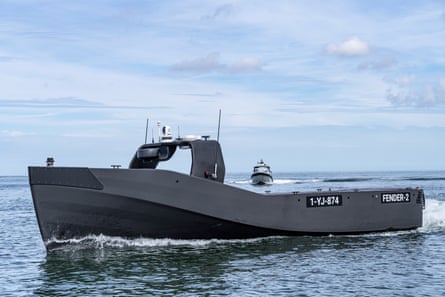
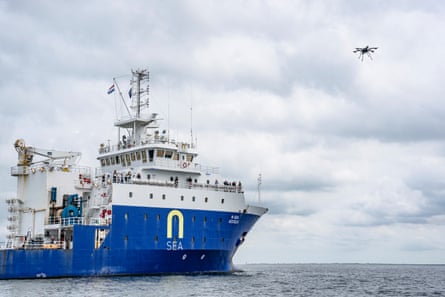
Central to all this is the GeoSea vessel. Once used to monitor the seabed around windfarms, it is now the base for testing Noa drones – which look like giant flies – the Defender vessels and a Lobster Robotics undersea mine mapper. The “system of systems” is designed so that new models can be swapped in and out as technology advances.
Drones are already used in live conflicts. Their use and capability have increased exponentially since Russia invaded Ukraine in 2022. They have played a key role in Iranian strikes, and in the war in the Middle East, while the US Navy deployed unmanned sea vessels this year in operations against Iran.
For the Dutch navy, uncrewed systems are more than a trend. “The goal is to do as many things as possible with unmanned systems to keep people out of danger zones,” says Feenstra. “The work has got a lot more difficult, especially with the amount of information, speed and capacity demanded. And some jobs are unbelievably boring.”
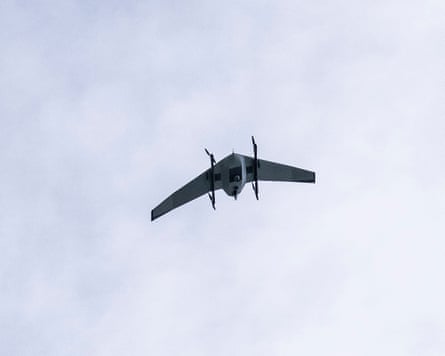
On the command to “monitor that ship”, for instance, the Defender vessels are deployed, two carbon-fibre Noa drones are dispatched and another drone resembling a huge bat flies high overhead.
Technical failure is always a risk. Artificial intelligence can hallucinate, or generate a false result, says the software integration lead Ferdinand Peters. “You need to let the system work for you, but not think for you,” he says. “We need to think carefully about where we use it and where we do not.”
A machine will not decide to pull the trigger here. “A person is always part of the decision-making chain,” says Feenstra.
The ethical question isn’t new, either: for more than 40 years, the Netherlands has had the Goalkeeper air defence system, which can function autonomously.
“What we know from the past is that even when people make the plan or collect the information, something can go wrong,” says Feenstra. “The question is where the culpability will lie if you automate everything.”
It makes sense for a country with a labour shortage to aim for more autonomy, but the Dutch are an inspiration to other countries collaborating on security in the North and Baltic seas, according to Lee Willett, a naval analyst.
“The Dutch punch above their weight,” Willett says. “They are also advancing what they have because they recognise that they are a relatively small navy in an incredibly important part of the world.”
Sidharth Kaushal, senior research fellow for sea power at the Royal United Services Institute thinktank in London says he believes the tide has turned towards such systems – not least, because they reduce long stretches at sea.
“Uncrewed systems don’t completely remove the requirement for manpower – you tend to need more engineers – but they provide a different balance in terms of family life,” he says. “This is the direction of travel.”
| # | Наименование новости | Тональность | Информативность | Дата публикации |
|---|---|---|---|---|
| 1 | From Foe to Friend: The Dutch Rethink Their War Against the Sea | 0 | 6.8 | 20-07-2026 |
| 2 | UK Replaces Plans For Future Destroyer With Drone Controller Ships | 0 | 7 | 30-06-2026 |
| 3 | В Нидерландах разрешили особо охраняемым тюрьмам сбивать дроны | 0 | 5 | 29-06-2026 |
| 4 | ⚡Нидерланды увеличат численность армии до более чем 100 тысяч человек ... | 0 | 5 | 30-06-2026 |
| 5 | ⚡Нидерланды увеличат численность армии до более чем 100 тысяч человек ... | 0 | 7 | 30-06-2026 |
| 6 | ⚡Нидерланды увеличат численность армии до более чем 100 тысяч человек ... | 0 | 7 | 30-06-2026 |
| 7 | Нидерланды активизируют оснащение армии беспилотными системами | 0 | 7 | 29-06-2026 |
| 8 | 🇳🇱 К 2030 году Нидерланды увеличат состав армии до 100 ... | 0 | 7 | 29-06-2026 |
| 9 | Navy Seeks Vendor-Neutral USV Maintenance Framework | 0 | 22.27 | 28-07-2026 |
| 10 | В НАТО провели цифровые учения по использованию беспилотников против кораблей | 0 | 0 | 13-06-2025 |