Просмотр новости
Найдите то, что Вас интересует
 Спутники
 РН
РН SpaceX
 Роскосмос
 NASA
NASA
СпутникиРНSpaceXРоскосмосNASATheoretical physicists at Johannes Gutenberg University Mainz (JGU) have developed a new method of ordering Feynman integrals. This critical step in the scientific process of making theoretical predictions for high-energy precision measurements has posed a major computational bottleneck until now.

Teilen:
16.07.2026 09:54
A new “library” for Feynman integralsTheoretical physicists at Johannes Gutenberg University Mainz (JGU) have developed a new method of ordering Feynman integrals. This critical step in the scientific process of making theoretical predictions for high-energy precision measurements has posed a major computational bottleneck until now.
New method of organizing Feynman integrals speeds up computation time by a factor of 1,000
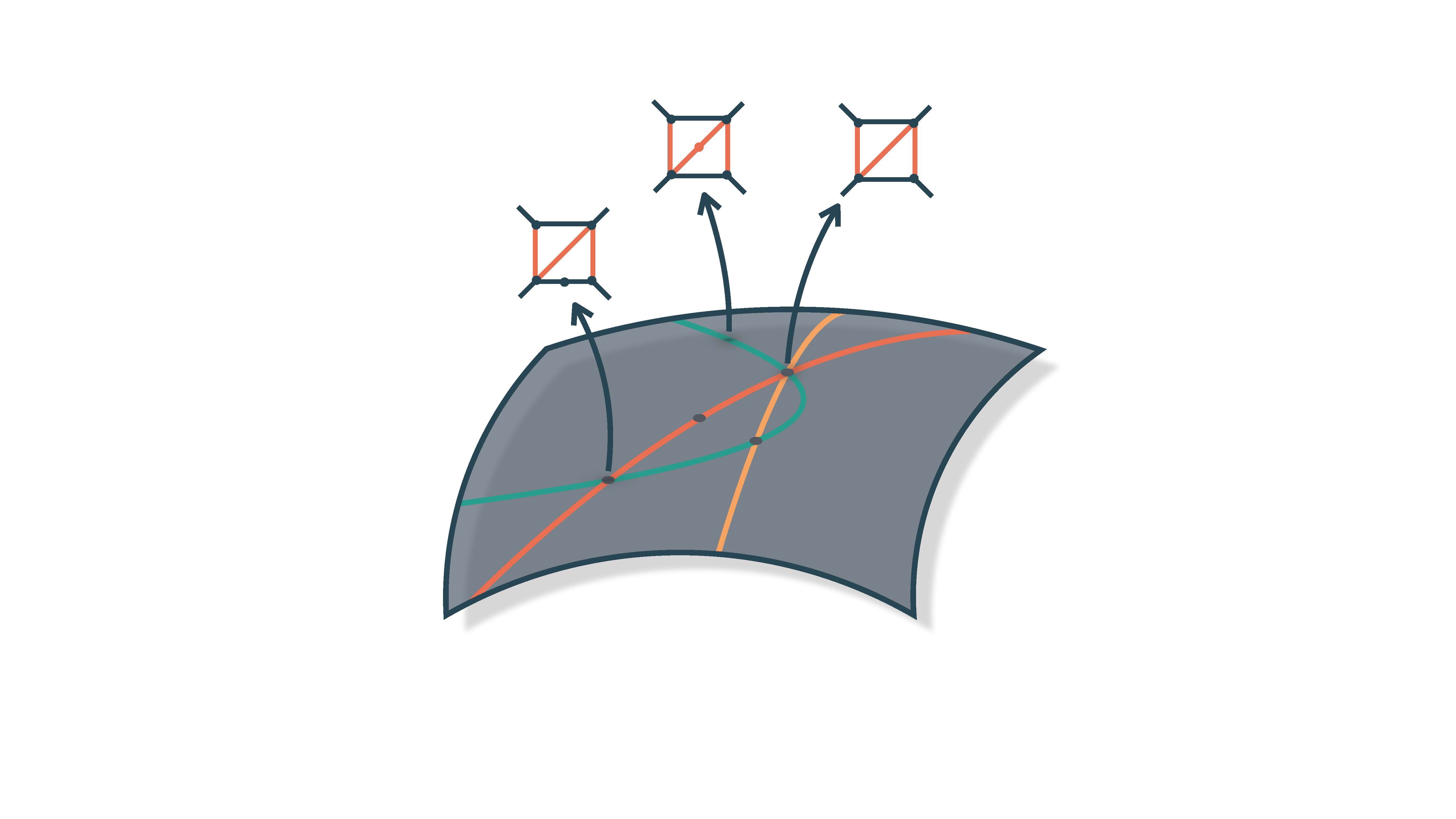
Theoretical physicists at Johannes Gutenberg University Mainz (JGU) have developed a new method of ordering Feynman integrals. This critical step in the scientific process of making theoretical predictions for high-energy precision measurements has posed a major computational bottleneck until now. Scientists in the research group of Professor Stefan Weinzierl from the PRISMA⁺⁺ Cluster of Excellence propose a solution to this longstanding challenge in a new article published in the prestigious journal Physical Review Letters and a new article in Physical Review D. By ordering the integrals according to their intrinsic geometric properties, they can speed up computation times by a factor of about 1,000.
“Feynman integrals are mathematical expressions that researchers must evaluate to make precise predictions,” said Stefan Weinzierl. “These are the first pillars for precison predictions for measurements at facilities like the Large Hadron Collider in Switzerland.” The number of these integrals varies from process to process, with some processes needing up to one million of them. Stefan Weinzierl: “Using linear algebra with an ad-hoc ordering was the standard procedure until now. With the new method we can now do precision predictions for many more processes which were not feasible before.”
The search for the best order of integrals
To overcome the challenge of ordering integrals efficiently, Stefan Weinzierl and his team looked at the inherent geometrical properties of each integral. “The idea is similar to organizing a library. You could sort books by purchase date, but it's much more useful to sort by content: poetry on one shelf, thrillers on another. To do that, you have to look inside each book. We do the same for Feynman integrals: we look ’inside’, specifically at their geometric structure, rather than relying on superficial labels,” Stefan Weinzierl explained. The new method lets computer algebra programs automatically simplify the governing equations into much easier-to-solve forms.
The researchers developed and tested a two-step algorithm to achieve this. In the first step, the new method uses a new geometric order relation in the reduction of the integrals to obtain a basis of master integrals, whose differential equations can be expressed as a Laurent polynomial in a regularization parameter (commonly referred to as ε or epsilon). The second step comprises a method to trivialize the epsilon-dependence of the aforementioned differential equations.
This two-step method provides a systematic algorithm to obtain an epsilon-factorized differential equation that can be used for any Feynman integral, which can in turn be applied to several predictions for high-energy physics. “We are looking forward to using our new method for ever better predictions,” said Stefan Weinzierl. “And also to seeing what our colleagues around the world achieve with it.”
Professor Dr. Stefan Weinzierl
Theoretical High Energy Physics (THEP)
and PRISMA++ Cluster of Excellence
Johannes Gutenberg University Mainz
55099 Mainz, GERMANY
e-mail: weinz001@uni-mainz.de
I. Bree et al., Geometric Bookkeeping Guide to Feynman Integral Reduction and 𝜖-Factorized Differential Equations, Physical Review Letters 136: 241602, 15 June 2026
DOI: 10.1103/pyt8-d7rt
https://doi.org/10.1103/pyt8-d7rt
I. Bree et al., New algorithms for Feynman integral reduction and epsilon-factorized differential equations, Physical Review D 113: 116019, 15 June 2026
DOI: 10.1103/mjpn-61yv
https://doi.org/10.1103/mjpn-61yv
https://Image:
https://download.uni-mainz.de/fb08-prisma/pms/08_PRISMA_PI_Feynman_integrals_ill...
https://Ordering Feynman integrals according to their intrinsic geometrical properties speeds up computation times significantly.
https://Ill./©: JGU
https://Related links:
https://prisma.uni-mainz.de/en/ – PRISMA⁺⁺ Cluster of Excellence
Bilder
Ordering Feynman integrals according to their intrinsic geometrical properties speeds up computation ...
Quelle: Prof. Dr. Stefan Weinzierl
Copyright: JGU
Merkmale dieser Pressemitteilung:
Journalisten, Wissenschaftler
Mathematik, Physik / Astronomie
überregional
Forschungs- / Wissenstransfer, Forschungsergebnisse
Englisch

| # | Наименование новости | Тональность | Информативность | Дата публикации |
|---|---|---|---|---|
| 1 | A new 'library' for Feynman integrals | 0 | 8.93 | 16-07-2026 |
| 2 | Eine neue „Bibliothek“ für Feynman-Integrale | 0 | 7 | 16-07-2026 |
| 3 | AI takes on one of physics' biggest mysteries | 5 | 7 | 08-07-2026 |
| 4 | UC Irvine physicists discover method to reverse ‘quantum scrambling' | 5 | 7 | 13-04-2026 |
| 5 | Two Humboldt Award winners are conducting research at GSI/FAIR this year | 0 | 5 | 20-07-2026 |
| 6 | Switching spin states in manganese ions with light opens new path for molecular memory | 2 | 7 | 29-06-2026 |
| 7 | UC Irvine physicists measure two neutrino parameters with unprecedented precision | 5 | 7 | 11-06-2026 |
| 8 | Clean crystal surface lets single molecules hit ultimate quantum limit | 6 | 7 | 26-06-2026 |
| 9 | A new quantum computer sets a high watermark for accuracy. Are we on the verge of a big breakthrough? | 6 | 7 | 24-06-2026 |
| 10 | New CERN measurement challenges conventional models of how gluons behave inside atomic nuclei | 0 | 5.89 | 11-08-2026 |