Просмотр новости
Найдите то, что Вас интересует
 Спутники
 РН
РН SpaceX
 Роскосмос
 NASA
NASA
СпутникиРНSpaceXРоскосмосNASAEurope’s political and business elite arrived at the World Economic Forum in Davos this year with nerves already frayed after a bruising first year of US President Donald Trump’s second term. That period was defined by the imposition of a protectionist tariff strategy to gain economic and geopolitical leverage, an often combative approach to the war in Ukraine and renewed doubts over Nato security guarantees.
In the run-up to Davos, the White House threatened eight European countries – including...
Europe’s political and business elite arrived at the
World Economic Forum in Davos this year with nerves already frayed after a bruising first year of US President Donald Trump’s second term. That period was defined by the imposition of a protectionist tariff strategy to gain economic and geopolitical leverage, an often combative approach to the war in Ukraine and renewed doubts over Nato security guarantees.
In the run-up to Davos, the White House threatened eight European countries – including the UK, Germany and Denmark – with tariffs of 10 to 25 per cent unless they supported the administration’s ambitions to control Greenland. The move turned a grinding war, a long-running trade dispute and a revived Arctic land grab into a single, combustible test of transatlantic economic and security solidarity.
At the outset, US Secretary of Commerce Howard Lutnick outlined the Trump administration’s position and the reason for attending Davos. He claimed that years of globalisation had failed, leaving American workers behind. Lutnick challenged Europe’s net zero ambitions, arguing that they would increase dependence on China. He also said that any economic dependence should be limited to close allies. That message, however, sat uneasily alongside the administration’s increasingly combative treatment of strategic partners and allies.
It is apparent that Trump is not merely challenging elements of the post-Cold War order – he is actively reshaping it. His transactional approach is contingent on political alignment and loyalty rather than on embedded rules. The effect is a dramatic shift from a system anchored in institutions to one organised around leverage, personal authority and bilateral deals, one with which many nations are struggling to come to terms.
However, the event that defined the World Economic Forum was Canadian Prime Minister Mark Carney’s address. He delivered what could be the most consequential address by a Western leader in years, outlining the end of the post-Cold War rules-based order and what might replace it.
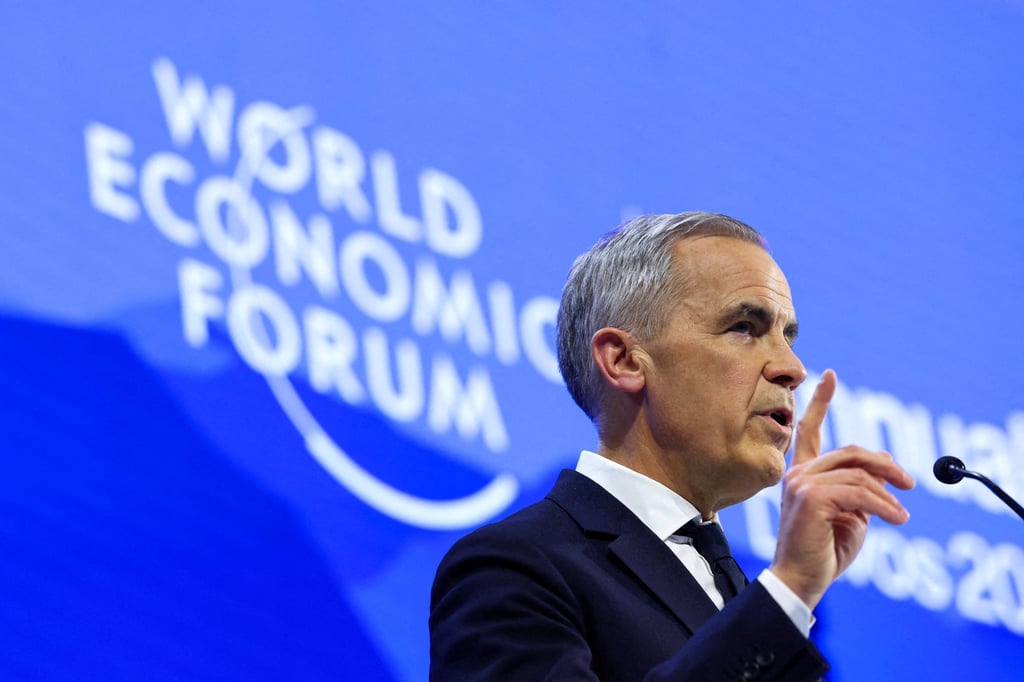
The former governor of the Bank of England and the Bank of Canada noted that the world has entered a distinct new phase, one in which trade, finance and supply chains are openly deployed as instruments of power and coercion. In this phase, international rules are applied much less consistently than before.
| # | Наименование новости | Тональность | Информативность | Дата публикации |
|---|---|---|---|---|
| 1 | Combative Trump heads to G7 for showdown with Europe and Zelensky | -3 | 6 | 15-06-2026 |
| 2 | Combative Trump storms into G7 powder keg as world leaders brace for showdowns with Europe and Zelensky | -2 | 6 | 17-06-2026 |
| 3 | US and China can again find common ground – in AI’s risks | 0 | 7 | 19-02-2026 |
| 4 | Euractiv: новые пошлины Трампа могут знаменовать "конец американского века" | 0 | 0 | 04-04-2025 |
| 5 | Politico: ЕС больше не может полагаться на США в вопросах безопасности | 0 | 0 | 20-02-2025 |
| 6 | Фон дер Ляйен заявила об очередях из стран для сотрудничества с ЕС | 0 | 0 | 22-04-2025 |
| 7 | CNBC Daily Open: Is India the first to face Trump's ‘secondary' tariff on Russia? | 0 | 7 | 31-07-2025 |
| 8 | Wie sich Europa auf den langen Weg zur eigenen Abschreckung macht | 0 | 5 | 11-07-2026 |
| 9 | Экс-госсекретарь США: Вашингтон оказался на грани второй холодной войны с Россией и Китаем | 0 | 0 | 31-10-2020 |