Просмотр новости
Найдите то, что Вас интересует
 Спутники
 РН
РН SpaceX
 Роскосмос
 NASA
NASA
СпутникиРНSpaceXРоскосмосNASA"This is a flagship project for India and Japan. Both countries are working on a common goal of commercial operations in 2027," a senior official told ET, adding Japanese experts are supervising work from the beginning of construction in 2021.
Synopsis
"This is a flagship project for India and Japan. Both countries are working on a common goal of commercial operations in 2027," a senior official told ET, adding Japanese experts are supervising work from the beginning of construction in 2021.
Listen to this article in summarized format
 iStock
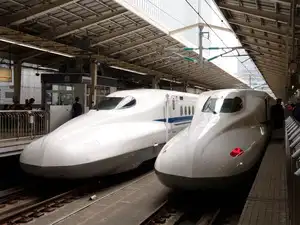
New Delhi: India and Japan had mutually agreed to run indigenous bullet trains and deploy globally inter-operable signalling systems in the Mumbai-Ahmedabad high speed rail corridor, a senior official said. A joint call by the two nations was taken after Japanese suppliers did not place proposals aligned with timelines for operating the Surat-Vapi high speed rail section from 2027.
"This is a flagship project for India and Japan. Both countries are working on a common goal of commercial operations in 2027," a senior official told ET, adding Japanese experts are supervising work from the beginning of construction in 2021.
India plans testing its home-made bullet trains in mid-2027 with civil work for the 97-kilometre Surat-Vapi high speed rail section completingthis year. The railway ministry plans to kick off commercial operations for the country’s first bullet train from August 2027.
This project garnered attention last week after former Japanese law minister, Hideki Makihara, accused India of being a tough negotiator and alleged delays in the bullet train project. The ministry of external affairs later clarified that discussions with Japan on the high-speed train are progressing well.
Indian officials working on the high-speed rail corridor said Makihara was not part of meetings on the bullet train project. Instead, representatives from Japan’s ministry of land, infrastructure, transport and tourism have been coordinating on this project.
" All approvals of drawings, designs, construction schemes, and quality control are done by Japanese experts,” the official told said, noting decisions are taken jointly by the two nations for speedy operationalisation of the corridor.
Makihara criticised Japanese Prime Minister Sanae Takaichi’s visit to India and accused India of not relying on Japanese technology for the bullet train. He flagged the decision to opt for open-source signalling protocols instead of Japan’s proprietary DS-ATC (Digital Automatic Train Control) in this project.
Officials said trainsets, signalling and Operations Control Centre (OCC) are long lead items, requiring suppliers to start manufacturing well in advance. "We started pursuing the Japanese side to give offers for these items. For two years, this exercise was conducted," the official said, adding the Japanese side "could not share offers for these items."
Indian officials were later told E5 series bullet trains were being phased out in Japan. "The new train series E10 was decided as the alternative train that will be offered to India," the official said, adding this train is still under development and is likely to be available only by 2032 in Japan and by 2034 in India.
“The Japanese vendors did not give any offers for supplying signalling systems in the bullet train project. A decision to go ahead with open-source signalling protocols was taken after techno-commercial evaluation and in agreement with concerned representatives from both nations,” officials said, adding Makihara’s comments were targeted at Japanese domestic politics.
The Japan International Cooperation Agency (JICA) has offered Official Development Assistance (ODA) loan assistance for the project. This funding, on commercial terms, comes with commitments to procure from Japanese approved suppliers.
