Просмотр новости
Найдите то, что Вас интересует
 Спутники
 РН
РН SpaceX
 Роскосмос
 NASA
NASA
СпутникиРНSpaceXРоскосмосNASANVIDIA announced full production ramp at GTC Taipei on June 1, 2026. NVIDIA said the rack assembly time dropped ~95% (from ~2 hours to ~5 minutes) thanks to the modular, cable-free MGX tray design. The misinterpreted statement that 1,000 Vera Rubin Racks can be assembled each day is correct but that is only the assembly ... Read more
NVIDIA announced full production ramp at GTC Taipei on June 1, 2026. NVIDIA said the rack assembly time dropped ~95% (from ~2 hours to ~5 minutes) thanks to the modular, cable-free MGX tray design. The misinterpreted statement that 1,000 Vera Rubin Racks can be assembled each day is correct but that is only the assembly step. This was viewed as Nvidia will constantly produce 1000 Rubin racks per day.
NVIDIA highlighted the fast assembly as proof of improved manufacturability and supply-chain efficiency, not as proof of a specific daily output rate. The real enablers for high volume are the doubled supply chain and the mature MGX ecosystem (dozens of partners already experienced with high-volume GB200/GB300 production). They may have combined the 5-minute claim with optimistic assumptions about parallel assembly lines. Confusion with statements from partners (Foxconn earlier said it could build ~1,000 AI racks per week for previous generations and planned to increase capacity). Over-extrapolation of “full production ramp” language.
NVIDIA Vera Rubin is the company’s next-generation rack-scale AI platform (successor to Grace Blackwell), optimized for agentic AI workloads. It delivers up to 10x higher agentic throughput / tokens per megawatt compared to Blackwell, with major gains in efficiency, NVLink scaling, and memory bandwidth. Nvidia has 300 global partners to ramp up Vera Rubin worldwide. NVIDIA partners CoreWeave, Google Cloud, Microsoft Azure and Mistral are among many deploying Vera Rubin, which delivers benchmark leadership on performance per watt and lowest token costs.
Nvidia says it will be able to produce up to 1,000 Vera Rubin racks ~PER DAY~. This would be 72000 Rubin GPUs per day. This would be over 2 million Rubin GPUs per month. It represents future peak capability once TSMC N3 wafers, CoWoS advanced packaging, HBM4 supply, power delivery, and data center infrastructure all align at scale.
When this happens Nvidia would generate over $630 Billion in revenue per quarter for Nvidia & manufacturing partners.
This is an aspirational maximum capacity figure reported from insiders (not current run-rate). This is directionally interesting but a little hard to believe for the near term. Realistic near-term ramp is far lower (analyst chatter on X suggests tens of racks/day building through late 2026). Achieving 1,000/day would imply enormous power/infrastructure implications (hundreds of MW/day).
* Rubin GPU is ~336 billion transistors (TSMC 3 nm), 288 GB HBM4, high Tensor Core performance (50 petaFLOPS NVFP4 per GPU), native support for advanced formats. Vera Rubin have 10X more inference tokens than a Blackwell GPU
* Vera CPU is a new 88-core ARM-based “Olympus” CPU for management, agentic workloads, and standalone use.
* Flagship Vera Rubin NVL72 rack is 72 Rubin GPUs + 36 Vera CPUs, 260 TB/s all-to-all NVLink 6 fabric, full liquid cooling (190–230 kW typical), modular MGX design.
* Integrated ecosystem is Groq 3 LPX inference accelerators, BlueField-4 DPUs/storage, Spectrum-X Photonics Ethernet (co-packaged optics), NVLink switches, etc.
Interesting report from @theinformation that Nvidia will be able to make 1000 Vera Rubin racks per day, which is $630b per quarter. Actually a little hard for me to believe and haven’t checked the math, but wow if true.
And Vera CPU racks and Groq LPU racks would be incremental…
— Gavin Baker (@GavinSBaker) July 21, 2026
CoWoS-L advanced packaging — the true ceiling
By mid-2026, CoWoS packaging utilization — not raw wafer starts — has become the binding constraint on AI hardware supply, with both CoWoS-S and CoWoS-L fully booked, and lead times of 52–78 weeks even as capacity nearly doubles. Capacity is going from ~75–80k wafers/month toward a 120–130k WPM target by end-2026. Going to ~200k WPM by end-2027 is consistent with the announced trajectory but not yet locked.
Rubin packages are enormous (CoWoS-L, oversized interposer, two reticle dies plus eight HBM4 stacks), so yield-per-wafer is low — each chip occupies significantly more physical space on a wafer, necessitating the 33% capacity boost just to maintain current unit volume delivery. NVIDIA already holds roughly 60% of CoWoS capacity — about 595,000 wafers — and has booked more than half of the 2026–2027 expansion, but that allocation is shared across Blackwell Ultra, Rubin, Vera, and automotive — Rubin gets only a slice of it in 2026.
HBM4 — a hard parallel ceiling and currently the softest spot in the bull case
Each Rubin GPU needs eight stacks of HBM4, totaling 288GB per chip. HBM is sold out for 2026, with new capacity not meaningfully impacting availability until 2027 and tightness forecast through 2028. The signal that should temper the bull case most: in April, SK Hynix was reportedly considering reducing its planned 2026 HBM4 shipments to NVIDIA by about 20–30%, amid delays in ramping the Vera Rubin platform. IF Nvidia solves the ramping problem, they could get a reversal of the 20-30% reduction in HBM4 memory.
N3 wafer + reticle capacity are limits as well.
Power and datacenter buildout (800VDC, all-liquid cooling — VR200 racks draw roughly 190–230 kW, up from 120–130 kW for Blackwell) are also limits.
2026 Rubin
The consensus 250–350k is realistic. The year is H2-weighted and Blackwell Ultra still carries most volume. Kuo’s estimate of 5,000–7,000 VR200 racks shipping in H2 2026 alone implies ~360–500k packages — that’s the credible high end, and given the HBM4 allocation trimming and ramp delays we may end up at the lower-middle of the range. Bull Case 1 (300–400k) is achievable. Bull Case 2 (350–450k) requires essentially flawless execution and is a stretch.
2027 Real Vera Rubin scaling
CoWoS approaches ~200k WPM and HBM4’s new cleanrooms come online. Base 800k–1.5M is reasonable. Bull Case 1 (1.5–2.5M) and Bull Case 2 (2–3.5M) are plausible but conditional — they need CoWoS and HBM4 both hitting upper targets simultaneously, which historically they haven’t. Bull Case 3’s 3M+ is best read as a late-2027/2028 exit run-rate. This would be 10-12 times less than the 2.1 million GPU per month of a 1000 rack per day maximum.
For networking, the platform’s sixth-generation NVLink scale-up delivers more than 2x throughput on complex workloads, 3x lower latency and 10x higher packet rates than off-the-shelf Ethernet. For scale-out, Spectrum-X Ethernet combines 102.4T Spectrum-6 switch systems, 1.6T ConnectX-9 SuperNICs, adaptive routing, advanced congestion control, telemetry and open operating system support, enabling 1.6x higher RDMA bandwidth than off-the-shelf Ethernet.
The world’s leading AI infrastructure builders — including CoreWeave, Microsoft, SpaceXAI and Tesla — are among the first to bring in Spectrum-6 switches to accelerate their AI factories. NVIDIA Photonics with co-packaged optics for scale-out — the industry’s first such switch in volume manufacturing — adds 5x lower power and 10x higher MTBI versus pluggable transceivers, with CoreWeave, Lambda and OCI among the first adopters.
Saving Setup Time, Water
NVIDIA’s three generations of rack-scale co-design produced a Vera Rubin NVL72 system with no cables, fans or hoses in the tray, cutting compute tray assembly time from hours to one minute.
A 45-degree Celsius liquid cooling inlet temperature design enables chiller-free dry-cooler operation. For new AI factories, this higher temperature dry cooling along with the closed-loop liquid cooling system saves millions of gallons of water per megawatt annually.
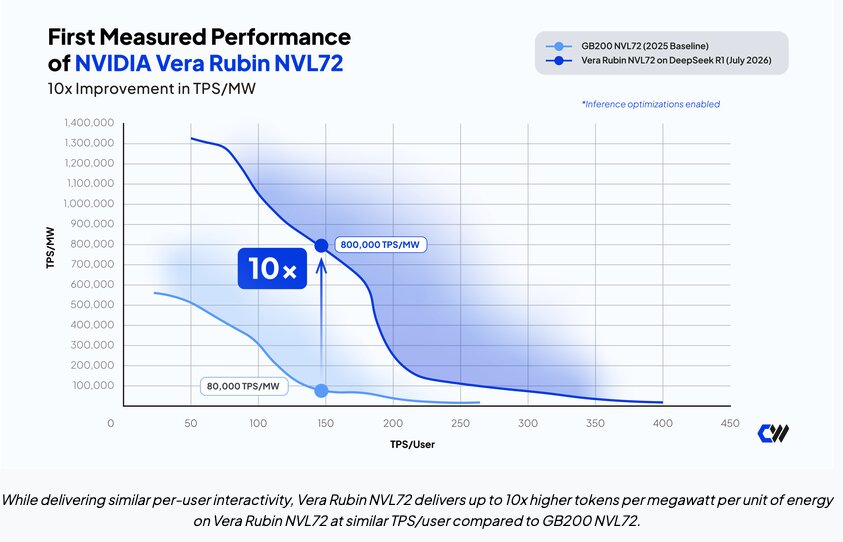 Screenshot

Brian Wang is a Futurist Thought Leader and a popular Science blogger with 1 million readers per month. His blog Nextbigfuture.com is ranked #1 Science News Blog. It covers many disruptive technology and trends including Space, Robotics, Artificial Intelligence, Medicine, Anti-aging Biotechnology, and Nanotechnology.
Known for identifying cutting edge technologies, he is currently a Co-Founder of a startup and fundraiser for high potential early-stage companies. He is the Head of Research for Allocations for deep technology investments and an Angel Investor at Space Angels.
A frequent speaker at corporations, he has been a TEDx speaker, a Singularity University speaker and guest at numerous interviews for radio and podcasts. He is open to public speaking and advising engagements.
| # | Наименование новости | Тональность | Информативность | Дата публикации |
|---|---|---|---|---|
| 1 | NVIDIA Vera Rubin Driving Performance Per Watt, Lowest Token Cost for Partners Worldwide | 0 | 13.16 | 21-07-2026 |
| 2 | Nvidia готовит новый «шокирующий» чип к анонсу на GTC 2026 | 2 | 6 | 19-02-2026 |
| 3 | NVIDIA Vera: 88 Olympus-Kerne und 1,2 TB/s LPDDR5X für Agentic-AI-Racks | 0 | 22.89 | 24-07-2026 |
| 4 | Nvidia планирует уменьшить объёмы поставок RTX 50 в 2026 году | 0 | 6 | 17-12-2025 |
| 5 | Samsung наращивает производство твердотельных накопителей PM1763 для платформы Vera Rubin от NVIDIA | 5 | 7 | 08-07-2026 |
| 6 | How NVIDIA GB10 CPU Performance Compares To Vera | 0 | 7 | 26-06-2026 |
| 7 | Nvidia's China-bound H20 AI chips face Beijing scrutiny over ‘tracking' and security concerns | 0 | 5 | 31-07-2025 |
| 8 | Samsung 900-Layer V-NAND Breakthrough Pushes the Industry Closer to the 1,000-Layer Era | 5 | 7 | 25-05-2026 |
| 9 | Nvidia готовит поводок для GPU. Пришло время взяться за своё | 0 | 7 | 01-01-1970 |
| 10 | Major AI Data Center Build Projects – Timelines, Status 2026–2028 | 0 | 7 | 25-06-2026 |