Просмотр новости
Найдите то, что Вас интересует
 Спутники
 РН
РН SpaceX
 Роскосмос
 NASA
NASA
СпутникиРНSpaceXРоскосмосNASAThe one constant is chaos, uncertainty, and unreliability.
By Fred Kaplan
Enter your email to receive alerts for this author.
Sign in or create an account to better manage your email preferences.
Unsubscribe from email alertsAre you sure you want to unsubscribe from email alerts for Fred Kaplan?
July 23, 20262:02 PM
Sign up for the Slatest to get the most insightful analysis, criticism, and advice out there, delivered to your inbox daily.
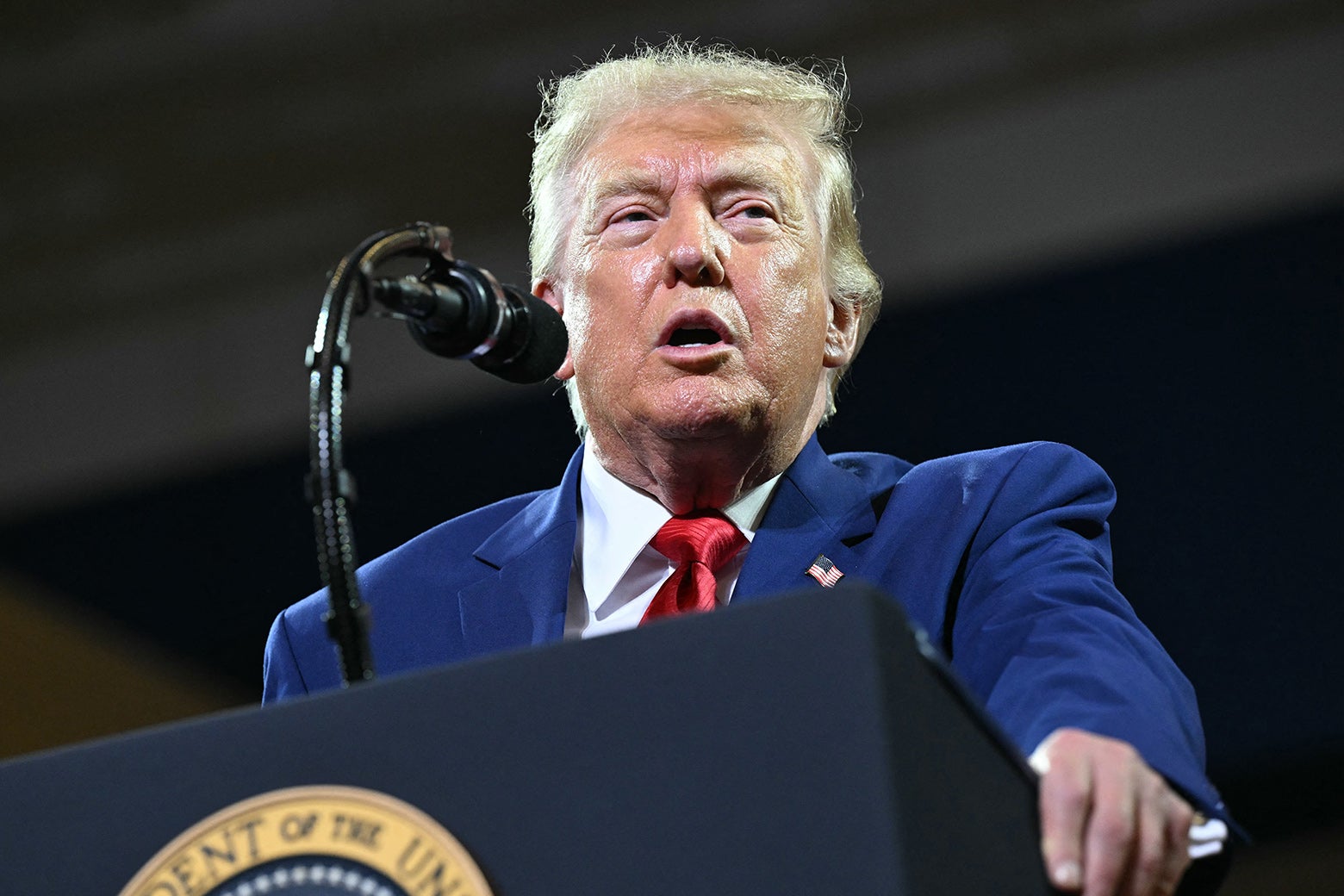
It’s becoming a standard feature of Donald Trump’s second presidency: He makes an announcement or sets in motion a new, significant policy—then he utters a remark or posts a caveat on social media, and the ship of state is cast into chaos, national policy rendered uncertain, the words and deeds of the world’s most powerful leader reduced to unreliable gibberish.
On Wednesday, the secretary of energy signed an agreement by which the United States would supply Saudi Arabia with nuclear energy technology. This was a very big deal. The Saudis have been seeking such a deal for many years. It could wean the kingdom away from its reliance on oil—but it could also lay the foundations for a Saudi nuclear weapon, which in turn could spur others in the region to build nuclear arsenals as well. And unlike similar agreements that the U.S. had struck with dozens of other countries, this one seemed unconditional. Saudi Arabia long ago signed the Nuclear Non-Proliferation Treaty, but it did not sign the NPT’s Additional Protocol, which allows international agents to conduct on-site inspections of reactors to verify that its operators aren’t converting the fuel for military purposes.
Israelis of all political stripes, taken by surprise by the deal, voiced alarm, fearing that this would inevitably lead to a Saudi nuclear weapon. Previous talks over a nuclear deal with Saudi Arabia hinged on normalization with Israel and there appeared to be no such condition for this deal. As I wrote on Wednesday, the concern in Israel over the Saudi deal seemed to indicate just how much favor Israel has lost in the United States in recent years.
Then, on Thursday, at 7:52 a.m., Trump posted on social media that the deal “is totally subject to Saudi Arabia joining the very respected and successful Abraham Accords.” These accords involve Arab or Muslim countries normalizing relations with Israel. (Negotiated in the final months of Trump’s first term, the initial signatories were Bahrain and the United Arab Emirates, followed by Morocco, Sudan, and Kazakhstan.) Trump’s post immediately threw a huge wrench into the deal. The Saudis have repeatedly said that they will not normalize relations with Israel unless Israel resumes talks toward creating a Palestinian state. Israeli Prime Minister Benjamin Netanyahu has repeatedly said he opposes such a state and has rejected even holding talks on the subject. (Since Hamas’ attack on Oct. 7, 2023, a strong majority of the Israeli population is skeptical of any peace deal with Palestinians.)
In other words, Trump’s new condition—which was not included in the deal negotiated earlier this week by Secretary of Energy Chris Wright and his Saudi counterpart—pretty much scuttles the deal. As one indicator of this, on Thursday, Netanyahu praised Trump’s social media post.
This may not be the end of the story. It is worth noting that President Joe Biden tried to negotiate a nuclear deal with the Saudis but made the deal dependent on the Saudis’ normalizing relations with Israel—which the Saudis rejected. Will Trump change his mind and once again loosen the deal’s terms once he realizes that he is now taking the same position as Biden, whom he incessantly lampoons as “sleepy Joe” and “the worst president” in American history?
It is also unclear where Trump’s equivocation leaves U.S.–Israel relations. The alliance has genuinely soured in recent months. Trump has steadily lost trust in Netanyahu, once shouting obscenities at him for restarting the war on Hezbollah in Lebanon just as Trump was seeking a ceasefire in Iran. At the same time, American public opinion has turned against Israel for its deadly attacks against Palestinian civilians in Gaza and the West Bank; this has led to growing numbers in Congress voting to cut off all military aid to Israel—a proposition that would have been unimaginable even a year ago.
Trump’s social media post suggests the alliance isn’t finished. But it leaves open many questions about Trump’s relationship with the Saudis, with Israel, and with the nuclear power industry, whose ailing fortunes the deal would have greatly boosted.
It’s unclear why or how Trump changed his mind, if he did change his mind. Did he know, or just not notice, that the agreement signed by his energy secretary contained no Saudi concessions on Israel (or much else)? If so, it’s unsettling that a Cabinet secretary can sign a historic contract with a foreign power without the president’s prior endorsement or full understanding. The next time Wright or any other Cabinet secretary pens an agreement abroad (or makes any sort of promise), the foreign government and everyone else in the world would have good reason to wonder whether the secretary is reflecting the president’s views—and whether those views might change a day or two later. If you’re an American ally (or adversary or something in between), it’s basically impossible to believe anything our president says at this point, or to view us as anything close to a reliable partner.
There’s something else very jolting about Trump’s social media post Thursday morning. Some of its language suggests that, despite several briefings, he completely misunderstands the subject of uranium enrichment—crucial to any negotiation with Iran. Toward the end of the post, he writes: “The United States is not opposed to Civil (Non-Enriched) Nuclear Facilities.” He seems to think that, in the context of nuclear facilities, “civil” is synonymous with “non-enriched.” In other words, he seems to think that if the facility is enriching uranium at all, it is by definition military—i.e., its purpose is to build nuclear weapons.
This simply isn’t true. By common understanding, uranium must be enriched to a level of 20 percent purity to be deemed “highly enriched” and 90 percent to be “weapons-grade.” (It is also generally recognized that it doesn’t take much time to go from 60 percent—the level that Iran’s enrichment had reached—to 90 percent.) During negotiations in February, Iran proposed restricting its enrichment to 3.67 percent and suspending all enrichment for five years. Trump rejected the idea because he wanted no enrichment, and so he started the war.
If Trump had known that 3.67 percent enrichment is nowhere near the level needed to build a bomb, might he have continued the talks with Iran and refrained from the bombing campaign, which has killed thousands of people and completely destabilized the global economy? Or did he reject the idea because he was told that 3.67 percent was the same level of enrichment allowed by the Iran nuclear deal signed by President Barack Obama and five other leaders back in 2015—the deal that Trump scuttled three years later, calling it the worst deal ever negotiated?
To put it another way: Is Trump’s position on enrichment driven by ignorance of the subject or by hatred of the Democratic presidents who came before him? Either way, it’s tragic that this is America’s leader at such a precarious moment in history.
Sign up for Slate's evening newsletter.
| # | Наименование новости | Тональность | Информативность | Дата публикации |
|---|---|---|---|---|
| 1 | It’s Only a Nuclear Weapon, So of Course Trump Is Just Making Things Up as He Goes | 0 | 11.16 | 23-07-2026 |
| 2 | Donald Trump’s blocking of Anthropic is capricious and chaotic | 0 | 10 | 14-06-2026 |
| 3 | Trump is losing his war of independence on rare earths | 0 | 9.18 | 20-08-2026 |
| 4 | Philip Cross: Iran shows Trump what it's like dealing with him | 0 | 7.9 | 31-07-2026 |
| 5 | Рябков считает, что неопределенность в отношениях с США затянется | 0 | 0 | 24-01-2019 |
| 6 | Trump and Xi will struggle to strike a major economic deal | 0 | 8.1 | 07-05-2026 |
| 7 | The Long Shadow of the Iran War | -8 | 6 | 17-06-2026 |
| 8 | WP: Трамп подрывает внешнюю политику США и не имеет четкой позиции в отношении России | 0 | 0 | 01-08-2020 |
| 9 | Трамп прокомментировал скандал вокруг его беседы с иностранным коллегой | 0 | 0 | 20-09-2019 |
| 10 | «Это шоу ужасов». Трамп угрожает выходом из НАТО из-за предательства Европы | -8 | 6 | 25-06-2026 |